Lately it seems like I and others I know are finding poems. They are the not-so-happy poems, which capture the zeitgeist of a world slowly unwinding that they thought they knew, but in the end, never did. Or maybe for some, we knew what we knew, and we wanted to pretend we were just overly worried and we were just getting overworked about nothing. Turns out we were overthinking nothing. We were always paying attention and trying to keep things in perspective. We still are.
My “neighbors” include everyone who did this wonderful performance of traditional Mexican folkloric dances at the Multnomah County Fair on Memorial Day 2025, not far from my home.
A dear friend I know is worried sick about this type of horror story of family separation by deportation happening to their family. This isn’t abstract. It’s now reality in probably every community in this country, because immigrants are our neighbors, coworkers, family members, and friends. Immigrants are in my step-family even. My great grandparents were immigrants, and they were not forced to leave largely because they were Finnish, and white. And as someone who is an adult adoptee, who was severed from my family by a state bureaucracy and then denied the ability to connect with them for decades relentlessly and also immorally by a state bureaucracy, this story and its sorrow has special resonance for me. If you think these stories don’t matter for your role in the workplace, you are gravely mistaken. Everything you do matters, wherever you engage others, including in and out of work. There’s no firewall here. We’re all in this as a nation, and that means where you work, where you live, where you worship, where you spend time, and where you do business. You have agency, and this is not a thing to sit out. The choice is always yours.
VOYCE conference flyer for event in metro St. Louis on July 10, 2025 on upholding patient rights when they receive medical care.
I’m ecstatic a nursing home ombudsman shared this conference flyer with me today. We’ve been communicating now for over six years, and during that time, we’ve had lows, then understanding, and also some wins. She said the topic and issues for this upcoming conference being hosted by VOYCE came up, in part, as a result of our many conversations about gaps in care for nursing home residents needing medical care. There’s been a lot of water under this bridge.
VOYCE is a long-term care ombudsman organization based in metro St. Louis, where I have a family member in a federally subsidized nursing home. Its mission is “to educate and empower individuals and their families for quality living across the continuum of long-term care.” They’ve always been responsive to me, and for that, I’m grateful.
And given all that is going on with the absolute political and economic chaos in my country, I could not have received a better message today.
Sometimes what you do as an advocate counts. This is true for me. I hope it’s also true for people who work for groups like VOYCE, who get too little credit and thanks.
In life, you rarely get the luck or privilege of knowing when your advocacy pays off, but that is not why you do it. You do it because it is the right thing to do, even if you lose, over, and over, and over, and over again. If it’s right, and you are firm and do not back down, you have found an unshakable power. Tapping into that takes time, and lots of trial and error. But it’s real.
I just heard that Bill Moyers died. He was 91 years old and lived a meaningful life. RIP.
Moyer was a consummate media professional. He was an insightful interviewer and a profoundly insightful human.
I love Moyers’ interviews with Joseph Campbell called “The Power of Myth.” The two collaborated in the PBS TV series released in 1988, exploring what enduring myths tell us about our lives. There were six episodes: “The Hero’s Adventure,” “The Message of the Myth,” “The First Storytellers,” “Sacrifice and Bliss,” “Love and the Goddess,” and “Masks of Eternity.” According to PBS, “The Power of Myth” was one of the most popular TV series in the history of public television, and it continues to inspire new audiences today. Campbell, sadly, died a year before it was aired.
Bill Moyers interviewing Joseph Campbell for the acclaimed PBS series “The Power of Myth.”
The insights from those interviews had an enormous impact on my own life, as I saw how important myth is to the human experience, in the past and the present. Myth in fact defines my lifelong identity as a bastard and adoptee. The series was also one of the most impactful moments for me in the world of engaging ideas.
From his interviews with author Campbell, Moyers elicited truths that speak to me today in many profound ways. This includes my own recent and wonderful adventures finding my biological kin in Finland, a land of my ancestors and also great myths.
Campbell shared with Moyers: “If you do follow your bliss, you put yourself on a kind of track that has been there all the while, waiting for you, and the life you ought to be living is the one you’re living somehow, and when you can see it you begin to deal with people who are in your field of your bliss, and they open doors to you.”
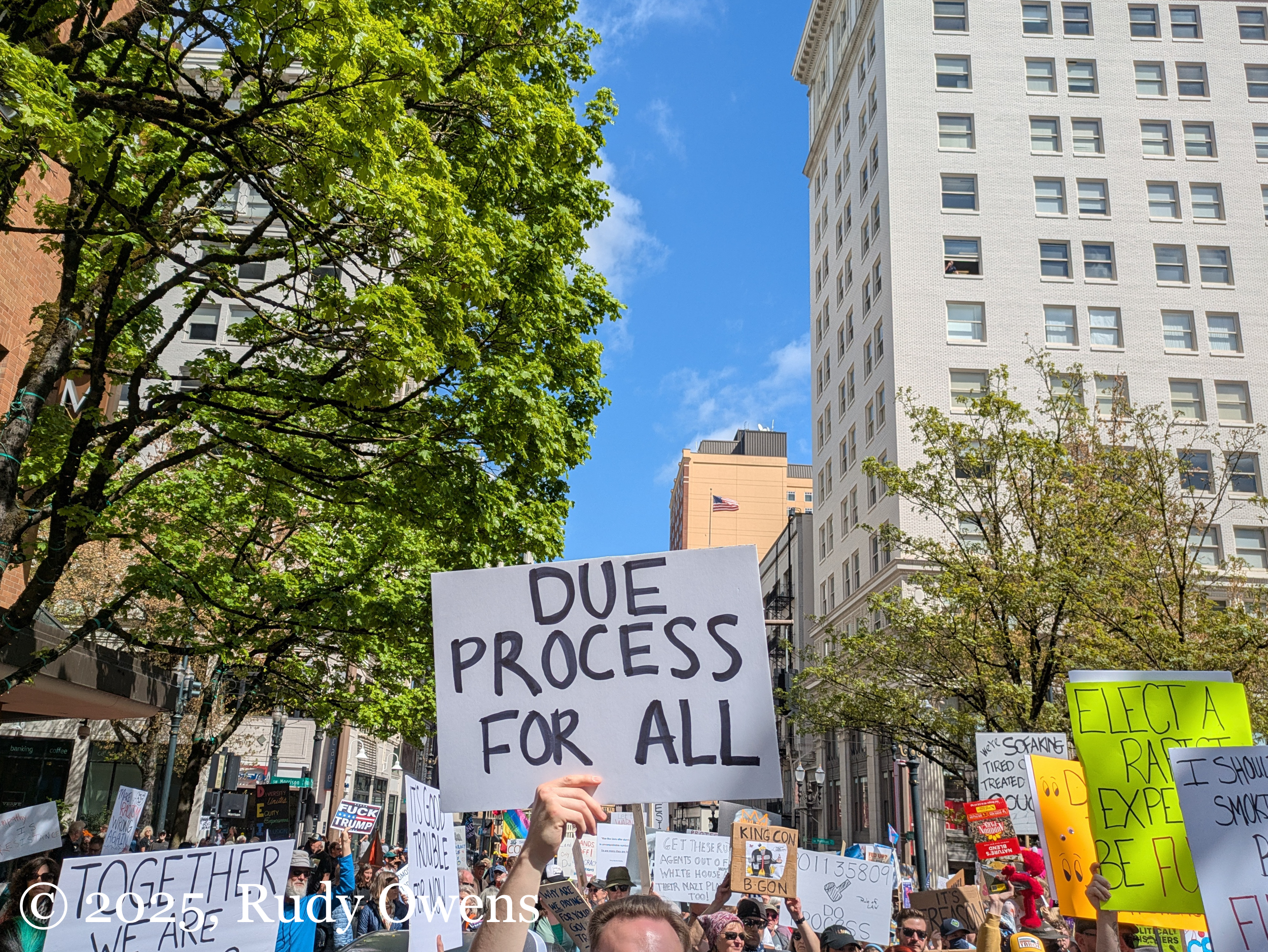
On April 19, 2025, hundreds and hundreds of thousands of Americans in all states protested against the loss of rights enshrined in the U.S. Constitution and the actions of the current Trump administration.
The weekend marked the 250th anniversary of the first shots fired in the American Revolution against the British Empire and a tyrannical monarch, King George III. In Massachusetts, the first battle of the American Revolution on April 19, 1775, known as the Battle of Lexington and Concord, is celebrated over a three-day weekend with the state holiday called Patriots’ Day, recognized on the third Monday in April in the commonwealth.
Today, in U.S. history books, the start of the American Revolutionary War (1775-1783) is known famously, at least to those who learned American history in school, as the famous “shot heard ’round the world.” The skirmishes by colonial militia against the imperial army of the British Empire persuaded many Americans to take up arms in the eventual conflict.
The issues that led to the first conflict of the American Revolution—the right to self-determination, liberty, democracy, the rule of law, a life free from the power of kings—helped to forge a nation 13 years later, in 1788.
That year, the American colonies adopted the U.S. Constitution. While revolutionary, it was also terribly marred and flawed by enshrining chattel slavery that held millions of African Americans in bondage until the end of the bloody Civil War in 1865. It was our country’s greatest sin. Ultimately, it would take over two centuries to guarantee the document’s original promise for all persons.
This framework for a nation, set forth in the Constitution, called for a system of checks and balances by three branches of government: the executive, legislative, and judicial branches. It begins with these famous words: “We the People of the United States, in Order to form a more perfect Union, establish Justice, insure domestic Tranquility, provide for the common defense, promote the general Welfare, and secure the Blessings of Liberty to ourselves and our Posterity, do ordain and establish this Constitution for the United States of America.”
On April 19, 2025, this sacred American text had special meaning for hundreds and hundreds of thousands of Americans across United States, who sought to renew their relation to our country’s charter and find living and breathing meaning of what the Constitution guarantees to all persons in our country, by the force of law.
Boston University historian Heather Cox Richardson, publisher of the newsletter “Letters from an American,” has a wonderful essay on these events two and a half centuries earlier and how we can make sense of these events in our country today. I hope you either read or listen.
University of Toronto professor Timothy Snyder (used for editorial comment purposes)
This week, I had a chance to create a new relationship with someone who I didn’t really know.
I did that because I saw someone who did something different—they spoke out, and they did that where it was not expected and was not comfortable. It was something that created a quiet stir, in my opinion.
After that happened I quickly contacted that person and, I hope, created the start of a mutually respectful connection, one built on trust and shared values.
This was necessary because I needed this person to know that they had done something that matters: they stood out and broke the spell of silence. This matters, according to experts on authoritarianism.
One of the most important voices to help people understand how authoritarianism works and how to confront it is University of Toronto historian of authoritarianism, Timothy Snyder. He is best known as the author of Bloodlands, a detailed and magisterial history of genocides, campaigns of starvation and mass murder, and conflicts in eastern and central Europe in the first half of the 20th century, bookmarked between the two horrific wars. I read about a third of it four years ago, and I did not have the stamina to complete it, but I was impressed by the scholarship.
My first real exposure to the horror of World War II came through the historic 26-hour documentary series called “World at War,” released in 1973 and 1974 by producer Jeremy Isaacs in the United Kingdom. I watched all of it on my local PBS affiliate in St. Louis as a grade schooler. I was profoundly shaken by what I saw and learned. I never forgot the series and the lessons from these horrific events that still echo today.
Now, more than 50 years later, I decided to revisit the first episode, “A New Germany (1933-39).” To my astonishment, it still crackles with intensity, and for me, it is more relevant than ever. I encourage everyone to watch it, especially now.
For those who haven’t heard about this series, I found a very good description: “One of the titans of documentary television, ‘The World at War’ is a work of astounding ambition, even by today’s standards. Broadcast between October 1973 and May 1974, this 26-part series attempts to encompass the full scope of the Second World War, a conflict fought on multiple fronts across multiple continents, on land and on sea and in the air. There have been many documentaries made in the subject in the decades since…but most have stuck to one aspect or country within the wider conflict. ‘The World at War’ had the audacity to attempt to tell the whole story—and even after nearly fifty years, the results are incredible.”
The first of the 26 episodes includes chilling archival footage of Germany’s immediate prewar years, with the voice of series narrator Laurence Olivier. It succinctly shows how a far-right radical and World War I veteran, Adolf Hitler, was able to seize power in the unstable but still democratic Weimar Republic through a mixture of hate, propaganda, street violence, and political deals with politicians who thought they could control Hitler. Within 100 days, after coming to power through peaceful means, democracy was snuffed out by the National Socialist German Workers’ Party (the Nazi Party), and Germany turned on the continent and beyond, pursuing a path of violent conflict, war, and unspeakable genocide.
After watching this episode, one must ask, How and why did a modern nation, the home of Goethe and Bach, universities and science, turn toward brutal authoritarianism rooted in hateful racial ideology that culminated in the mass murder of millions? How did the German people allow their country to be swept up by fascism that led to their country’s destruction and tens of millions of victims, including the attempted extermination of all European Jews and Sinti-Romani people. Will these mistakes happen again in our times, and what forms will they take?
What frightens me is that those living today, including those who are our supposed protectors and champions of democratic values and civil society, will fail to read the threat when it arrives. Unfortunately, the past can be terrifying. Many of us can simply be prone to willful ignorance because we don’t wish to acknowledge history and that societies can easily repeat our past collective failures. Sadly, when we finally realize some threats, it may be too late.
I just published an essay exploring what the Finnish word “sisu” means amid geopolitical tensions between Russia and the West, and in the context of hard choices that will always come.
I first discuss a video NATO published on January 28, 2025, about Finland’s deterrence strategy and how “sisu” is part of that.
This essay emerged during tense times in my own country, where we’re seeing events never experienced in the history of my government—including dismantling of public agencies and possible violations of the constitution, according to legal scholars.
Crisis moments make me think about historic times when you know that things you have been living and experiencing will not be the same, and when a conflict is coming.
How do people respond, morally, individually, and at the national level?
One lesson that stands out to me is how Finland resisted an unprovoked invasion by the USSR in November 1939. This was one of three wars it fought in WWII. Another, 1941-44, involved Finland attempting to reclaim lost territory from the first war, aligned with, yes, Nazi Germany, and then it fought a final war against Germany, 1944-45, to create lasting peace that preserved the country.
Nothing was pleasant about this time.
Finland endured, and it did it with little help, and by making incredibly complex choices at enormous costs. I’ve seen war memorials in nearly every Finnish city/town I have visited in 2023 and 2024 that highlight these costs.
At some point, hard choices are made when confronting immoral forces and great harm.
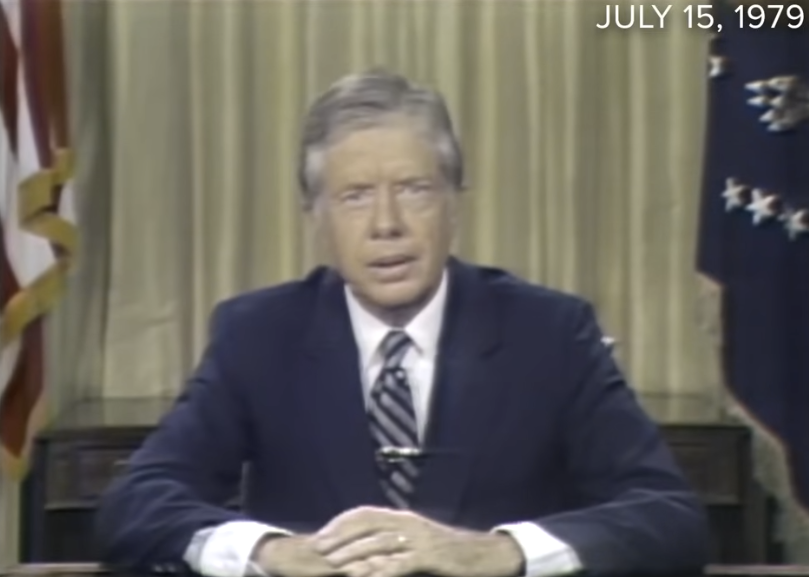
On July 15, 1979, the now-late President Jimmy Carter delivered what modern-day commentators and pundits today call the “Malaise Speech.” They still do not understand who Carter was and what he shared so plainly during his address to the nation.
President Jimmy Carter speaking to the American people on July 15, 1979
What has struck me in the six days since Carter died at age 100, on December 29, 2024, is how outraged and confused the news commentators and politicos remain about a U.S. president who dared talk about our country’s “lack of meaning” and overt worship of consumerism. (This sounds a lot like Viktor Frankl to me.)
Forty-five years later, not much has changed in our country. We are a country fueled by consumer spending, measuring 70 percent of economic activity. In that, there still is little meaning.
Carter was and is still right about the underlying truth, and people are afraid of the truth still.
As the nation gets ready to honor his legacy with his upcoming funeral events, I find his words still speak honestly about larger issues we have never changed: “In a nation that was proud of hard work, strong families, close-knit communities, and our faith in God, too many of us now tend to worship self-indulgence and consumption. Human identity is no longer defined by what one does, but by what one owns. But we’ve discovered that owning things and consuming things does not satisfy our longing for meaning. We’ve learned that piling up material goods cannot fill the emptiness of lives which have no confidence or purpose.”
South Koreans cheer the moment an impeachment vote against President Yoon Suk Yeol is announced publicly.
It is so good to have good news again lately.
First, the world mostly cheered as it witnessed the stunning fall of the horribly brutal regime of the Assad family in Syria on December 8, 2024. That situation is not over, and nations including the United States and Israel were quick to take military actions inside of Syria for their own security interests. But seeing ordinary Syrians with smiles brought me joy.
And now, today, December 14, 2024, the National Assembly of the Republic of Korea voted to impeach its president, Yoon Suk Yeol, who declared martial law on December 3, 2024 (literally in the dark of night), only to rescind that order six hours later when faced with democratic opposition in the nation’s elected legislative body and in the streets.
This is what democracy looks like, and I am so impressed by the people of South Korea for defending their country’s basic democratic freedoms. Well done! This is footage, shared by AFP, of the moment the vote by the National Assembly was announced.
Personally, I am in need of hope now, and I want to thank the people of Syria and South Korea for sharing that with the world.