Poems for dark times

Lately it seems like I and others I know are finding poems. They are the not-so-happy poems, which capture the zeitgeist of a world slowly unwinding that they thought they knew, but in the end, never did. Or maybe for some, we knew what we knew, and we wanted to pretend we were just overly worried and we were just getting overworked about nothing. Turns out we were overthinking nothing. We were always paying attention and trying to keep things in perspective. We still are.

Two poems for this troubled times:

Ravensbrück Concentration Camp/Women’s Camp, “Roll Call,” by Vida Jocic (photo by author, Rudy Owens)

‘World at War’ documentary series has never been more relevant

My first real exposure to the horror of World War II came through the historic 26-hour documentary series called “World at War,” released in 1973 and 1974 by producer Jeremy Isaacs in the United Kingdom. I watched all of it on my local PBS affiliate in St. Louis as a grade schooler. I was profoundly shaken by what I saw and learned. I never forgot the series and the lessons from these horrific events that still echo today.

Now, more than 50 years later, I decided to revisit the first episode, “A New Germany (1933-39).” To my astonishment, it still crackles with intensity, and for me, it is more relevant than ever. I encourage everyone to watch it, especially now.

For those who haven’t heard about this series, I found a very good description: “One of the titans of documentary television, ‘The World at War’ is a work of astounding ambition, even by today’s standards. Broadcast between October 1973 and May 1974, this 26-part series attempts to encompass the full scope of the Second World War, a conflict fought on multiple fronts across multiple continents, on land and on sea and in the air. There have been many documentaries made in the subject in the decades since…but most have stuck to one aspect or country within the wider conflict. ‘The World at War’ had the audacity to attempt to tell the whole story—and even after nearly fifty years, the results are incredible.”

The first of the 26 episodes includes chilling archival footage of Germany’s immediate prewar years, with the voice of series narrator Laurence Olivier. It succinctly shows how a far-right radical and World War I veteran, Adolf Hitler, was able to seize power in the unstable but still democratic Weimar Republic through a mixture of hate, propaganda, street violence, and political deals with politicians who thought they could control Hitler. Within 100 days, after coming to power through peaceful means, democracy was snuffed out by the National Socialist German Workers’ Party (the Nazi Party), and Germany turned on the continent and beyond, pursuing a path of violent conflict, war, and unspeakable genocide.

After watching this episode, one must ask, How and why did a modern nation, the home of Goethe and Bach, universities and science, turn toward brutal authoritarianism rooted in hateful racial ideology that culminated in the mass murder of millions? How did the German people allow their country to be swept up by fascism that led to their country’s destruction and tens of millions of victims, including the attempted extermination of all European Jews and Sinti-Romani people. Will these mistakes happen again in our times, and what forms will they take?

What frightens me is that those living today, including those who are our supposed protectors and champions of democratic values and civil society, will fail to read the threat when it arrives. Unfortunately, the past can be terrifying. Many of us can simply be prone to willful ignorance because we don’t wish to acknowledge history and that societies can easily repeat our past collective failures. Sadly, when we finally realize some threats, it may be too late.

Times will come when you must confront a looming threat

I just published an essay exploring what the Finnish word “sisu” means amid geopolitical tensions between Russia and the West, and in the context of hard choices that will always come.

I first discuss a video NATO published on January 28, 2025, about Finland’s deterrence strategy and how “sisu” is part of that.

This essay emerged during tense times in my own country, where we’re seeing events never experienced in the history of my government—including dismantling of public agencies and possible violations of the constitution, according to legal scholars.

Crisis moments make me think about historic times when you know that things you have been living and experiencing will not be the same, and when a conflict is coming.

How do people respond, morally, individually, and at the national level?

One lesson that stands out to me is how Finland resisted an unprovoked invasion by the USSR in November 1939. This was one of three wars it fought in WWII. Another, 1941-44, involved Finland attempting to reclaim lost territory from the first war, aligned with, yes, Nazi Germany, and then it fought a final war against Germany, 1944-45, to create lasting peace that preserved the country.

Nothing was pleasant about this time.

Finland endured, and it did it with little help, and by making incredibly complex choices at enormous costs. I’ve seen war memorials in nearly every Finnish city/town I have visited in 2023 and 2024 that highlight these costs.

At some point, hard choices are made when confronting immoral forces and great harm.

A coup can happen during the dead of night or in the glare of daylight

I woke up this morning, like many in the United States, almost in shock to learn a mostly stable and modern democracy, South Korea, also known as the Republic of Korea, was under martial law, by the unilateral decision of President Yoon Suk Yeol, made late on December 3, 2024, around 10:30 p.m. (KST).

President Yoon Suk Yeol of the Republic of Korea announcing martial law, on television

It was around 6 a.m. Pacific Time, December 3, as I was taking in the morning news and still waking up, when I heard the first news stories on my radio.

And then, about six hour later, around 4:30 a.m. (KST), December 4,  following a courageous vote of defiance  by the members of the National Assembly of the Republic of Korea, including the majority liberal Democratic Party and his own minority People’s Power Party, President Yoon lifted his declaration formally during a cabinet meeting.

All of this happened in darkness.

Most of the country was asleep when the South Korean military forcibly entered and surrounded the parliament building. They were filmed landing on the building with military helicopters and entering the building by force.

My immediate reaction was like the opinions of many regional observers—total disbelief.

You mean the land of K-Pop, high-tech electronics, Kia and Hyundai automobiles, not to mention a growing soccer powerhouse, was again in the throngs of political instability after mostly decades of calm?

How could this happen so fast in a country of more than 50 million people, and also host to nearly 30,000 U.S. service personnel.

It felt completely improbable, and yet it was real.

I needed to trust my senses and my awareness that the world is in the middle of unprecedented change.

The hugely unpopular President Yoon provided an erratic message to justify his decision. He called the actions necessary to protect the country from “North Korean communist forces” and “antistate forces,” and to “rebuild and protect” the nation from  “falling into ruin.” The message could be coming from other comparable strongmen vying for power globally, anywhere.

According to the Center for Strategic and International Studies, Yoon’s  decree, made under Proclamation No. 1 at 11 p.m. (KST), December 3, the following measures were implemented while the short-lived decree lasted:

  • All political activities, including the operations of the National Assembly, local assemblies, political parties, political associations, gatherings, and protests, were banned.
  • Any act that denied or attempts to subvert the democratic system were prohibited, including fake news, manipulation of public opinion, and false incitement.
  • All media and publications were subject to the control of the Martial Law Command.
  • Acts of social disruption, such as strikes, slowdowns, or gatherings, were prohibited.
  • All medical personnel, including interns, who are on strike or have left their medical posts were required to return to their duties within 48 hours and serve diligently. Violators would be punished under the Martial Law Act.
  • Except for anti-state forces and those attempting to subvert the system, innocent citizens would be provided with measures to minimize disruptions to their daily lives.

And then it was over the afternoon of December 4 (KST), with some opponents calling for the arrest and impeachment of President Yoon.

For me the developments appeared absolutely stunning, inside a country with no clearly visible threat, either from the militarized Communist North Korea, led by dictator Kim Jong Un, or any other nation. It was experiencing relative political and economic stability.

Though President Yoon had rescinded the martial law, the world saw how some of the national armed forces faithfully carried out its orders at the nerve center South Korea’s democratic government. Later in the day, after my workday ended, I had time to catch up on news developments and saw footage of South Korea’s military personnel in full body armor breaking into the National Assembly building to take control of Korea’s legislative branch. It was surreal footage, yet also familiar.

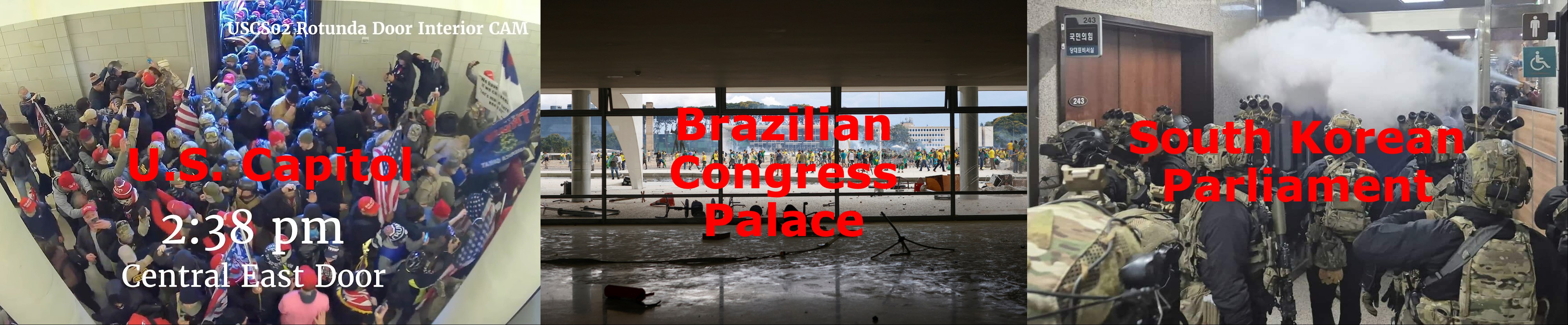
Three coups happened in three democracies over four short years.

All of this had painful echoes of the last two major coups I saw covered live on television in even larger democracies: the United States and Brazil.

The U.S coup, to prevent the peaceful transition of power on January 6, 2021, under the urging of President Donald Trump, led to a coordinated and violent assault by Trump supporters at the U.S. Capitol, trying to prevent Joe Biden from being peacefully being affirmed as the 46th president of the United States. It happened in broad daylight, with the world and nation watching live.

It also resembled the right wing coup in Brasilia, Brazil, at the National Congress, when supporters of former President Jair Bolsonaro, in broad daylight on January 8, 2023, overran the country’s capitol compound, trashing the Brazilian Congress, Supreme Court, and Presidential Palace, to prevent the transition of power to president-elect Lula de Silva. It also failed like the U.S. insurrection.

At the end of the day I shared a post on one of my social media feeds. I wrote: “Democracy, it requires the people to say: ‘No.’ Coups now are looking more routine. After today, what’s next?  USA: January 2021, coup attempt. Brazil: January 2023, coup attempt. South Korea: December 2024, coup attempt.”

You can bet all democracies and autocracies took notes how easy this was and what happened in Seoul, South Korea.

It took courage and the elected legislative leaders in this vital democracy in east Asia to challenge the elected president’s dead-of-night seizure of power by military force, without even a credible national, military, economic, or even public health threat.

So, will the next assault happen in daylight, like in the United States and Brazil, or again in the dead of night, like South Korea? More importantly, will the next effort succeed?

Genghis Khan, the revolutionary reformer

When I say the words “revolutionary reformer,” I bet the words Genghis Khan do not come to mind. He was both—a radical and a change agent unlike few others ever.

Before winning his honorific name of Genghis Khan, Borjigin Temüjin (1162–1227) rose from obscurity to mythical status, also becoming one of the most misunderstood figures of world history.

He was an unimportant son of an outcast family. His family was abandoned by its clan to die on the Mongol steppes. For a time, the young Temüjin, before his rise to power, was even a slave. He never forgot this humiliation.

Genghis Khan was the greatest conqueror in human history and a radical promoter of egalitarian reforms.

Through harsh life experiences in what is now Mongolia, he honed his abilities to unite disparate groups and people of different religious traditions and end archaic practices that stymied egalitarianism and the rights of those oppressed.

Genghis Khan drew his leadership ranks from those who proved themselves in battle. He was able to identify and promote capable subordinate leaders using a promotion system based strictly on merit. This proved dramatic on the field of battle.

These methods also challenged the orders and religions of the era, including Christianity and Islam in the West and Chinese traditions of Taoism and Confucianism in the East. In creating warriors loyal to his cause, he persuaded them to abandon their religious traditions and pledge allegiance to his vision of a united kingdom.

Unlike other cultures and rulers of his day, Genghis Khan also promoted religious tolerance studied and learned Islam, Buddhism, Taoism, and Christianity. He was remarkably tolerant to the local cultures in the administration of his cities. He provided order in exchange, of course, for taxes.

Above all, he and his armies were unrivaled innovators in the art of warfare. He became the world’s single greatest military conqueror, building a land empire two and a half times larger in its territory than the Roman Empire at its zenith. At the height of their power, the Mongols controlled an area which stretched from central Europe to the Pacific Ocean.

Historian Jack Weatherford, in his work “Genghis Khan and the Making of the Modern World,” summarizes Khan’s amazing feats this way: “In twenty-five years, the Mongol army subjugated more lands and people than the Romans had conquered in four hundred years. Genghis Khan together with his sones and grandsons, conquered the most densely populated civilizations of the thirteenth century. Whether measured by the number of people defeated, the sum of the countries annexed, or by the total area occupied, Genghis Khan conquered more than twice as much as any many in history.”

In the many lands they controlled, the Mongols provided security for travelers and they promoted trade. They reduced taxes and encouraged travel and commerce. This so-called “Pax Mongolica” allowed for the caravan routes of central Asia to flourish. Persian businessmen would visit lands in China regularly, and a diplomatic envoy from the Mongols could visit Europe and take communion with the pope in Rome.

In addition to the creation of cross-continental trade, the Mongols created an efficient and modern postal system. The Yam postal system, similar to the more modern Pony Express, relied on horses and provided the Mongols a rapid communications system, which they also extended to merchants. The merchant Marco Polo in fact used the Yam system to support his travels.

Few have changed world history like Genghis Khan.

He was, when needed, remarkably violent, conquering what is now modern-day Beijing in 1215, as he subdued the kingdoms of what is now modern-day China. The Mongol armies in 1241 decimated Czech, Polish and German knights in Poland in 1241.

In Europe, which fell as spectacularly as the earlier Chinese kingdoms did just decades earlier, the writers of the era branded the Mongol armies as an almost supernatural evil.

Describing the Mongol army that conquered Europe, also known as “Tatars,” after Genghis Khan’s death, a chronicler named Matthew Paris in 1241 wrote “they swarmed out and, like locusts, overwhelmed the face of the Earth. They devastated the lands of the East with dreadful destruction, laying waste with fire and carnage. Traveling through the lands of the Saracens, they leveled cities, cut down forests, tore down fortresses, ripped up vineyards, destroyed agricultural fields, and massacred city dwellers and rural folk.”

Mongol forces won everywhere because they employed superior tactics, weaponry, and speed.

They also were brutal when they needed to crush their foes and send a message to their rivals. In 1258, nearly three decades after Genghis Khan’s death, they besieged, sacked, and burned the great Caliphate of Baghdad in a feat not replicated until the American and British invasion of the city in 2003.

To those defeated by the Mongol’s lightning-fast cavalry and steppe-raised soldiers, organized along egalitarian principles and commanded by the most proven leaders, the Mongol army was the representation of the devil itself. They brought the planet’s mightiest and non-egalitarian systems to their knees unlike any military and political force before or since.

Yet Genghis Khan and his successors were astonishingly modern and enlightened.

John Mullin, writing on the innovations of Genghis Khan for the Federal Reserve Bank of Richmond in 2021, notes: “The Mongol empire was full of juxtaposition. In their military conquests, the Mongols countered resistance with ruthless violence. Yet after establishing control, their rule over conquered territories could be more nuanced. In the ‘Yasa’ legal code that Genghis [Khan] promulgated to complement customary Mongol law, the death penalty was ubiquitous. Acts of robbery and treason were punished with severity—but the Yuan legal code that the Mongols established in China had only half the number of capital crimes as the Song dynasty code that it supplanted, and the death penalty appears to have been used only sparingly on civilians.”

It is also important to remember Genghis Khan’s first acts as a leader. After taking power in 1206 of a united Mongol people, he wiped out practices that had cruelly subjected nearly all women to property status, brutally harmed bastard-born kids (illegitimate kids), and had ordinary people turned into slaves. He ended all of these oppressive systems. He had experienced and witnessed all of these cruelties during his life and rise to leadership. He never forgot what he had learned from the harshest of life lessons.

Today, it is no surprise those who accused Genghis Khan of barbarism were those who lost to him—the Chinese, most of the Muslim kingdoms of the Mideast/Near East, the West, and what is now Russia and Ukraine. Those defeated also were the ones who wrote the recorded history following their staggering defeats. They chose most lurid and exaggerated prose.

Yet, those who wrote the historic record, ultimately, stayed stuck in ways that Mongols were not. The social and religious systems that outlived the Mongol empire kept alive archaic and non-egalitarian systems that continued to the modern era and even today, especially the treatment of women. On the plains of Mongolia, nearly 1,000 years earlier, Genghis Khan had at least temporarily freed a generation of people from their societal prisons.

Half a century later, I realize why

Last week I heard a cover of “Bridge Over Troubled Water,” the classic Simon & Garfunkel folk song from the same-named album released in 1970. It was on regular rotation in my home when it came out. I was only 5 years old at the time. It was wildly popular, and the song and album each won Grammy Awards for best of categories that year.

There’s a reason this song resonated globally at a troubling time. The year of its release was troubling, globally, as the Vietnam War and other tensions boiled. According to Rolling Stone: “It not only lorded over the U.S. charts but went Top 10 in South Africa, Malaysia, Lebanon, Denmark, Switzerland, and other countries. Everyone from Aretha Franklin and country banjo legend Earl Scruggs to cabaret star Peggy Lee covered it. Columbia claimed that the Bridge Over Troubled Water LP sold nearly 2 million copies in three weeks.”

My mom was playing this song in particular on our record player over, and over, and over, and over, again in 1970. Then, as I was listening to this cover more than 50 years later, it hit me. She was desperately trying to leave a horrifically abusive marriage, and it was her way of finding peace. She was able to leave three years later, but by the skin of her teeth. We had nothing (her, me, my sister). There were funner times I can assure you. Funny how one can suddenly realize small things with the power of music.

I feel now, also, we are in such times and feel troubled waters in so many places. Maybe music will be the one thing that can bring peace to many. Music may be the universal medicine to life’s problems.

Reminiscing on my violent, alcoholic father

It has been more than 35 years since my adoptive father died of health complications that followed years of destructive behavior and a losing battle with alcoholism.

Though he has long been buried in a cemetery plot in the Cleveland suburb of Rocky River, Ohio, next to his father and mother, his impact on my life and my family lived on long after he passed away.

Even today, I frequently am forced to confront my long-buried memories of this often violent yet aextremely intelligent man who was an ordained Lutheran minister.

A shot taken with my adoptive father and sister in our home.

For the last seven years, when my adoptive mom was on her long and difficult journey with Alzheimer’s disease, my adoptive father’s memory frequently came up in our conversations. When I visited her in her home in University City, Missouri, flying out from my home cities of Seattle and then Portland, we spent endless hours talking about the past and her memories that grew dimmer over time. She could recall snippets of her past life and share them with me. She frequently repeated ideas or hazy recollections. She repeated two things more than any other during these seven years.

First, she told me, I have the greatest husband in the whole world. She was referencing her current husband and full-time caregiver, my stepfather, who cared for right up until her final day. Second, she told me, my first husband used to beat me. That was a reference to my adoptive father and her first husband, from the summer of 1958 through their divorce in the summer of 1973. During that time they lived in Detroit, moved briefly to Boston in late 1965 and 1966, and then moved to the metro St. Louis area, where my mom lived out the rest of her life.

My adoptive parents in front of their west Detroit home, likely in the late 1950s or early 1960s.

When my mom’s memory was sharper in the early years of her Alzheimer’s, she repeated constantly how often my adoptive father would hit her. She said the doctors told her the violence could have contributed to her awful and prolonged brain-wasting disease. I can still remember those incidents as if they happened hours ago. I too can never forget them.

I would always reply during these countless recollections that, yes, mom, your husband—my stepfather—was the best husband in the world. I would say nothing about her comments on her years of domestic abuse at the hands of my adoptive father—her former husband. These conversations continued until the second-to-last time I saw her alive, in September 2019.

In the end, my adoptive mom had two distinct memories, one of violence and one of love, which she likely had little control over because of her deteriorated state from Alzheimer’s.

Making Sense of my Adoptive Father

Though my life with my adoptive father in a nuclear family lasted eight years, I spent another five more visiting him, first in the St. Louis area and then in the Huntington, West Virginia and Chesapeake, Ohio metro area, where he resettled after the divorce.

Those trips with my adoptive sister to stay with him several times a year, as part of the divorce custodial settlement, were as bad if not worse than the times when we lived as a family under one roof.

I tried to reconstruct those years from memory starting about five years ago, as I began to write my memoir as an adoptee. I remember the day I wrote out the first outline to my memoir on a hot July day on a river beach. I then started with a chapter exploring my childhood and younger years with my adoptive father.

I wrote that chapter first. It proved to the hardest one to do because I had to dredge up memories that were neatly buried.

I also needed to revisit the places of my childhood and youth, in Huntington and Chesapeake, letting me remember things I had forgotten, perhaps as a way to carry on with life. I took a road trip there in September 2015.

My adoptive father lived for several years in this house, owned by the next door Lutheran church, where her served as a minister in the 1970s.

I published an essay on that trip on one of my blogs. I wrote about my childhood trips to see him: “I had no choice in the matter. I had to go there. I had to visit my father. It was bad to awful, and sometimes downright terrible. But when you are young, you are flexible and stronger than you think. You actually can do impossible things, and still come out at the end of the tunnel with a smile. I did. Despite the odds, I really did.”

When I finished the revised text to my memoir in late 2017, I left my first chapter on my adoptive father out. That decision came easily. I decided it was too personal about a relation that shaped my life. No one else would understand that journey but me. By that time in my life, into my fifth decade, I also realized I had become more like the generations who preceded me, who were reserved, not someone who wanted to “tell all.”

I also had come to a deeper realization about living life and finding meaning. I was able to see my unpleasant times with my adoptive father through a completely different perspective, shaped by my life and the knowledge I had gained from life.

Rudy Owens’ memoir on his experience as an adoptee and on the U.S. adoption system.

I described my later life’s wisdom in the introduction to my book, which I published in May 2018: “My adoptive father, a Lutheran minister, was abusive and an alcoholic. He had a serious drinking problem before I was even placed in his and my adoptive family’s middle-class, two-story brick home in metro Detroit. He treated my adoptive mother, my adoptive sister, and me very poorly. At times, when he was drunk, he could have killed my sister and me on more than a dozen occasions—when he would drive us in a total stupor. My adoptive family’s struggles were not pleasant, but they are also things no one could have predicted, and their meaning and purpose may still not even be clear to me. However, the way I confronted these challenges was uniquely my own, and I own how I addressed my reality and the conditions of my life. No one else is responsible for that.”

The Impact of Living through Domestic Violence Never Goes Away

As I continue to reflect on my life, I remain honest that the impacts of my adoptive father’s actions never fully disappeared. I see that most clearly when I read and learn about how domestic violence impacted others in their youth and their eventual journeys in life.

Patrick Stewart in his role as Captain Jean-Luc Picard on the Star Trek: The Next Generation TV series and film franchise.

I only recently learned that the fine British actor Patrick Stewart, known to the world as Captain Jean-Luc Picard of the Star Trek: The Next Generation TV series, also grew up in a home marred by domestic violence. I had always felt something raw when watching Stewart’s performances, as Picard, as Ebenezer Scrooge in his version of A Christmas Carol, and his lesser and earlier roles in films like Excalibur. He always had bursts of rage that felt like a smothering volcano, but controlled just barely.

By accident this month, I found his essay published in November 2009, in The Guardian (Patrick Stewart: the legacy of domestic violence). In it, he laid bare what he and his mother experienced at the rough hands of his World War II hero and domestic-abuser father. He wrote in the bluntest of terms how his father badly beat his mother, especially when he was drunk. He described the terror of living under the shadow of a violent person, who put their lives at risk.

“Violence is a choice a man makes and he alone is responsible for it,” Stewart wrote. “No one came to help. No adult stepped in and took charge. I needed someone else to take over and tell me everything was going to be all right and that it wasn’t my fault. I wanted the anger to go away and, while it stayed, I felt responsible. The sense of guilt and loneliness provoked by domestic violence is tainting—and lasting.”

Everything Stewart described echoed eerily what I had written in 2016, without ever reading Stewart’s essay, penned six years earlier.

In the section of my book I deleted, I wrote: “In those frequent drunken conditions, the ordinary looking man could transform into frightening malevolence, and you never quite knew how he would erupt. The well-worn expression walking on eggshells is actually a perfect match for what my mom, sister, and I faced for years around him.”

I also described the ravaging effects of alcohol, which I internalize to this day, as a survival mechanism. “In those intoxicated moments, my father’s ordinary appearance would be transformed by alcohol. His speech would slur. His left eye would slant behind his glasses. It was the mark an alcoholic I learned to spot instantaneously in others the rest of my life—one of the weird outcomes of growing up around someone with this affliction. To this day I can spot a problem drinkers with Spiderman-like quickness, usually in the first five seconds of meeting them. And my self-defense response kicks into a state of hyper readiness, just in case.”

On some days, like ones I have had this month, I revisit my life’s decisions that still leave sorrow, including my decisions to live a life that eschewed anything resembling domestic normality and middle-class happiness. I still associate these with my adoptive family and father.

Like all of us, we have to confront ourselves and decisions. There are days it is hard, when I might see families that appear “normal,” and I can observe a father who acts compassionately around others without toxic masculinity or the effects of alcohol. On those off days, these apparently normal activities allow me to play “what if” games in my mind.

In the end, I let those thoughts go, because I own this path and my thoughts entirely.

In the chapter I cut from my memoir, I concluded with a meditation on restorative justice. I described how embracing forgiveness means letting go of the power the offense and the offender over a person. It means no longer letting the offender and their actions control you anymore. Without this act of healing, the wound can fester and can control one’s actions indefinitely.

Like Stewart, I cannot entirely let go of the memories of a violent man who failed as a father. But I have found a path to becoming a better person and the person I wanted to be. I never followed in my adoptive father’s footsteps. For that I take credit. I accomplished more than I knew I ever would.

‘Ideals are peaceful, history is violent’

About 15 years ago, a friend of mine told me a story that has stuck in my memory. It was not her story. Rather, it was the story of her husband’s father. Her husband is Jewish, and she is of Armenian descent. So both have a keen sense of history, and the consequences of history, including the crimes that occurred during war. So this is why I gave this story a lot of weight.

Her husband came from the city where I grew up, St. Louis. His father lived there most of his life. The father, I learned, was a veteran of World War II. He fought in Europe, with an armored division as it entered Germany in April 1945, just as the European conflict was ready to end.

The Tank Crew in the FIlm Fury

Above is a publicity shot of the WWII action film Fury, starring Brad Pitt (2014).

She told me about her father-in-law sharing war tales. They were not happy stories. There were stories of conflict and death. One story he shared was about his armored column’s capture of Nazi soldiers. The American soldiers chose not to take the surrendering soldiers into custody. Instead, they shot them down with their weapons, and kept their advance.

I had often wondered how much truth there was to that tale. I know war is pure hell, and soldiers on all sides do not allow their better angels to rule when their inner demons are unleashed in life and death combat. I just did not know what to think about U.S. GIs mowing down Nazis surrendering in the heat of battle.

I thought about that tale again while watching the 2014 film Fury, by writer and director David Ayer, starring Brad Pitt as the leader of a U.S. Sherman tank crew. In one scene, Pitt’s character, Don “Wardaddy” Collier, leads a team of tanks and soldiers in an attack on a German position. They overcome the Germans, and in the final moments of victory, slaughter them in brutal fashion. This was far less brutal than the Nazi were everywhere, when they pillaged and committed war atrocities on an unimaginable scale, especially in eastern Europe and the Soviet Union.

Brad Pitt as Don "Wardaddy" Collier

Above is a publicity shot from the WWII combat film Fury, with Brad Pitt.

One German soldier escapes the executions and is left at the mercy of the enraged American soldiers. Wardaddy picks out his newest team member, a teenager named Norman Ellison (played by Logan Lerman) and forces him to shoot the surviving German soldier with a pistol. It is a painful scene, because the elder Wardaddy is initiating his new “son” into the art of death to make him ready for combat and a better team player.

The film captured a fair bit of critical acclaim for its gritty realism of combat in the claustrophobic conditions of these metal boxes that were no match for Nazi Panzers. I kept thinking about my friend’s father-in-law as a young man, faced with a choice of capturing the enemy or killing them, so they could achieve their objectives more quickly, with less risk to their side. I now believe everything I heard was true.

It was war, and the most brutal war in human history. This was how the war was won. Fury holds back nothing. It is worth watching to appreciate what happened day in and day out, from Stalingrad to Warsaw to Anzio to the Ardennes to the fall of Berlin. Mercy was in short supply, and a whole lot of killing happened to bring the horrible mess to an end—a mess started by the Nazis and carried to an extreme. As Wardaddy told Ellison, before he died, “Ideals are peaceful. History is violent.”