South Koreans cheer the moment an impeachment vote against President Yoon Suk Yeol is announced publicly.
It is so good to have good news again lately.
First, the world mostly cheered as it witnessed the stunning fall of the horribly brutal regime of the Assad family in Syria on December 8, 2024. That situation is not over, and nations including the United States and Israel were quick to take military actions inside of Syria for their own security interests. But seeing ordinary Syrians with smiles brought me joy.
And now, today, December 14, 2024, the National Assembly of the Republic of Korea voted to impeach its president, Yoon Suk Yeol, who declared martial law on December 3, 2024 (literally in the dark of night), only to rescind that order six hours later when faced with democratic opposition in the nation’s elected legislative body and in the streets.
This is what democracy looks like, and I am so impressed by the people of South Korea for defending their country’s basic democratic freedoms. Well done! This is footage, shared by AFP, of the moment the vote by the National Assembly was announced.
Personally, I am in need of hope now, and I want to thank the people of Syria and South Korea for sharing that with the world.
I woke up this morning, like many in the United States, almost in shock to learn a mostly stable and modern democracy, South Korea, also known as the Republic of Korea, was under martial law, by the unilateral decision of President Yoon Suk Yeol, made late on December 3, 2024, around 10:30 p.m. (KST).
President Yoon Suk Yeol of the Republic of Korea announcing martial law, on television
It was around 6 a.m. Pacific Time, December 3, as I was taking in the morning news and still waking up, when I heard the first news stories on my radio.
And then, about six hour later, around 4:30 a.m. (KST), December 4, following a courageous vote of defiance by the members of the National Assembly of the Republic of Korea, including the majority liberal Democratic Party and his own minority People’s Power Party, President Yoon lifted his declaration formally during a cabinet meeting.
All of this happened in darkness.
Most of the country was asleep when the South Korean military forcibly entered and surrounded the parliament building. They were filmed landing on the building with military helicopters and entering the building by force.
My immediate reaction was like the opinions of many regional observers—total disbelief.
You mean the land of K-Pop, high-tech electronics, Kia and Hyundai automobiles, not to mention a growing soccer powerhouse, was again in the throngs of political instability after mostly decades of calm?
How could this happen so fast in a country of more than 50 million people, and also host to nearly 30,000 U.S. service personnel.
It felt completely improbable, and yet it was real.
I needed to trust my senses and my awareness that the world is in the middle of unprecedented change.
The hugely unpopular President Yoon provided an erratic message to justify his decision. He called the actions necessary to protect the country from “North Korean communist forces” and “antistate forces,” and to “rebuild and protect” the nation from “falling into ruin.” The message could be coming from other comparable strongmen vying for power globally, anywhere.
According to the Center for Strategic and International Studies, Yoon’s decree, made under Proclamation No. 1 at 11 p.m. (KST), December 3, the following measures were implemented while the short-lived decree lasted:
All political activities, including the operations of the National Assembly, local assemblies, political parties, political associations, gatherings, and protests, were banned.
Any act that denied or attempts to subvert the democratic system were prohibited, including fake news, manipulation of public opinion, and false incitement.
All media and publications were subject to the control of the Martial Law Command.
Acts of social disruption, such as strikes, slowdowns, or gatherings, were prohibited.
All medical personnel, including interns, who are on strike or have left their medical posts were required to return to their duties within 48 hours and serve diligently. Violators would be punished under the Martial Law Act.
Except for anti-state forces and those attempting to subvert the system, innocent citizens would be provided with measures to minimize disruptions to their daily lives.
And then it was over the afternoon of December 4 (KST), with some opponents calling for the arrest and impeachment of President Yoon.
For me the developments appeared absolutely stunning, inside a country with no clearly visible threat, either from the militarized Communist North Korea, led by dictator Kim Jong Un, or any other nation. It was experiencing relative political and economic stability.
Though President Yoon had rescinded the martial law, the world saw how some of the national armed forces faithfully carried out its orders at the nerve center South Korea’s democratic government. Later in the day, after my workday ended, I had time to catch up on news developments and saw footage of South Korea’s military personnel in full body armor breaking into the National Assembly building to take control of Korea’s legislative branch. It was surreal footage, yet also familiar.
Three coups happened in three democracies over four short years.
All of this had painful echoes of the last two major coups I saw covered live on television in even larger democracies: the United States and Brazil.
The U.S coup, to prevent the peaceful transition of power on January 6, 2021, under the urging of President Donald Trump, led to a coordinated and violent assault by Trump supporters at the U.S. Capitol, trying to prevent Joe Biden from being peacefully being affirmed as the 46th president of the United States. It happened in broad daylight, with the world and nation watching live.
It also resembled the right wing coup in Brasilia, Brazil, at the National Congress, when supporters of former President Jair Bolsonaro, in broad daylight on January 8, 2023, overran the country’s capitol compound, trashing the Brazilian Congress, Supreme Court, and Presidential Palace, to prevent the transition of power to president-elect Lula de Silva. It also failed like the U.S. insurrection.
At the end of the day I shared a post on one of my social media feeds. I wrote: “Democracy, it requires the people to say: ‘No.’ Coups now are looking more routine. After today, what’s next? USA: January 2021, coup attempt. Brazil: January 2023, coup attempt. South Korea: December 2024, coup attempt.”
You can bet all democracies and autocracies took notes how easy this was and what happened in Seoul, South Korea.
It took courage and the elected legislative leaders in this vital democracy in east Asia to challenge the elected president’s dead-of-night seizure of power by military force, without even a credible national, military, economic, or even public health threat.
So, will the next assault happen in daylight, like in the United States and Brazil, or again in the dead of night, like South Korea? More importantly, will the next effort succeed?
Discounting history and facts has been one of humanity’s greatest failings. That remains true especially in the bright, glaring hot “now.”
During tonight’s horrifically moderated debate between a sleepwalking President Joe Biden and serial-lying convicted felon and former president, Donald Trump, we saw CNN abdicate all responsibility to moderate by not demanding even a shred of the truth. This event makes this wisdom from past experiences more pressing.
I wrote to a friend right after, “I’ve rarely seen a failure like this ever in presidential debates. I wonder if that’s crossing your mind? The stakes were too high, and CNN allowed this mess to happen. I think history tells us all failures like this are too costly.”
We already know that what has happened before, in a democracy like Weimar Germany 1933, can happen again.
If you’re not familiar with the ease with which a failed coup right-wing plotter, Adolf Hitler, and his Nazi thugs seized power without a majority of the people, I recommend reading this article from Foreign Policy in February 2021, “Weimar’s Lessons for Biden’s America.” There are also dozens of books in your public library. Many will have this story.
We also are dealing with brutal facts about our unfair world.
Authoritarian regimes thrive—in China, Russia, North Korea, etc.—and crush civilian democratic systems without many consequences once public movements are quashed. Who now remembers the brutal crushing of democracy in Hong Kong in between 2019 and 2021. It’s rarely talked about, ever, by media observers or international bodies that promote democratic values.
Minutes after the Biden-Trump debate ended, I sent an email to another older and long-time friend, whose wife is a Belgian citizen, if moving is on their minds. They have a home in Belgium already, and he likely can retire early as a minister.
He probably will mock me as being alarmist, as he normally like to use jokes and insults to deflect hard topics he doesn’t like to address. Also, he is a German American, who never really came to grips with the heritage of his ancestor’s home country, Germany, home of the Nazis and birthplace of what later became some of the greatest crimes against humanity.
I also think that many “smart” and “clever” liberal people, who think their wits and societal standing will endure a society that rips down civil society, will not be able to process past historic facts. In fact, most of us can’t because they are too hard to contemplate.
I believe we are now entering the chapter of historic events, where years later we’ll ask, why did that person see it coming and why did most of the people just allow it to happen and get sucked into the abyss, like the Nazi-sympathizing typical German citizen who was not a criminal or subhuman by Nazi standards. No, this is a new chapter of U.S. history. It’s a chapter where likely violent and also street-smart people will rise to the occasion.
I have already begun planning for what happens next in my country accordingly. I want to be very public about this because I know already this can happen, and I’ve been more than two dozen former Nazi camps that the dictatorship there and its racist regime built.
If you have studied history, you know events and mistakes and horrors can and do repeat themselves, all of the time. Denial is a failed strategy that leads to more failures. I now have to implement a plan.
It is actually great to have even small things go wrong. It breaks up routine. It forces you to use your skills of tolerance and control.
I stumbled on this sign during the COVID-19 pandemic and it has along resonated with me.
Today, on a warm sunny day, I headed to swim at the community center. It was rush hour. It took me 30 minutes to get there. Then, when I arrived, I learned the pool was closed for lifeguard training. I’ve never had that happen. So back home I drove, and got stuck in the late evening traffic jam from the hills of Portland to my home. It was slow, and it’s a drag on nice nights.
I used to sit in this traffic jam daily for nearly two years, when I drove 100 miles a day (there and back) to Salem, usually in the car more than three hours total a day. It was brutal on me. It was also a very hard time when my mom was near death and I was running on fumes. At that moment tonight, I felt blessed. I was now working at home, I am pretty good with my job, and my mom’s suffering has long passed. Her journey had ended, and that was good.
I needed this reminder to be thankful of how far things have come from those days of little sleep and a lot of stress. Here’s a little thing I spotted near my home a few years ago. It rings true for me.
Another year of my life gets ready to end. The clock will start anew to begin the exercise of measuring life’s passing by years. That means it is time to reflect on how I spent it, as my planet circled the sun and I counted away irretrievable minutes, hours, and days of being alive in the universe.
I felt a mythical pull to Finland last year, and found myself there twice in six months, completing a journey that started decades earlier.
Physically, I feel a bit older. That is a given.
However, the cumulative issues I have experienced and still feel in my back have sharpened my understanding of my mortality. I have been humbled, even as I respect every aspect about caring for myself. It is now more clear that my days of very good health could be over. I may now be entering a phase of manageable but slow decay. I’m still overall in great health. I run. I bike. I swim. I rollerski. I surf far less frequently, and cross-country ski even less often. But I can feel the reality of what “the slow glide out” now means. My best years, in terms of physical health, were in my 40s.
My mental health, however, has remarkably improved during the past five years, as I continue to appreciate what a purposeful mindset of “finding meaning” has brought to my daily life. The hardest challenges I have navigated the last two decades strengthened my ability to withstand the strongest storms. Maybe I have just accepted who I am, at last, and the wisdom of wiser predecessors who have offered ideas of living well. So despite many challenges, my outlook is very calm.
Awaiting the inevitable loss of family
I continue to plan for loss and death. Human myths have been doing this for all of us since we first collected our shared stories and passed them down orally. So this is nothing new, and because it’s not new, it should not be feared or avoided.
I have three family members who face very severe health challenges. Two are my biological kin and one is my adoptive sibling. The stress can gnaw at any moment, out of the blue. Yet I can do nothing to change what will inevitably come. That could be any day.
I took this shot in 2015 at the Detroit Institute of the Arts with one of my ill family members, who is nearing the end of their journey.
I fortunately have found my safe harbors in spaces that always serve me well: exercise, good food, a sense of gratitude for my own good fortune, being mindful of what is within my power to address, and deep knowledge of what I cannot change.
Feeling at peace with death is one of the oldest roles of myths for humanity, and I have found my place with its company this year even more. As Joseph Campbell, author of the Hero with a Thousand Faces, describes, death and death imagery are the very beginning of mythology. Campbell let all of us know that there is comfort knowing that what we all experience has been charted for millennia in myth: “So there’s a sense of death as not death somehow, that death is required for new fresh life.”
In fact, it was the cumulative stresses surrounding the health and wellness of my surviving family that finally propelled me to visit one of my ancestral home countries of my biological mother, Finland. I felt what I can only call a mythical pull to go there.
Hearing the call of Finland
My planning started on an important day celebrating Finland’s great myth, called the Kalevala. On February 28, 2023, on Kalevala Day, I vowed to visit the Nordic nation that summer. What’s more, I would also seek out my biological family I could trace only as far back as my maternal grandmother and grandfather, who emigrated to the Upper Peninsula of Michigan in the early 1900s. There were no contacts between my Finnish-American biological family and their distal relatives in Finland since the 1950s.
Famous Finnish painter Akseli Gallen-Kallela’s study called “Kullervo Herding his Wild Flocks” (1917) is held in the collection of the Ateneum art museum in Helsinki, Finland.
I announced my idea publicly, to make it known I was taking a mythical journey: “And my new journey into my ancestral past has begun,” I wrote. “Where it ends now, I know not. Once the ship leaves its harbor of safety for parts unknown, the mind, heart, and soul breath in the fresh sea air that only is found by discovery. Finland.”
Everything about this idea was mythical. I could feel the tug, the way I did when I set out to find my birth mother and my biological families in the mid-1980s, completing the task in April 1989 in Ann Arbor, Michigan.
In fact, understanding myth and my adoption story gave me what I consider to be a tactical advantage compared to other adoptees who start their journeys for self-awareness far later in life. I was in a totally different place because I already had deep knowledge of myth’s meaning to the human experience because I read countless books on myths as a young person and learned the stories of the Bible in church every Sunday.
I knew intuitively why my impossible task had meaning and that I would succeed, like the “hero” celebrated in myths and tales across the time and all cultures. My memoir and study of the U.S. adoption experience explores interplay of myth and adoption in detail, where I describe why my experience closely resembled the “hero’s story.”
In this instance, I immediately recognized the myth dynamic in wanting to go back to a family origin location, in Finland.
That recognition propelled me forward with the power that can only be understood as mythical and by all the dynamic rules of a mythical story. It was familiar territory, and it completely energized me. I knew I was on a journey, which made it easier for me to throw myself completely headlong into this project. The myth played out almost effortlessly, with joy instead of sorrow.
I successfully found my long-lost Finnish relatives, thanks to blind good fortune of finding a benefactor named Satu, a professor who I contacted by email in the early summer 2023. (Even Satu’s role felt mythical, like the kindly stranger who intervenes to propel the hero forward on their journey to the unknown.)
In my long story about meeting my biological family, I describe how we first met by video calls and email and finally in person in Kurikka and Tampere, Finland, in September, 2023. Even before I met them, we knew that the meeting would be special for all of us.
I described in my story how one of my aunts told me how I resembled her adult kids. “I find same features on my sons’ and your faces,” she wrote to me. I also noted: “Later I learned that others in the family, including two daughters, said the same thing, completely separate from each other. When I compared a photo to the youngest son in the family with myself, and shared it with friends, everyone I sent them to were mostly stunned; some swore we could be brothers. All my friends mostly shared that the power of genetic similarities were both astonishing and cool.”
Embracing my Finnish mythical muse: Kullervo
I stumbled on the bronze statue of the famous mythical antihero Kullervo and his loyal friend and dog, Musti, my first morning in Helsinki, probably by fate.
On my first morning in Helsinki in September 2023, I went for a run. It was cloudy and rainy. I got lost. Almost by design, I regained my bearings near Toolonlahti, a bay in central Helsinki. I stopped my run the moment I saw a bronze sculpture of the Finnish antihero, Kullervo. The statue shows the famous mythical character, and his dog Musti, the moment before he kills himself with his own sword. It stands peacefully in an outdoor rose garden in Kaupunginpuutarha park in Helsinki, but feels tense with foreboding. This was no accident. It was myth at play. I immediately shared the photos with my Finnish relatives, who told me it was Kullervo.
Kullervo is perhaps the most beloved character from the Kalevala by the Finnish people, despite a mostly short section in the epic myth relative to other heroes in it. Jean Sibelius wrote an entire musical score with a chorus telling his doomed and tragic story. As an infant, he was enslaved and orphaned, only to be tormented by the clan that destroyed his family. Despite abuses, he learns he has magic power, befriends a dog Musti, sleeps with his sister unknowingly (who kills herself), murders the man and clan that enslaved him, and finally kills himself in anguish.
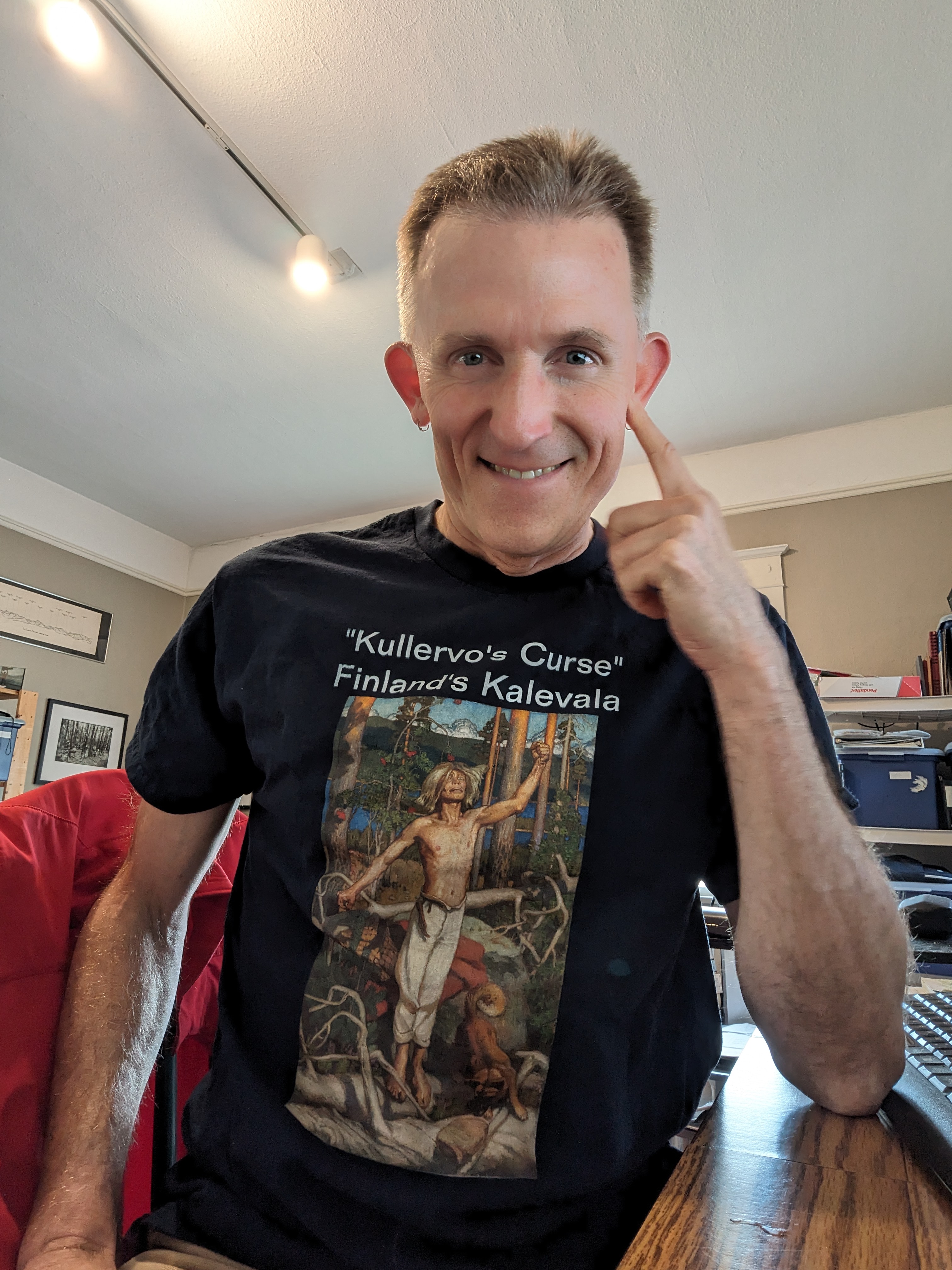
This is my favorite painting by the great Finnish artist Akseli Gallen-Kallela called “Kullervo’s Curse,” which I know proudly wear around town.
I made my T-shirt honoring Kullervo based on the painting by the great Finnish artist Akseli Gallen-Kallela, when I returned from Finland in February 2024.
My latest trip to Finland in February 2024, visiting family again in Tampere and Kurikka, completed the mythic trip I had started in late September 2023. It offered fresh insights into a nation and its national identity and stories. The Kalevala, the national story, is part of this story the Finns tell themselves. It also gave me wonderful insights into my ethnic Finnish roots.
When I returned, I looked back at the year of impossible events. I did what I knew I would always do. I had visited my ancestral villages of my blood relatives. I found my relatives, with whom I shared a physical resemblance and a strong kin connection. I felt connected to my identity that was long hidden from me by laws in Michigan. All told, in one year, I have written nearly 20 stories about my long journey back to my roots.
Without trying to write another book, I laid the foundations for one that arrived almost organically. I had no intention of writing any of these stories when the strange siren call to take the journey started. Yet it just happened, the way a myth naturally unfolds. My friend saw my new collection of essays and called me the “Finland Fanatic.”
What a perfect name for a book. What a perfect description of a mythical character, pulled by the power of the quest. My journey so far has been a happy one. Death of my family is still stalking my path forward. We shall see where it goes this coming year.
Exactly two weeks from tomorrow, it will have been four years since I last saw my mom alive. She was on her final days of her life’s journey. We spent some of that time together, quietly, in her room at a care facility, and in the facility’s dining room, where I fed her and was able to witness a lovely church service, where a woman sang hymns and played piano and made many smile. I smiled a bit too. My mom died less than two weeks later, just before the pandemic descended on the world, and there wasn’t time to stop and process things for a long time. But after Alzheimer’s disease, there wasn’t a lot left to hold on to, when the person you had known already and slowly had disappeared as their brain was collapsing. This weekend, I may take down the photos I have had taped to my living room walls since that time. It could be the moment to let this finally go.
When I say the words “revolutionary reformer,” I bet the words Genghis Khan do not come to mind. He was both—a radical and a change agent unlike few others ever.
Before winning his honorific name of Genghis Khan, Borjigin Temüjin (1162–1227) rose from obscurity to mythical status, also becoming one of the most misunderstood figures of world history.
He was an unimportant son of an outcast family. His family was abandoned by its clan to die on the Mongol steppes. For a time, the young Temüjin, before his rise to power, was even a slave. He never forgot this humiliation.
Genghis Khan was the greatest conqueror in human history and a radical promoter of egalitarian reforms.
Through harsh life experiences in what is now Mongolia, he honed his abilities to unite disparate groups and people of different religious traditions and end archaic practices that stymied egalitarianism and the rights of those oppressed.
Genghis Khan drew his leadership ranks from those who proved themselves in battle. He was able to identify and promote capable subordinate leaders using a promotion system based strictly on merit. This proved dramatic on the field of battle.
These methods also challenged the orders and religions of the era, including Christianity and Islam in the West and Chinese traditions of Taoism and Confucianism in the East. In creating warriors loyal to his cause, he persuaded them to abandon their religious traditions and pledge allegiance to his vision of a united kingdom.
Unlike other cultures and rulers of his day, Genghis Khan also promoted religious tolerance studied and learned Islam, Buddhism, Taoism, and Christianity. He was remarkably tolerant to the local cultures in the administration of his cities. He provided order in exchange, of course, for taxes.
Above all, he and his armies were unrivaled innovators in the art of warfare. He became the world’s single greatest military conqueror, building a land empire two and a half times larger in its territory than the Roman Empire at its zenith. At the height of their power, the Mongols controlled an area which stretched from central Europe to the Pacific Ocean.
Historian Jack Weatherford, in his work “Genghis Khan and the Making of the Modern World,” summarizes Khan’s amazing feats this way: “In twenty-five years, the Mongol army subjugated more lands and people than the Romans had conquered in four hundred years. Genghis Khan together with his sones and grandsons, conquered the most densely populated civilizations of the thirteenth century. Whether measured by the number of people defeated, the sum of the countries annexed, or by the total area occupied, Genghis Khan conquered more than twice as much as any many in history.”
In the many lands they controlled, the Mongols provided security for travelers and they promoted trade. They reduced taxes and encouraged travel and commerce. This so-called “Pax Mongolica” allowed for the caravan routes of central Asia to flourish. Persian businessmen would visit lands in China regularly, and a diplomatic envoy from the Mongols could visit Europe and take communion with the pope in Rome.
In addition to the creation of cross-continental trade, the Mongols created an efficient and modern postal system. The Yam postal system, similar to the more modern Pony Express, relied on horses and provided the Mongols a rapid communications system, which they also extended to merchants. The merchant Marco Polo in fact used the Yam system to support his travels.
Few have changed world history like Genghis Khan.
He was, when needed, remarkably violent, conquering what is now modern-day Beijing in 1215, as he subdued the kingdoms of what is now modern-day China. The Mongol armies in 1241 decimated Czech, Polish and German knights in Poland in 1241.
In Europe, which fell as spectacularly as the earlier Chinese kingdoms did just decades earlier, the writers of the era branded the Mongol armies as an almost supernatural evil.
Describing the Mongol army that conquered Europe, also known as “Tatars,” after Genghis Khan’s death, a chronicler named Matthew Paris in 1241 wrote “they swarmed out and, like locusts, overwhelmed the face of the Earth. They devastated the lands of the East with dreadful destruction, laying waste with fire and carnage. Traveling through the lands of the Saracens, they leveled cities, cut down forests, tore down fortresses, ripped up vineyards, destroyed agricultural fields, and massacred city dwellers and rural folk.”
Mongol forces won everywhere because they employed superior tactics, weaponry, and speed.
They also were brutal when they needed to crush their foes and send a message to their rivals. In 1258, nearly three decades after Genghis Khan’s death, they besieged, sacked, and burned the great Caliphate of Baghdad in a feat not replicated until the American and British invasion of the city in 2003.
To those defeated by the Mongol’s lightning-fast cavalry and steppe-raised soldiers, organized along egalitarian principles and commanded by the most proven leaders, the Mongol army was the representation of the devil itself. They brought the planet’s mightiest and non-egalitarian systems to their knees unlike any military and political force before or since.
Yet Genghis Khan and his successors were astonishingly modern and enlightened.
John Mullin, writing on the innovations of Genghis Khan for the Federal Reserve Bank of Richmond in 2021, notes: “The Mongol empire was full of juxtaposition. In their military conquests, the Mongols countered resistance with ruthless violence. Yet after establishing control, their rule over conquered territories could be more nuanced. In the ‘Yasa’ legal code that Genghis [Khan] promulgated to complement customary Mongol law, the death penalty was ubiquitous. Acts of robbery and treason were punished with severity—but the Yuan legal code that the Mongols established in China had only half the number of capital crimes as the Song dynasty code that it supplanted, and the death penalty appears to have been used only sparingly on civilians.”
It is also important to remember Genghis Khan’s first acts as a leader. After taking power in 1206 of a united Mongol people, he wiped out practices that had cruelly subjected nearly all women to property status, brutally harmed bastard-born kids (illegitimate kids), and had ordinary people turned into slaves. He ended all of these oppressive systems. He had experienced and witnessed all of these cruelties during his life and rise to leadership. He never forgot what he had learned from the harshest of life lessons.
Today, it is no surprise those who accused Genghis Khan of barbarism were those who lost to him—the Chinese, most of the Muslim kingdoms of the Mideast/Near East, the West, and what is now Russia and Ukraine. Those defeated also were the ones who wrote the recorded history following their staggering defeats. They chose most lurid and exaggerated prose.
Yet, those who wrote the historic record, ultimately, stayed stuck in ways that Mongols were not. The social and religious systems that outlived the Mongol empire kept alive archaic and non-egalitarian systems that continued to the modern era and even today, especially the treatment of women. On the plains of Mongolia, nearly 1,000 years earlier, Genghis Khan had at least temporarily freed a generation of people from their societal prisons.
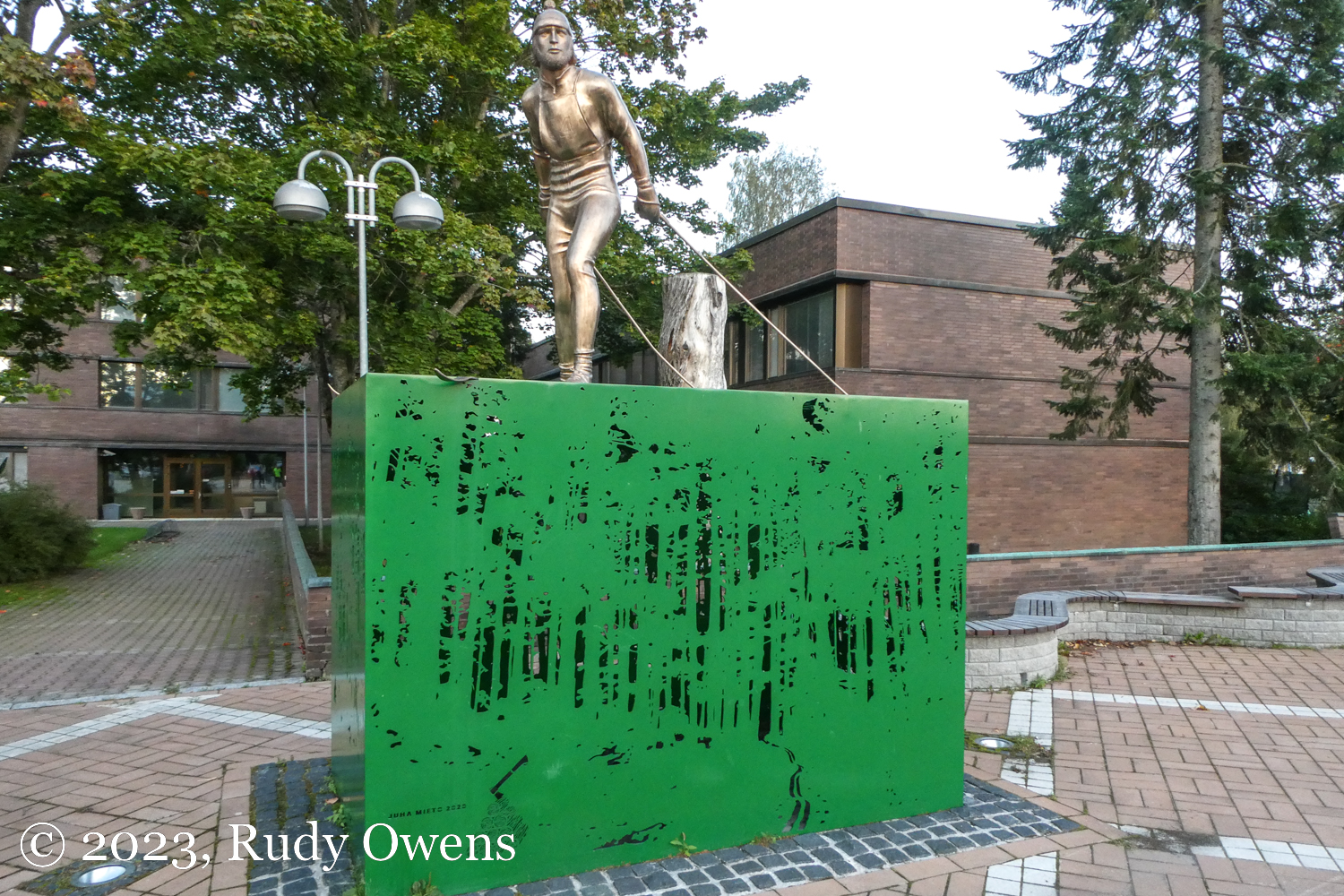
Olympic gold medalist and Finnish ski legend Juha Mieto is celebrated in his home city of Kurikka with this status in the city center.
In September 2023, I visited the 20,000-person community of Kurikka, Finland. Kurikka is the kind of place that will never go into any Finnish guidebook, but it’s where I had a lot of great moments in Finland for my first-ever visit to the Nordic nation.
At the center of the city I found this statue of a very famous Finnish skier, Juha Mieto. It turns out a completely unknown Finnish woman who connected me to my distant relatives in Finland this summer also has a connection to Kurikka and Mieto too, and I had no way of knowing that at the time I saw this statue.
Several months before I was standing in the Kurikka city center, I had been in touch with my “email friend” in Finland asking her for help. Our interaction was an entirely serendipitous human connection that tipped the scales of fate for me and had brought me to this very spot.
Today I learned she is a blood relative of this very famous Finnish national skier. The famous Mieto grabbed a gold medal a 1976 Winter Olympics in Lake Placid, New York, and also a silver medal, in the 1980 Winter Olympics in Innsbruck, Austria, finishing one one-hundredth of a second behind his Swedish rival, Thomas Wassberg.
Kurikka is also the home city of Finnish relatives I found through my benefactor’s help.
When I visited one of my Finnish relatives in Kurikka in September 2023, I first saw this statue. I photographed it because it was distinct, but I didn’t fully appreciate who I was photographing at the time—a Finnish sports legend. I mentioned this visit in my story about my trip and seeing this statue. I shared the story with my benefactor as a late “thank you” gift to show how important her help was to me. And that’s when she mentioned her personal connection to Kurikka and the man turned into a bronze ski statue.
Talk about funny coincidences. Life is full of them. I have always found that the more you do things to go where your instincts are telling you to go, the more these things will happen. Perhaps good luck, my connection to friendly stranger, and maybe something more made all of this happen.
The famous Swiss psychiatrist Carl Jung created the term synchronicity to explain relationships between events that could not be explained by simple cause and effect logic.
Jung suggested that unique and synchronistic events had meaningful connections rooted in perceptions. He explained it this way: “I found where ‘coincidences’ which were connected so meaningfully that their ‘chance’ concurrence would represent a degree of improbability that would have to be expressed by an astronomical figure.”
I have long thought that synchronicity can be harnessed, especially when I felt it working in wonderous ways for me. I fortunately could tap into that for my trip to Finland.
I would not say that I’m “extraordinary.” I’m just me. And I felt synchronicity the entire time I was planning my trip and then having one of the most rewarding times of my life.
I also have a bit of advice. Trust the siren when you hear it. It calls for a reason.
Last week I heard a cover of “Bridge Over Troubled Water,” the classic Simon & Garfunkel folk song from the same-named album released in 1970. It was on regular rotation in my home when it came out. I was only 5 years old at the time. It was wildly popular, and the song and album each won Grammy Awards for best of categories that year.
There’s a reason this song resonated globally at a troubling time. The year of its release was troubling, globally, as the Vietnam War and other tensions boiled. According to Rolling Stone: “It not only lorded over the U.S. charts but went Top 10 in South Africa, Malaysia, Lebanon, Denmark, Switzerland, and other countries. Everyone from Aretha Franklin and country banjo legend Earl Scruggs to cabaret star Peggy Lee covered it. Columbia claimed that the Bridge Over Troubled Water LP sold nearly 2 million copies in three weeks.”
My mom was playing this song in particular on our record player over, and over, and over, and over, again in 1970. Then, as I was listening to this cover more than 50 years later, it hit me. She was desperately trying to leave a horrifically abusive marriage, and it was her way of finding peace. She was able to leave three years later, but by the skin of her teeth. We had nothing (her, me, my sister). There were funner times I can assure you. Funny how one can suddenly realize small things with the power of music.
I feel now, also, we are in such times and feel troubled waters in so many places. Maybe music will be the one thing that can bring peace to many. Music may be the universal medicine to life’s problems.
Once again I feel happy. My suddenly awful late afternoon turned from angry frustration to a nice opportunity practice my old tricks and learn something new. I have a comedy of errors, my own bad judgement, and a broken crapper to thank for this.
After I I tried to add the new universal toilet flapper, on the right, I broke the flush valve.
Just before I was ready to go for a roller ski after work today, I found my universal toilet flapper had broken. I thought I could simply replace this $7 part and get on with my day. This looked like a simple win.
So I dashed to Ace Hardware, got a generic new flapper, got close to getting it one. Then, in a blink of the eye and maybe too much force, I snapped the part of the toilet called the flush valve.
This part is important. You can’t flush your toilet without it, and it allows the water a path to flow from the toilet tank to the toilet bowl.
Well, after some cussing and kvetching, I gave myself a few moments to think. I told myself that things do break. I also allowed myself the grace to accept the truth that I’m allowed to give myself a break when they do fall apart.
I also know from so many life experiences that a problem is always an opportunity to learn what you didn’t know.
The flush valve is one of the main features of toilets most of us with a flush toilet use every day, and sometimes they break and have to be replaced.
In this case I also recognized my anger on a hot day was tied breaking up my beloved and shackling routine. I know this well.
For me the solution is to do what works. When I hit peak frustration, which I hit fast, I turned to best solutions. For me that is: taking a walk, cursing out loud a number of times, eating a good meal, listening to classical music, and then rationally determining a solution.
After my meal I spent some time having fun learning about a device I use countless times a day, the beloved flush valve. In short, I have now learned that flush valves in toilets frequently break. They should be replaced about very six years, and mine was due for failure.
Looking at my broken valve I can see it was ripe for falling apart. This was decrepit for sure. The problem was actually not my failed repair. It was something meant to happen.
As for the solution, I have several options. I may try to fix it myself, wait for my landlord (and get a lecture), or hire a plumber. These are called choices. I get to pick. I also am pretty happy I learned from cool YouTube videos how to replace a flush valve. It’s not a simple job, but it is a doable thing.









 The Path to Wisdom