This month marks the 40th anniversary of my adoptive father’s death.
Rudy Owens, his adoptive father, and his adoptive sister, in the late 1960s
I still have no pleasant memories about him or our time we shared during those earlier years before my family fell apart when I was still in grade school. It is a long story, rooted in his alcoholism and what he unleashed on my adoptive mom and their kids: my adoptive sister and me. I’ve written about this before.
I’ve ignored this anniversary for decades.
However, this month I heard an interview repeated on NPR with the late Rob Reiner, who, with his wife, Michele Singer Reiner, was tragically found murdered on December 14, 2025.
Reiner talked about listening to a comedy album his father—the celebrated comedy writer and actor Carl Reiner—made. I realized my late adoptive father had comedy albums like this in his collection that I heard growing up. Then his ghost came rushing back to my memory, like Jacob Marley’s ghost visits Ebenezer Scrooge on Christmas Eve in Charles Dickens’ “A Chistmas Carol.”
I did not go to my adoptive father’s funeral. I was in France floundering as an exchange student and very poor then, and it would have been impossible for me to go.
By then, in my own way, I had already forgiven him before I Ieft for college for the path of destruction he left in his wake. I did that because I had to come to terms with who I was and who he was. I needed to do that to get on with my life, and it was an important moment in my life and path toward becoming a better person.
I talked about that in my book because this was an important part of my experience as an adoptee confronting the harsh reality that adoption can force on many adoptees.
Ultimately, my adoptive father was an unhappy soul, tormented by demons, which he unleashed on others. Still I also found something good from those dark years. I grew up fast, and ultimately adversity early in life helped me confront later challenges that surprisingly did not break me. I had a hidden inner strength I could tap into—rooted in lived experience.
We’re all tested in life. He was my first hard test, stretching a long time. I won that test, I think. But it was not simple. Few things in life that count are simple or easy.
My “neighbors” include everyone who did this wonderful performance of traditional Mexican folkloric dances at the Multnomah County Fair on Memorial Day 2025, not far from my home.
A dear friend I know is worried sick about this type of horror story of family separation by deportation happening to their family. This isn’t abstract. It’s now reality in probably every community in this country, because immigrants are our neighbors, coworkers, family members, and friends. Immigrants are in my step-family even. My great grandparents were immigrants, and they were not forced to leave largely because they were Finnish, and white. And as someone who is an adult adoptee, who was severed from my family by a state bureaucracy and then denied the ability to connect with them for decades relentlessly and also immorally by a state bureaucracy, this story and its sorrow has special resonance for me. If you think these stories don’t matter for your role in the workplace, you are gravely mistaken. Everything you do matters, wherever you engage others, including in and out of work. There’s no firewall here. We’re all in this as a nation, and that means where you work, where you live, where you worship, where you spend time, and where you do business. You have agency, and this is not a thing to sit out. The choice is always yours.
Another year of my life gets ready to end. The clock will start anew to begin the exercise of measuring life’s passing by years. That means it is time to reflect on how I spent it, as my planet circled the sun and I counted away irretrievable minutes, hours, and days of being alive in the universe.
I felt a mythical pull to Finland last year, and found myself there twice in six months, completing a journey that started decades earlier.
Physically, I feel a bit older. That is a given.
However, the cumulative issues I have experienced and still feel in my back have sharpened my understanding of my mortality. I have been humbled, even as I respect every aspect about caring for myself. It is now more clear that my days of very good health could be over. I may now be entering a phase of manageable but slow decay. I’m still overall in great health. I run. I bike. I swim. I rollerski. I surf far less frequently, and cross-country ski even less often. But I can feel the reality of what “the slow glide out” now means. My best years, in terms of physical health, were in my 40s.
My mental health, however, has remarkably improved during the past five years, as I continue to appreciate what a purposeful mindset of “finding meaning” has brought to my daily life. The hardest challenges I have navigated the last two decades strengthened my ability to withstand the strongest storms. Maybe I have just accepted who I am, at last, and the wisdom of wiser predecessors who have offered ideas of living well. So despite many challenges, my outlook is very calm.
Awaiting the inevitable loss of family
I continue to plan for loss and death. Human myths have been doing this for all of us since we first collected our shared stories and passed them down orally. So this is nothing new, and because it’s not new, it should not be feared or avoided.
I have three family members who face very severe health challenges. Two are my biological kin and one is my adoptive sibling. The stress can gnaw at any moment, out of the blue. Yet I can do nothing to change what will inevitably come. That could be any day.
I took this shot in 2015 at the Detroit Institute of the Arts with one of my ill family members, who is nearing the end of their journey.
I fortunately have found my safe harbors in spaces that always serve me well: exercise, good food, a sense of gratitude for my own good fortune, being mindful of what is within my power to address, and deep knowledge of what I cannot change.
Feeling at peace with death is one of the oldest roles of myths for humanity, and I have found my place with its company this year even more. As Joseph Campbell, author of the Hero with a Thousand Faces, describes, death and death imagery are the very beginning of mythology. Campbell let all of us know that there is comfort knowing that what we all experience has been charted for millennia in myth: “So there’s a sense of death as not death somehow, that death is required for new fresh life.”
In fact, it was the cumulative stresses surrounding the health and wellness of my surviving family that finally propelled me to visit one of my ancestral home countries of my biological mother, Finland. I felt what I can only call a mythical pull to go there.
Hearing the call of Finland
My planning started on an important day celebrating Finland’s great myth, called the Kalevala. On February 28, 2023, on Kalevala Day, I vowed to visit the Nordic nation that summer. What’s more, I would also seek out my biological family I could trace only as far back as my maternal grandmother and grandfather, who emigrated to the Upper Peninsula of Michigan in the early 1900s. There were no contacts between my Finnish-American biological family and their distal relatives in Finland since the 1950s.
Famous Finnish painter Akseli Gallen-Kallela’s study called “Kullervo Herding his Wild Flocks” (1917) is held in the collection of the Ateneum art museum in Helsinki, Finland.
I announced my idea publicly, to make it known I was taking a mythical journey: “And my new journey into my ancestral past has begun,” I wrote. “Where it ends now, I know not. Once the ship leaves its harbor of safety for parts unknown, the mind, heart, and soul breath in the fresh sea air that only is found by discovery. Finland.”
Everything about this idea was mythical. I could feel the tug, the way I did when I set out to find my birth mother and my biological families in the mid-1980s, completing the task in April 1989 in Ann Arbor, Michigan.
In fact, understanding myth and my adoption story gave me what I consider to be a tactical advantage compared to other adoptees who start their journeys for self-awareness far later in life. I was in a totally different place because I already had deep knowledge of myth’s meaning to the human experience because I read countless books on myths as a young person and learned the stories of the Bible in church every Sunday.
I knew intuitively why my impossible task had meaning and that I would succeed, like the “hero” celebrated in myths and tales across the time and all cultures. My memoir and study of the U.S. adoption experience explores interplay of myth and adoption in detail, where I describe why my experience closely resembled the “hero’s story.”
In this instance, I immediately recognized the myth dynamic in wanting to go back to a family origin location, in Finland.
That recognition propelled me forward with the power that can only be understood as mythical and by all the dynamic rules of a mythical story. It was familiar territory, and it completely energized me. I knew I was on a journey, which made it easier for me to throw myself completely headlong into this project. The myth played out almost effortlessly, with joy instead of sorrow.
I successfully found my long-lost Finnish relatives, thanks to blind good fortune of finding a benefactor named Satu, a professor who I contacted by email in the early summer 2023. (Even Satu’s role felt mythical, like the kindly stranger who intervenes to propel the hero forward on their journey to the unknown.)
In my long story about meeting my biological family, I describe how we first met by video calls and email and finally in person in Kurikka and Tampere, Finland, in September, 2023. Even before I met them, we knew that the meeting would be special for all of us.
I described in my story how one of my aunts told me how I resembled her adult kids. “I find same features on my sons’ and your faces,” she wrote to me. I also noted: “Later I learned that others in the family, including two daughters, said the same thing, completely separate from each other. When I compared a photo to the youngest son in the family with myself, and shared it with friends, everyone I sent them to were mostly stunned; some swore we could be brothers. All my friends mostly shared that the power of genetic similarities were both astonishing and cool.”
Embracing my Finnish mythical muse: Kullervo
I stumbled on the bronze statue of the famous mythical antihero Kullervo and his loyal friend and dog, Musti, my first morning in Helsinki, probably by fate.
On my first morning in Helsinki in September 2023, I went for a run. It was cloudy and rainy. I got lost. Almost by design, I regained my bearings near Toolonlahti, a bay in central Helsinki. I stopped my run the moment I saw a bronze sculpture of the Finnish antihero, Kullervo. The statue shows the famous mythical character, and his dog Musti, the moment before he kills himself with his own sword. It stands peacefully in an outdoor rose garden in Kaupunginpuutarha park in Helsinki, but feels tense with foreboding. This was no accident. It was myth at play. I immediately shared the photos with my Finnish relatives, who told me it was Kullervo.
Kullervo is perhaps the most beloved character from the Kalevala by the Finnish people, despite a mostly short section in the epic myth relative to other heroes in it. Jean Sibelius wrote an entire musical score with a chorus telling his doomed and tragic story. As an infant, he was enslaved and orphaned, only to be tormented by the clan that destroyed his family. Despite abuses, he learns he has magic power, befriends a dog Musti, sleeps with his sister unknowingly (who kills herself), murders the man and clan that enslaved him, and finally kills himself in anguish.
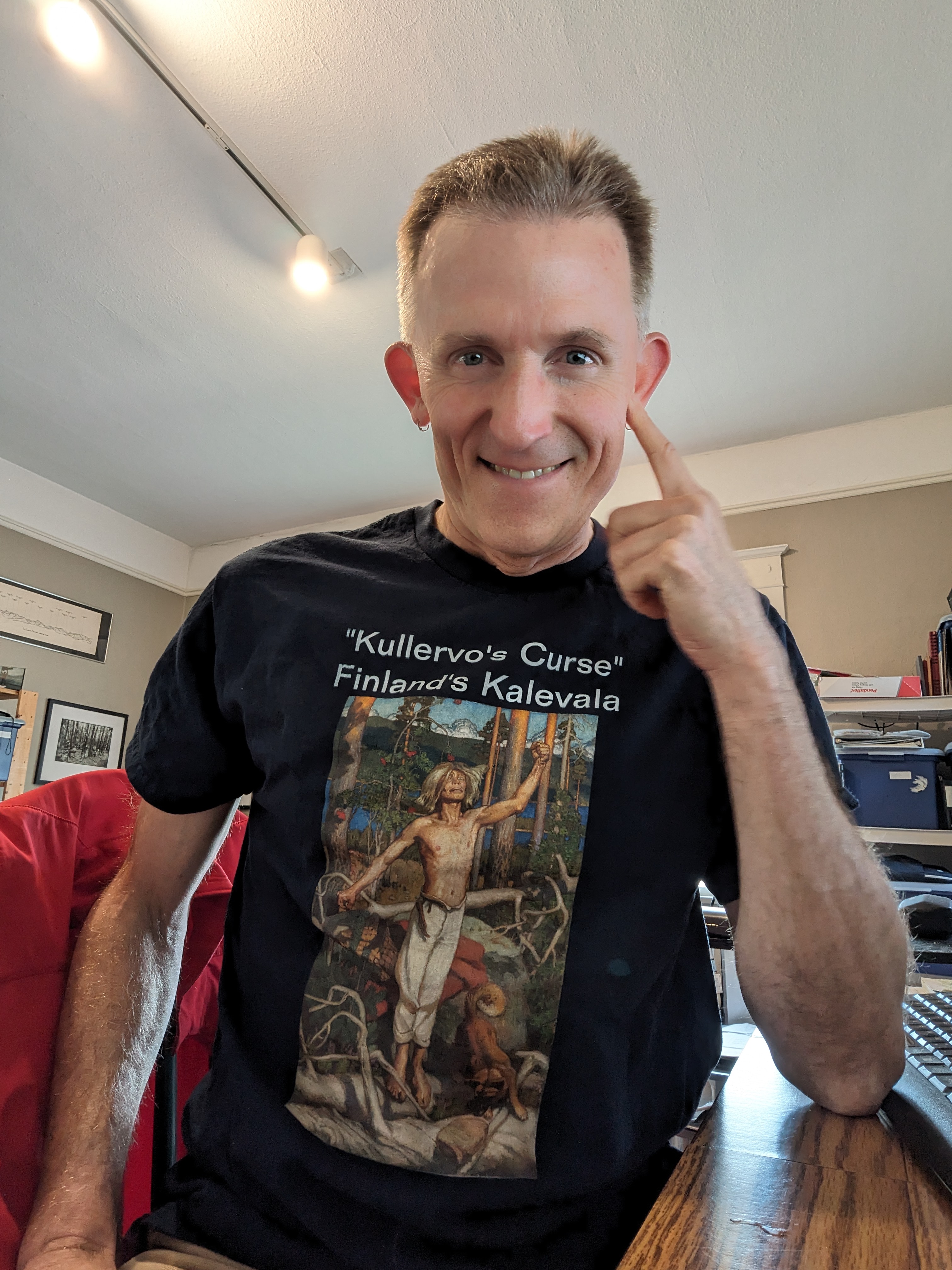
This is my favorite painting by the great Finnish artist Akseli Gallen-Kallela called “Kullervo’s Curse,” which I know proudly wear around town.
I made my T-shirt honoring Kullervo based on the painting by the great Finnish artist Akseli Gallen-Kallela, when I returned from Finland in February 2024.
My latest trip to Finland in February 2024, visiting family again in Tampere and Kurikka, completed the mythic trip I had started in late September 2023. It offered fresh insights into a nation and its national identity and stories. The Kalevala, the national story, is part of this story the Finns tell themselves. It also gave me wonderful insights into my ethnic Finnish roots.
When I returned, I looked back at the year of impossible events. I did what I knew I would always do. I had visited my ancestral villages of my blood relatives. I found my relatives, with whom I shared a physical resemblance and a strong kin connection. I felt connected to my identity that was long hidden from me by laws in Michigan. All told, in one year, I have written nearly 20 stories about my long journey back to my roots.
Without trying to write another book, I laid the foundations for one that arrived almost organically. I had no intention of writing any of these stories when the strange siren call to take the journey started. Yet it just happened, the way a myth naturally unfolds. My friend saw my new collection of essays and called me the “Finland Fanatic.”
What a perfect name for a book. What a perfect description of a mythical character, pulled by the power of the quest. My journey so far has been a happy one. Death of my family is still stalking my path forward. We shall see where it goes this coming year.
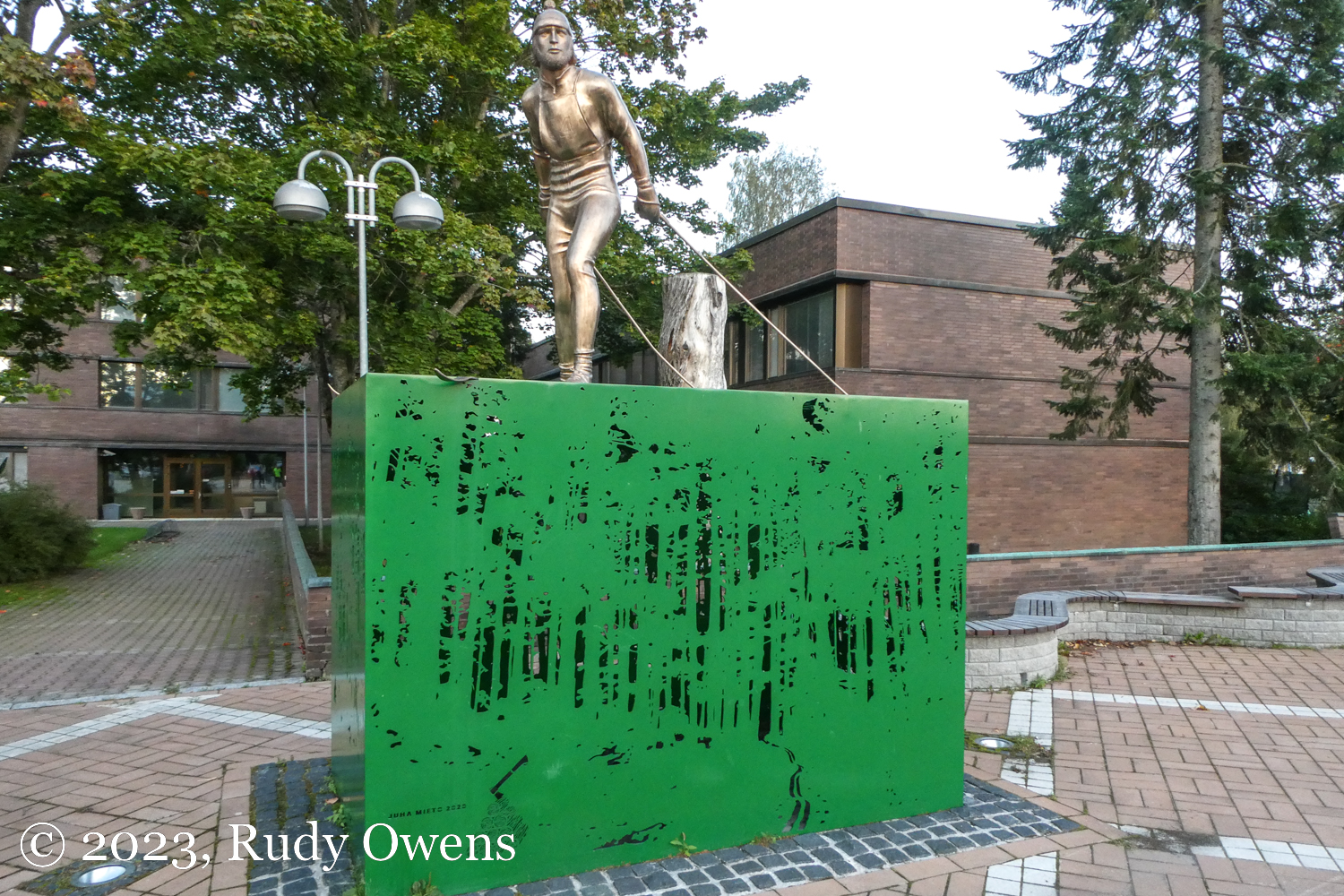
Olympic gold medalist and Finnish ski legend Juha Mieto is celebrated in his home city of Kurikka with this status in the city center.
In September 2023, I visited the 20,000-person community of Kurikka, Finland. Kurikka is the kind of place that will never go into any Finnish guidebook, but it’s where I had a lot of great moments in Finland for my first-ever visit to the Nordic nation.
At the center of the city I found this statue of a very famous Finnish skier, Juha Mieto. It turns out a completely unknown Finnish woman who connected me to my distant relatives in Finland this summer also has a connection to Kurikka and Mieto too, and I had no way of knowing that at the time I saw this statue.
Several months before I was standing in the Kurikka city center, I had been in touch with my “email friend” in Finland asking her for help. Our interaction was an entirely serendipitous human connection that tipped the scales of fate for me and had brought me to this very spot.
Today I learned she is a blood relative of this very famous Finnish national skier. The famous Mieto grabbed a gold medal a 1976 Winter Olympics in Lake Placid, New York, and also a silver medal, in the 1980 Winter Olympics in Innsbruck, Austria, finishing one one-hundredth of a second behind his Swedish rival, Thomas Wassberg.
Kurikka is also the home city of Finnish relatives I found through my benefactor’s help.
When I visited one of my Finnish relatives in Kurikka in September 2023, I first saw this statue. I photographed it because it was distinct, but I didn’t fully appreciate who I was photographing at the time—a Finnish sports legend. I mentioned this visit in my story about my trip and seeing this statue. I shared the story with my benefactor as a late “thank you” gift to show how important her help was to me. And that’s when she mentioned her personal connection to Kurikka and the man turned into a bronze ski statue.
Talk about funny coincidences. Life is full of them. I have always found that the more you do things to go where your instincts are telling you to go, the more these things will happen. Perhaps good luck, my connection to friendly stranger, and maybe something more made all of this happen.
The famous Swiss psychiatrist Carl Jung created the term synchronicity to explain relationships between events that could not be explained by simple cause and effect logic.
Jung suggested that unique and synchronistic events had meaningful connections rooted in perceptions. He explained it this way: “I found where ‘coincidences’ which were connected so meaningfully that their ‘chance’ concurrence would represent a degree of improbability that would have to be expressed by an astronomical figure.”
I have long thought that synchronicity can be harnessed, especially when I felt it working in wonderous ways for me. I fortunately could tap into that for my trip to Finland.
I would not say that I’m “extraordinary.” I’m just me. And I felt synchronicity the entire time I was planning my trip and then having one of the most rewarding times of my life.
I also have a bit of advice. Trust the siren when you hear it. It calls for a reason.
One of mine is to write my holiday cards on Thanksgiving day. I have kept this tradition for more years than I can recall. No matter where I have lived or what happened on that day, I always found time to think about those in my life, including family and friends.
The act of writing and remembering reminds me of the bonds of connection I have with people far-flung across this country. Some of these connections help sustain me, good times and bad. Some have little impact in my life.
I went with an Oregon-themed card this year. In past years I have made my own. On each of the cards I create a personal message, written by hand and signed. A regular theme, if I can find one, is to share a positive wish of good fortune for the coming year. It is always preferable to be positive, even when we know some persons may be experiencing hard times, like some of my relations and friendships.
In my case, my card writing involves my circle of friends who seem to remain a part of my life as I age. They can be called my “chosen circle.” They are not family, for me at least. They matter a great deal in my life.
My “family card list” includes my step-family, my adoptive family, and my biological family. Because I am adoptee, and because that status is fraught with complexities about the meaning of “family,” my holiday card tradition has challenged me.
Having had a step-family since I was 18 years old, I can vouch first-hand that these relations are not easy. Step-family bonds are not blood-based or kinship-based.
Everyone in those dynamics knows the minefields, and to deny these tensions is to deny the critical role of genetic kinship in how all species, including humans, care for and help their close genetic relations succeed. This is equally if not truer of adoptive-family relationships.
Author and adoptee Rudy Owens gets ready to mail his 2022 holiday cards to his biological, step-, and adoptive family and friends on Thanksgiving day 2022.
In my book, You Don’t Know How Lucky You Are, I write about the meaning of relationships with non-biologically related step-family and other distal adoptive kin: “There simply is no bond that joins us, much the way I feel about my adoptive cousins, uncles, and aunts. For me, there is no blood that ties us, nor DNA to bind us. We are not true kin, both as I perceive it and as I have experienced this relation for decades now.”
Yet each year, on Thanksgiving I will still write letters of fellowship for the coming Christmas, or winter holidays if you prefer to call it that.
There is very little power I have to create relations where none are hardwired to exist by the determinant laws of biology and genetics. What I do control is my ability to offer a hopeful gesture. Whether that gesture is accepted or rejected, like so much in our lives, is not in our power to manage.
Because I was separated as a newborn baby from my biological family by laws and systems that erased my past and discriminated against me and millions of others by status of birth, I only began my biological family relations in my mid-20s. I explain all of this in my book for any reader seeking to understand what that means for me and other adoptees.
As someone who is now in my mid-50s and getting older, I remain clear-eyed how those relations will remain forever impacted by this system of separating families. And with my surviving biological family members who I do have contact with, again, I am not able to control how they respond. It has never been simple or easy to explain to anyone who is not adopted and separated from their biological family relations.
So with Thanksgiving now behind us, and my holiday cards on their way to my blended, adoptive, and biological family, I will celebrate what some may call our betters selves, to be the person I prefer to be.
Yes, adoption as a system forever made my holidays a mixed up time, but I have, for decades now, not let this define the meaning I give this time of year freely.
My mother’s misfortune of developing Alzheimer’s still shapes my way of navigating the world. She endured the horrible disease for more than seven years, before finally dying, with little left of her cognitive functions.
Roman artwork Memento Mori, in the Naples National Archaeological Museum
To deal with the illness as a family member, I had to readjust my way of navigating the world. I had to deal with stress. I had to deal with family conflict. I had to deal with helping someone who could never be cured.
Most of all I had to practice what philosophers did more than 2,000 ago, meditate on one’s mortality, or memento mori.
Death, as the ultimate end of my mother’s condition, became relentless as a nagging thought. I had to think about it because it was the way her suffering would end. This is simply an honest reflection, because that is what Alzheimer’s was truly like. It was worse for my step-father, who was her dutiful and loving caregiver.
However, practicing memento mori was not a scary thing. It was and remains a pragmatic thing, as all human life ends, and avoiding thoughts about this is folly. All of us will die, regardless of our station in life or our deepest fears about the end.
Because of this knowledge, I continue to tidy up my plans. I have attended to my probate planning instead of putting off the boring but critical details.
I also realize that by living alone, I am at much greater risk of misfortune, mostly because no one will care for me. This is also a byproduct of being adopted, which is a related and complex story.
So I have started making plans for logical “what if” possibilities.
What if I am hit by a bus? What if I have a bike accident that goes tragically wrong if I am struck by a car? What if I get a serious illness that arrives suddenly?
Too many things have happened in my immediate world of family and friends lately to forestall such thinking and planning.
Tonight I took another small but practical step. In my apartment, I hung a very visible sheet of paper on a wall that could be seen and found in the event of an emergency. It is my cheat sheet who to contact if I am not there and there is a need to reach my emergency contacts. It is a small thing, but it was both easy to and logical. I will add this to my wallet too. And why not?
My mom and step-father had a similar list on their refrigerator door for years as she was sliding to her end. I know hundreds of thousands of others may have done the same thing. They are like the paintings Romans made of skulls and skeletons, reminding all of us our end will eventually come.
This week, I found myself locking horns with two intractable systems that are among the least accountable and most unbending in the United States. One is a nursing home in St. Louis, Missouri, that cares for a family member of mine, which in its operation is not that different than the more than 15,000 licensed facilities nationally. The other is a medical clinic in metro Portland, Oregon, where I visited a doctor for a visit in September this year. Each represents a part of the much larger systems of for-profit healthcare and nursing home care, and their structure and management are likely representative of their thousands of counterparts throughout the country.
Sociologist Max Weber was the first to describe how modern bureaucracies function, often immorally, and to explain the historical emergence of bureaucratic institutions.
Both of these institutions that provide medical and health services are, theoretically, there to serve others and provide services that are essential and also something most persons see as “morally good.” These two facilities are not related in any way. Yet both are much alike in how they function as bureaucracies that are mostly intractable in their actions and inflexible when asked to be accountable.
In my long decades now of dealing with bureaucratic systems, I have learned important lessons. The most important of those lessons is to never accept “no,” which is the reflex response of organizations that do not take ownership for their actions that can cause harm and can be morally wrong.
I spent decades of my life fighting a large bureaucracy in Michigan, the Michigan Department of Health and Human Services, which denied me my original birth records for nearly three decades, even after I had met my birth mother who signed a consent form in 1989 that should have forced the agency to give me my original birth certificate. It took a court battle to secure my birth certificate’s release in 2016. The long dance I had with that ossified bureaucracy provided wisdom I continue to use in how I do my work professionally today in a large government agency and how I deal with other bureaucracies that intentionally choose to do wrong as opposed to good. In nearly every sense, being an adoptee denied basic legal rights was my advanced training how I respond to immoral, inflexible systems and institutions to this day.
Fighting in the trenches with the nursing home system
For nearly two years I have had to engage in long-distance advocacy for my family member who is permanently bedbound in a Medicaid-funded nursing home in St. Louis. These efforts mostly focus on getting the staff there to provide legally mandated, competent care, which is lacking. The facility is privately run, but receives federal reimbursement in the life-saving help for my family member. However, it continues to fall short in many ways, such as how it informed family members of COVID-19 outbreaks, the offering of required services such as oral health care, and most recently in not offering seasonal influenza vaccine and COVID-19 vaccine boosters. Both are recommended for these settings and for patients like my family member. My family member has not received either of these shots, but should have already by early November.
I continue to work with the Missouri Ombudsman Program, which has no regulatory power over these places. It mostly has moral authority to embarrass the nursing homes and nudge them to providing what is mandated already by law. I did that again this week, when I found the facility caring for my family member had failed to offer either of these potentially life-saving shots to my family member.
When I called the nursing home facility, I could not get a straight answer if and when the shots would be provided. I was transferred four times. No person gave their full name. A woman said I should call back the director, who now refuses to respond to my communications. The last person I spoke to told me, in true bureaucratic fashion:
The nursing home where my family member lives is no different than thousands of others licensed in the United States.
They were “just in zoom meeting” that morning to plan for vaccinations—a remarkable coincidence of timing.
They claimed the pharmacy has not been provided materials. This was not explained further, and often there are partnerships that come into nursing homes.
They could not provide any timeline about when either boosters or the flu vaccine could be provided.
They refused to answer my questions if they had planned for routine seasonal influenza vaccinations, which for decades has been is a standard healthcare activity in for all nursing homes and long-term care facilities in this country.
I do not think my efforts solved this problem. I doubt the root issue of poor care is solvable. But I was determined to do my best and just ask them to do their job and care for their residents that they have legal, professional, and moral responsibilities to fulfill as a licensed care facility in the state of Missouri. I also relayed my concerns in writing to the Ombudsman representative, who said they would send a representative to that facility to see how my family was doing and if these vaccines would be administered.
The black box of medical billing, the hallmark of the for-profit U.S. healthcare system
This week, I continued in my efforts to get answers to questions I posed to a medical clinic in Portland to explain why it charged me a high cost for a procedure that could have been charged less than half the final amount. My call marked the third time I asked this medical clinic to explain why a visit involving a conversation with a doctor and the analysis of a test result was charged more than $500, when it could have been as low as just over $230 or up to $600 or more. The black box hiding this information is hidden to all patients, as it is for many charges for medical care in the United State. My efforts with all providers is to get them to tell me the cost in advance, and when they fail to do that—which is nearly always—I ask for breakdown how a consumer can learn how a charge is made.
My call a month ago was never returned, and once again I talked to a billing representative lasting nearly 15 minutes. I was not rude, but I was firm and unflinching asking for the company to explain how it determined a cost of service. The replies were:
Sir, I don’t understand your question (said three times after I kept repeating my request).
The insurance has paid for this. Your balance is zero. That really means, what is your problem, leave it alone, and the system is broke and let’s not try to fix it with this issue.
You’ll have to speak with our manager. I am not able to answer your questions. It could be because it was a new office visit.
I was then transferred to a manager’s voicemail. I left my third message and await a call that may or may not ever happen.
When I have made such calls in the past, I have been “accidentally” canceled as a patient for future visits. Mostly I have been told that the team reviewed the notes and that the medical charges are correct and not being changed.
Why fight battles that may never win the conflict?
The choice we face against intractable systems is never easy, and that choice is informed by lived experience. I prefer to be the lion, not the lamb.
As I contemplate my skirmishes with bureaucracy this week, in that enormous world of health care and nursing home care, I again had to confront myself and my goals. So why do what I do? When I look in the mirror, I see the person I was when I was younger, as an adoptee denied my legal rights, and told by every institution and person around me I was never going to get what I was legally mandated to own and have as a human. I see someone who had to learn, through trial and painful error, a path forward.
So again, why? The answer is simple: Because even small efforts matter and because when harm happens, to millions of patients or nursing home residents, it is clearly immoral and wrong. These engagements also help focus my mindset and my practice that is needed for dealing with unaccountable bureaucratic systems.
In those engagements, the lambs are usually skewered and the lion will always stand strong, even if the victory means losing that battle. I choose to be the lion.
In early June, I visited Michigan, my birth state. I made a four-day whirlwind visit to promote my new book and advocate for changes to Michigan’s outdated adoption laws that deny Michigan-born adoptees their original birth records.
Crittenton General Hospital in Detroit, taken in 1930 (from the National Florence Crittenton Mission).
During the two days I was in the Detroit and Ann Arbor area, I finally returned to the place of my birth: Crittenton General Hospital, the epicenter of adoption in Michigan for decades.
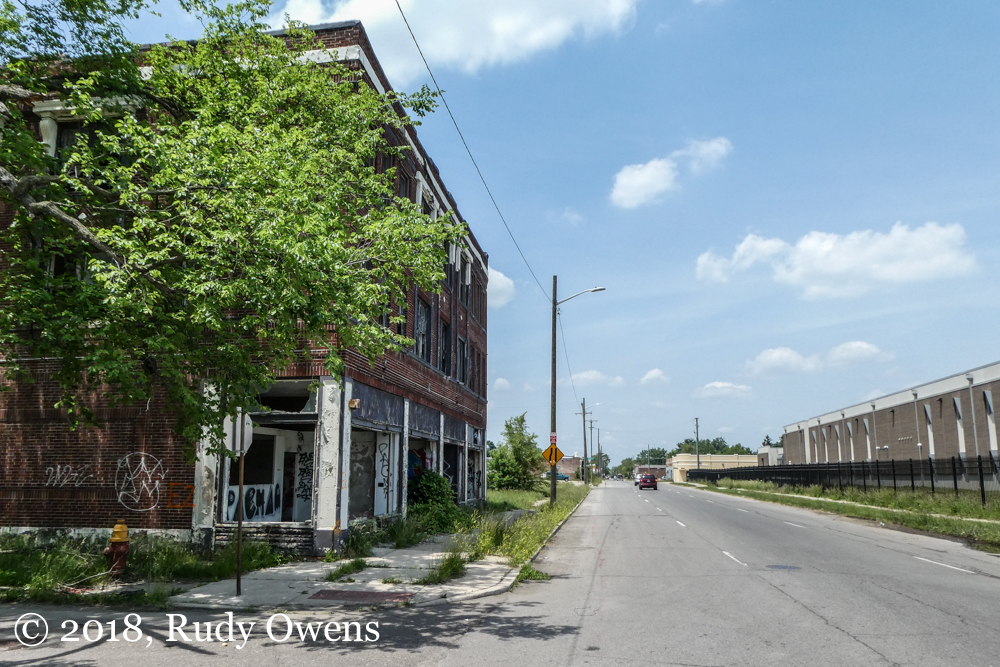
The building is now torn down. In its place is a large, boxy utilitarian set of buildings housing the Detroit Jobs Center and a nursing home, all surrounded by a gated steel fence. There is no plaque mentioning the hospital, how long it operated, and who it served. The surrounding area, just west of the John Lodge Freeway and at the intersections of Rosa Parks Boulevard and Tuxedo Street, is severely distressed.
Decay was visible everywhere near the old Crittenton General Hospital site, off of Rose Parks Boulevard.
Multiple houses a half a block from the old hospital site were in various states of collapsing. On Rosa Parks, by the rear entrance to the jobs center, a two-story apartment was slowly falling down—and no doubt would be destroyed one day or, sadly, torched by an arsonist.
The former Crittenton Maternity Home on Woodrow Wilson is now the home of Cass Community Social Services. The former home used to house single mothers before they gave birth next door at the former Crittenton General Hospital, from the the 1950s through the 1970s.
The former Crittenton Maternity Home, in a three-story brick building next to the old hospital site, is still standing. It is now run by Cass Community Social Services. I saw a young and I’m sure poor mother with her child entering the building. I realized how the story of single mothers continues today, but with different issues and without the full-throated promotion of adoption by nearly all major groups involved in social work and the care of children. I took some photos of the home and then went to the hospital site.
I took out my sign that I had quickly made in my car using a fat Sharpie. It simply said: “I was born here.”
I took multiple pictures, on a hot, muggy, and sunny day, but I could not manage a smile. I could not make light of my origins at this place, where so many mothers said goodbye, forever, to their children. It is not a happy story.
Rudy Owens at the site of the former Crittenton General Hospital, where he was born and relinquished into foster care in the mid-1960s, and then adopted at five and a half weeks after his birth.
Despite my stern appearance, I felt a sense of elation to have finally returned to my place of origin. It felt like closure. I accomplished what I set out to do decades earlier, for myself and on behalf of other adoptees denied knowledge of who they were and where they came from.
This time, I had controlled the story. This time, I was telling that to the world with my newly published book and public conversations that had been connecting with readers. This time, I owned the moment, unlike the one when I arrived as a nearly underweight baby, heading into the U.S. adoption system in Michigan and a new family.
And no one, not the state of Michigan or the groups who determined my life because of my status as an illegitimate child, could ever take that from me.
Yeah, it was worth it. That selfie and throwaway sign were my Trajan’s Column, as glorious as anything ever built by a conquering Roman emperor. The adoptee hero, as I frequently describe all adoptees searching for their past, had returned victorious to Rome (Detroit), even if there were no crowds throwing garlands upon me and no one to write poetry celebrating that victory. I had written that story already.
Sun Tzu, the brilliant Chinese strategist, reportedly born in 554 BC, should be studied and read by every adoptee in the United States who is denied equal treatment under the law and their original birth records. His classic treatise, The Art of War, remainsone of the most frequently studied, quoted, and referenced tools in human civilization for anyone who engages in advocacy and, yes, war.
Everything is there for the adoptee or birth parent seeking his/her records and past and for advocacy groups seeking reform and justice from a system that denies basic justice and equality to millions.
For adoptees who are plagued by insecurity, doubt, and depression about the injustice of discriminatory state adoption laws and historic and unspoken prejudice against illegitimately born people like adoptees, I first recommend drawing from your wisdom and discipline you have gained from your experience. Finding wisdom in books will be meaningless unless you can first put that knowledge into a perspective you have lived yourself.
So Why Sun Tzu and an Ancient Text?
My tweet to adoptees on preparing for long campaigns for equal rights: read Sun Tzu.
Most adoptees will learn that their path to wisdom and later action will eventually require discipline, awareness of one’s adversaries, and adapting successfully from tough experience. Luckily, Sun Tzu provides one of the easiest to access toolkits to guide you as you embark on your journey that only you can make.
If your mind is open to new ideas, Sun Tzu’s timeless observations and tactics allow anyone to become an irresistible force. As Sun Tzu says, “Being unconquerable lies with yourself.”
In my case, I embraced many of these strategies to overcome the country’s discriminatory adoption system and achieve a measure of justice and wisdom, which I describe in my book on my adoption experience. Sun Tzu correctly notes, “If you know the enemy and know yourself, your victory will not stand in doubt; if you know Heaven and know Earth, you may make your victory complete.”
The film character Jason Bourne has staked out a unique place in cinematic history as an anti-hero on a hero’s quest. The essential conflict surrounds a man searching for his past, who will stop at nothing to find out who he is and how he became that way.
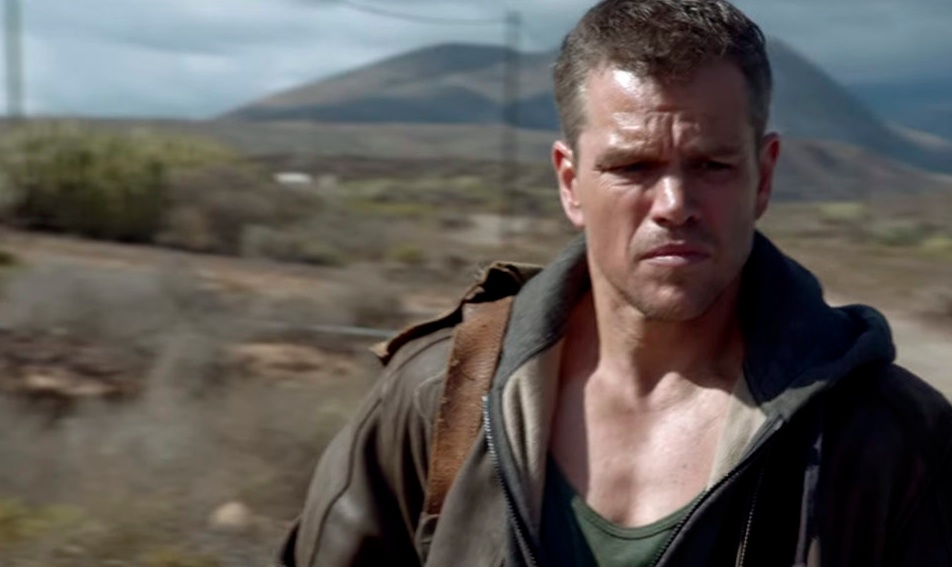
Jason Bourne, a man on a mission, to find out who he is–something most adoptees share.
For most viewers, Bourne is an uber-sexy and straight-up action hero, who can improvise killing with a ball-point pen, dirty towel, magazine, toaster, and shoelace. For anyone who is an adoptee, who has spent a life wanting to know who they are and where they came from, they will see this rogue agent with amnesia as a different story, about a person intensely wanting to know one’s self. They likely see Bourne’s narrative as their own.
His very name, which means outer limit in old English, also plays on the word’s other usage, as a verb, meaning coming into life from the womb. He’s a man who is literally born anew, without knowing where he comes from.
Bourne’s many opponents, in the dark world of secret U.S. government black ops programs and intelligence, are part of a vast system that works relentlessly to stop and kill him and those he loves. They had recruited him, brainwashed him, trained him, turned him loose to kill, and now need to terminate him to ensure their own personal survival.
Jason Bourne escapes again on his journey of self-knowledge and discovery.
The right anti-hero for a morally ambiguous world
At one level, this is a perfect story for our complicated times of secret rendition and torture, bulk data collection, and little-publicized military and intelligence operations. During the years Matt Damon’s Bourne emerged on the screen in 2002 in The Bourne Identity, the United States was involved in two official wars following 9-11 and supported other military ventures in Africa and the Mideast. The films emerged while U.S. national intelligence services widely expanded data collection programs on ordinary citizens and real and perceived enemies of the state.
The Bourne Supremacy followed in 2004, ramping up the fight choreography and exotic locations where Bourne battles his enemies. The last Jason Bourne franchise film, The Bourne Ultimatum, released in 2007, presciently predicted the later revelations of 2013 by former CIA employee and government contractor Edward Snowden. Real programs like the CIA-run Prism eerily resembled the fictional Treadstone and Blackbriar programs that our hero Bourne was once a member of in the first three Bourne films.
Like many fans of the Bourne series, I and others secretly cheer our hero as he gathers information through clues captured with surveillance gear, deception, impersonations, odd alliances, and direct confrontations with his nemeses. All Bourne wants to know is, who he is and how did he become the killer who can tear apart a U.S. embassy in Geneva as if it were second nature? How and why did he have to kill people deemed to be threats by his handlers?
Throughout the chases, escapes, explosions, and close-quarter death fights, our hero Bourne is constantly looking for answers. He has PTSD-like flashbacks, and tries to figure out his past dashing from Geneva to Paris, from Naples to Berlin. Why would he keep risking his life seeking answers?
The real motive is archetypal and older than Oedipus Rex
The motive is archetypal. Bourne is acting out a natural desire. It is the drive that is the most innate in humans—a quest of self-discovery. This is precisely the yearning every adoptee has. I would argue that the intensity of this desire for any adoptee is as strong as anything we see in the onscreen Bourne. It has a type of intensity that unsettles those who do not relate to this story in a personal way.
For those in the United States lucky to be born when original birth records were once again made accessible, this quest is much simpler than Bourne’s bloody odyssey. But for adoptees who were born in states where their original birth records are still closed, such as Michigan for adoptees who are my age range, they are more like Bourne on his now 14-year journey—denied answers, obstructed at every turn.
Unlike Bourne, adoptees are not trained in combat, subterfuge, and intelligence. They can’t beat up social service managers and storm into offices to reclaim documents that are theirs, such as their original birth certificates. They are mostly on their own. They have to play ball in a legal reality that treats them as second-class citizens, with no chance to hack a safe that holds all of the secrets kept hidden from them.
The second film in the series, The Bourne Supremacy, concludes with Bourne confronting his murderous past and telling actress Oksana Akinshina’s Irena Neski character, the daughter of two Russian activists, that he killed them and that she should know what he did to her mother and father. It’s a scene worth sharing again:
Jason Bourne discovers he is a murderer, and confesses his crime with the daughter of a couple he killed on assignment–his Oedipus Rex moment of truth and catharsis.
Bourne: Does that mean a lot to you? Neski: It’s nothing. It’s just a picture. Bourne: No. It’s ’cause you don’t know how they died. Neski: I do. Bourne: No, you don’t. I would want to know. I would want to know that my … that my mother didn’t kill my father, that she didn’t kill herself. Neski: What? Bourne: It’s not what happened to your parents. I killed them. I killed them. It was my job. It was my first time. Your father was supposed to be alone. But then your mother … came out of nowhere, and I had to change my plan. Bourne: It changes things, that knowledge. Doesn’t it? When what you love gets taken from you, you wanna know the truth.
This is one of the most moving scenes of the entire series, reminiscent of classic Greek tragedy. It brings instantly to mind one of the most famous adoption narratives ever, Oedipus Rex. In the play by Sophocles, the audience learns that king Oedipus was orphaned as a child to escape his planned murder by his father, King Laius, all because prophecy foretold a terrible future of regicide by his son.
A baby Oedipus was later adopted by a shepherd, never knowing the truth about his past.
Oedipus eventually becomes king of Thebes after killing his then-unknown biological father, King Laius, on the road along the way and solving the riddle of the Sphinx. He is rewarded for defeating the Sphinx by being married to the dowager queen who is his biological mother, Jocasta. The plague that grips the land, we learn, is because of his abominations. But our hero pursues the truth to learn that he is both a murderous adoptee and someone who slept with his own mother—a very stern warning against the adoption from our Greek forebears. He blinds himself plunging a knife into his eyes, and then leaves the throne.
Bourne, unlike Oedipus, does not blind himself. He does, however, confront all three of the father figures in the first three films who failed, in succession, to have their rogue agent killed: Chris Cooper’s Alexander Conklin, Brian Cox’s Ward Abbot, and Bourne’s brainwasher—knocked off in the only Bourne film without Damon—Albert Finney’s Dr. Albert Kirsch. With each character, he chooses not to kill them. He acts more humanely than the “fathers” who wanted him murdered for his quest of discovery.
To put it mildly, the confrontations are cathartic in the truest Greek sense of the word. They bring to stormy conclusions the hidden secrets and the hero’s willingness to accept the consequences for the truth.
To succeed in your journey, you need to be resilient and ready for what you do not expect. Also, you can never just let it be, ever, like Jason Bourne, who comes back in July 2016.
Catharsis and its inevitability for anyone on this journey
For an adoptee who does find out who they are, and who are lucky enough to either meet their birth families and/or find their original birth documents, there will be catharsis.
There will be realizations that the fantasies about one’s past need to be thrown away. There may be realities of knowing who one truly comes from, good and bad. It could be both, but it could be far worse or better than imagined. These moments forever change the lives of the families who tried to keep the information secret, such as the fathers who impregnated and abandoned many single women, or the mothers, who realize that a past that brought so much turmoil must now be confronted.
This is not a place for anything but mythical, archetypal storytelling. It is good that the messenger is someone who is as resilient as Bourne.
I for one am very anxious to see how our hero, Bourne, resolves his journey in the fourth film, Jason Bourne. He will re-emerge from shadows and back into the light. Will he accept himself and find what he needs to know? All we know is that nothing will stop him. For that reason, I will be in the theater, cheering him on, knowing that the journey is worth the burden and obstacles.









 The Path to Wisdom