Bill Moyers’ death and finding divine inspiration in sharing ideas with Joseph Campbell

I just heard that Bill Moyers died. He was 91 years old and lived a meaningful life. RIP.

Moyer was a consummate media professional. He was an insightful interviewer and a profoundly insightful human.

I love Moyers’ interviews with Joseph Campbell called “The Power of Myth.” The two collaborated in the PBS TV series released in 1988, exploring what enduring myths tell us about our lives. There were six episodes: “The Hero’s Adventure,” “The Message of the Myth,” “The First Storytellers,” “Sacrifice and Bliss,” “Love and the Goddess,” and “Masks of Eternity.” According to PBS, “The Power of Myth” was one of the most popular TV series in the history of public television, and it continues to inspire new audiences today. Campbell, sadly, died a year before it was aired.

Bill Moyers interviewing Joseph Campbell for the acclaimed PBS series “The Power of Myth.”

The insights from those interviews had an enormous impact on my own life, as I saw how important myth is to the human experience, in the past and the present. Myth in fact defines my lifelong identity as a bastard and adoptee. The series was also one of the most impactful moments for me in the world of engaging ideas.

From his interviews with author Campbell, Moyers elicited truths that speak to me today in many profound ways. This includes my own recent and wonderful adventures finding my biological kin in Finland, a land of my ancestors and also great myths.

Campbell shared with Moyers: “If you do follow your bliss, you put yourself on a kind of track that has been there all the while, waiting for you, and the life you ought to be living is the one you’re living somehow, and when you can see it you begin to deal with people who are in your field of your bliss, and they open doors to you.”

When unexpected mishaps get you out of your routine

It is actually great to have even small things go wrong. It breaks up routine. It forces you to use your skills of tolerance and control.

I stumbled on this sign during the COVID-19 pandemic and it has along resonated with me.

Today, on a warm sunny day, I headed to swim at the community center. It was rush hour. It took me 30 minutes to get there. Then, when I arrived, I learned the pool was closed for lifeguard training. I’ve never had that happen. So back home I drove, and got stuck in the late evening traffic jam from the hills of Portland to my home. It was slow, and it’s a drag on nice nights.

I used to sit in this traffic jam daily for nearly two years, when I drove 100 miles a day (there and back) to Salem, usually in the car more than three hours total a day. It was brutal on me. It was also a very hard time when my mom was near death and I was running on fumes. At that moment tonight, I felt blessed. I was now working at home, I am pretty good with my job, and my mom’s suffering has long passed. Her journey had ended, and that was good.

I needed this reminder to be thankful of how far things have come from those days of little sleep and a lot of stress. Here’s a little thing I spotted near my home a few years ago. It rings true for me.

A year of living mythologically

Another year of my life gets ready to end. The clock will start anew to begin the exercise of measuring life’s passing by years. That means it is time to reflect on how I spent it, as my planet circled the sun and I counted away irretrievable minutes, hours, and days of being alive in the universe.

I felt a mythical pull to Finland last year, and found myself there twice in six months, completing a journey that started decades earlier.

Physically, I feel a bit older. That is a given.

However, the cumulative issues I have experienced and still feel in my back have sharpened my understanding of my mortality. I have been humbled, even as I respect every aspect about caring for myself. It is now more clear that my days of very good health could be over. I may now be entering a phase of manageable but slow decay. I’m still overall in great health. I run. I bike. I swim. I rollerski. I surf far less frequently, and cross-country ski even less often. But I can feel the reality of what “the slow glide out” now means. My best years, in terms of physical health, were in my 40s.

My mental health, however, has remarkably improved during the past five years, as I continue to appreciate what a purposeful mindset of “finding meaning” has brought to my daily life. The hardest challenges I have navigated the last two decades strengthened my ability to withstand the strongest storms. Maybe I have just accepted who I am, at last, and the wisdom of wiser predecessors who have offered ideas of living well. So despite many challenges, my outlook is very calm.

Awaiting the inevitable loss of family

I continue to plan for loss and death. Human myths have been doing this for all of us since we first collected our shared stories and passed them down orally. So this is nothing new, and because it’s not new, it should not be feared or avoided.

I have three family members who face very severe health challenges. Two are my biological kin and one is my adoptive sibling. The stress can gnaw at any moment, out of the blue. Yet I can do nothing to change what will inevitably come. That could be any day.

I took this shot in 2015 at the Detroit Institute of the Arts with one of my ill family members, who is nearing the end of their journey.

I fortunately have found my safe harbors in spaces that always serve me well: exercise, good food, a sense of gratitude for my own good fortune, being mindful of what is within my power to address, and deep knowledge of what I cannot change.

Feeling at peace with death is one of the oldest roles of myths for humanity, and I have found my place with its company this year even more. As Joseph Campbell, author of the Hero with a Thousand Faces, describes, death and death imagery are the very beginning of mythology. Campbell let all of us know that there is comfort knowing that what we all experience has been charted for millennia in myth: “So there’s a sense of death as not death somehow, that death is required for new fresh life.” 

In fact, it was the cumulative stresses surrounding the health and wellness of my surviving family that finally propelled me to visit one of my ancestral home countries of my biological mother, Finland. I felt what I can only call a mythical pull to go there.

Hearing the call of Finland

My planning started on an important day celebrating Finland’s great myth, called the Kalevala. On February 28, 2023, on Kalevala Day, I vowed to visit the Nordic nation that summer. What’s more, I would also seek out my biological family I could trace only as far back as my maternal grandmother and grandfather, who emigrated to the Upper Peninsula of Michigan in the early 1900s. There were no contacts between my Finnish-American biological family and their distal relatives in Finland since the 1950s.

Famous Finnish painter Akseli Gallen-Kallela’s study called “Kullervo Herding his Wild Flocks” (1917) is held in the collection of the Ateneum art museum in Helsinki, Finland.

I announced my idea publicly, to make it known I was taking a mythical journey: “And my new journey into my ancestral past has begun,” I wrote. “Where it ends now, I know not. Once the ship leaves its harbor of safety for parts unknown, the mind, heart, and soul breath in the fresh sea air that only is found by discovery. Finland.”

Everything about this idea was mythical. I could feel the tug, the way I did when I set out to find my birth mother and my biological families in the mid-1980s, completing the task in April 1989 in Ann Arbor, Michigan.

In fact, understanding myth and my adoption story gave me what I consider to be a tactical advantage compared to other adoptees who start their journeys for self-awareness far later in life. I was in a totally different place because I already had deep knowledge of myth’s meaning to the human experience because I read countless books on myths as a young person and learned the stories of the Bible in church every Sunday.

I knew intuitively why my impossible task had meaning and that I would succeed, like the “hero” celebrated in myths and tales across the time and all cultures. My memoir and study of the U.S. adoption experience explores interplay of myth and adoption in detail, where I describe why my experience closely resembled the “hero’s story.”

In this instance, I immediately recognized the myth dynamic in wanting to go back to a family origin location, in Finland.

That recognition propelled me forward with the power that can only be understood as mythical and by all the dynamic rules of a mythical story. It was familiar territory, and it completely energized me. I knew I was on a journey, which made it easier for me to throw myself completely headlong into this project. The myth played out almost effortlessly, with joy instead of sorrow.

I successfully found my long-lost Finnish relatives, thanks to blind good fortune of finding a benefactor named Satu, a professor who I contacted by email in the early summer 2023. (Even Satu’s role felt mythical, like the kindly stranger who intervenes to propel the hero forward on their journey to the unknown.)

In my long story about meeting my biological family, I describe how we first met by video calls and email and finally in person in Kurikka and Tampere, Finland, in September, 2023. Even before I met them, we knew that the meeting would be special for all of us.

I described in my story how one of my aunts told me how I resembled her adult kids. “I find same features on my sons’ and your faces,” she wrote to me. I also noted: “Later I learned that others in the family, including two daughters, said the same thing, completely separate from each other. When I compared a photo to the youngest son in the family with myself, and shared it with friends, everyone I sent them to were mostly stunned; some swore we could be brothers. All my friends mostly shared that the power of genetic similarities were both astonishing and cool.”

Embracing my Finnish mythical muse: Kullervo

I stumbled on the bronze statue of the famous mythical antihero Kullervo and his loyal friend and dog, Musti, my first morning in Helsinki, probably by fate.

On my first morning in Helsinki in September 2023, I went for a run. It was cloudy and rainy. I got lost. Almost by design, I regained my bearings near Toolonlahti, a bay in central Helsinki. I stopped my run the moment I saw a bronze sculpture of the Finnish antihero, Kullervo. The statue shows the famous mythical character, and his dog Musti, the moment before he kills himself with his own sword.  It stands peacefully in an outdoor rose garden in Kaupunginpuutarha park in Helsinki, but feels tense with foreboding. This was no accident. It was myth at play. I immediately shared the photos with my Finnish relatives, who told me it was Kullervo.

Kullervo is perhaps the most beloved character from the Kalevala by the Finnish people, despite a mostly short section in the epic myth relative to other heroes in it. Jean Sibelius wrote an entire musical score with a chorus telling his doomed and tragic story. As an infant, he was enslaved and orphaned, only to be tormented by the clan that destroyed his family. Despite abuses, he learns he has magic power, befriends a dog Musti, sleeps with his sister unknowingly (who kills herself), murders the man and clan that enslaved him, and finally kills himself in anguish.

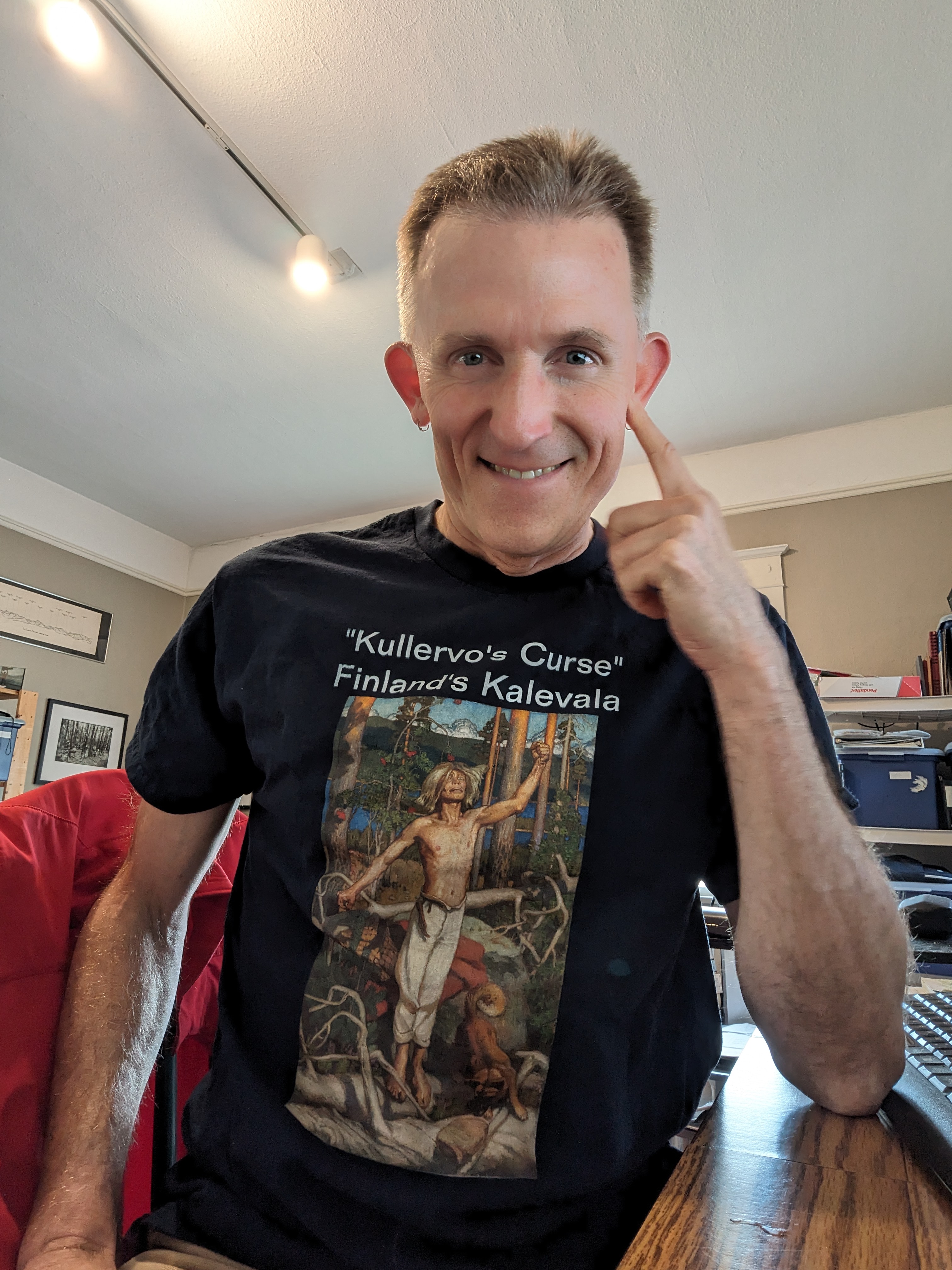
This is my favorite painting by the great Finnish artist Akseli Gallen-Kallela called “Kullervo’s Curse,” which I know proudly wear around town.

I made my T-shirt honoring Kullervo based on the painting by the great Finnish artist Akseli Gallen-Kallela, when I returned from Finland in February 2024. 

My latest trip to Finland in February 2024, visiting family again in Tampere and Kurikka, completed the mythic trip I had started in late September 2023. It offered fresh insights into a nation and its national identity and stories. The Kalevala, the national story, is part of this story the Finns tell themselves. It also gave me wonderful insights into my ethnic Finnish roots.

When I returned, I looked back at the year of impossible events. I did what I knew I would always do. I had visited my ancestral villages of my blood relatives. I found my relatives, with whom I shared a physical resemblance and a strong kin connection. I felt connected to my identity that was long hidden from me by laws in Michigan. All told, in one year,  I have written nearly 20 stories about my long journey back to my roots.

Without trying to write another book, I laid the foundations for one that arrived almost organically. I had no intention of writing any of these stories when the strange siren call to take the journey started. Yet it just happened, the way a myth naturally unfolds. My friend saw my new collection of essays and called me the “Finland Fanatic.”

What a perfect name for a book. What a perfect description of a mythical character, pulled by the power of the quest. My journey so far has been a happy one. Death of my family is still stalking my path forward. We shall see where it goes this coming year.

When serendipity is not just an accident

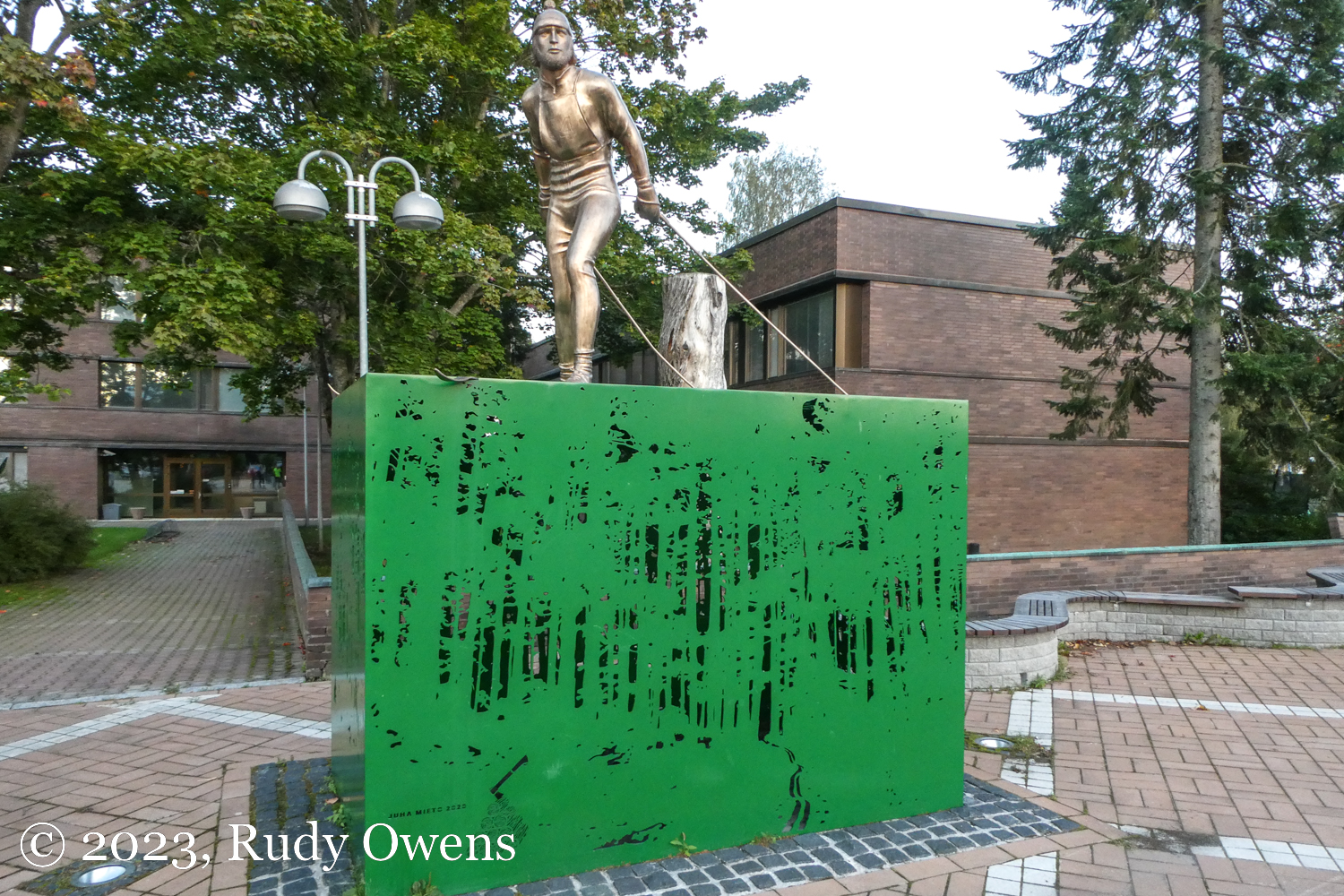
Olympic gold medalist and Finnish ski legend Juha Mieto is celebrated in his home city of Kurikka with this status in the city center.

In September 2023, I visited the 20,000-person community of Kurikka, Finland. Kurikka is the kind of place that will never go into any Finnish guidebook, but it’s where I had a lot of great moments in Finland for my first-ever visit to the Nordic nation.

At the center of the city I found this statue of a very famous Finnish skier, Juha Mieto. It turns out a completely unknown Finnish woman who connected me to my distant relatives in Finland this summer also has a connection to Kurikka and Mieto too, and I had no way of knowing that at the time I saw this statue.

Several months before I was standing in the Kurikka city center, I had been in touch with my “email friend” in Finland asking her for help. Our interaction was an entirely serendipitous human connection that tipped the scales of fate for me and had brought me to this very spot.

Today I learned she is a blood relative of this very famous Finnish national skier. The famous Mieto grabbed a gold medal a 1976 Winter Olympics in Lake Placid, New York, and also a silver medal, in the 1980 Winter Olympics in Innsbruck, Austria, finishing one one-hundredth of a second behind his Swedish rival, Thomas Wassberg.  

Kurikka is also the home city of Finnish relatives I found through my benefactor’s help.

When I visited one of my Finnish relatives in Kurikka in September 2023, I first saw this statue. I photographed it because it was distinct, but I didn’t fully appreciate who I was photographing at the time—a Finnish sports legend. I mentioned this visit in my story about my trip and seeing this statue. I shared the story with my benefactor as a late “thank you” gift to show how important her help was to me. And that’s when she mentioned her personal connection to Kurikka and the man turned into a bronze ski statue.

Talk about funny coincidences. Life is full of them. I have always found that the more you do things to go where your instincts are telling you to go, the more these things will happen. Perhaps good luck, my connection to friendly stranger, and maybe something more made all of this happen.

The famous Swiss psychiatrist Carl Jung created the term synchronicity to explain relationships between events that could not be explained by simple cause and effect logic.

Jung suggested that unique and synchronistic events had meaningful connections rooted in perceptions. He explained it this way: “I found where ‘coincidences’ which were connected so meaningfully that their ‘chance’ concurrence would represent a degree of improbability that would have to be expressed by an astronomical figure.”

I have long thought that synchronicity can be harnessed, especially when I felt it working in wonderous ways for me. I fortunately could tap into that for my trip to Finland.

I would not say that I’m “extraordinary.” I’m just me. And I felt synchronicity the entire time I was planning my trip and then having one of the most rewarding times of my life.

I also have a bit of advice. Trust the siren when you hear it. It calls for a reason.

Planning for the inevitable is not a fearful thing

My mother’s misfortune of developing Alzheimer’s still shapes my way of navigating the world. She endured the horrible disease for more than seven years, before finally dying, with little left of her cognitive functions.

Roman artwork Memento Mori, in the Naples National Archaeological Museum

To deal with the illness as a family member, I had to readjust my way of navigating the world. I had to deal with stress. I had to deal with family conflict. I had to deal with helping someone who could never be cured.

Most of all I had to practice what philosophers did more than 2,000 ago, meditate on one’s mortality, or memento mori.

Death, as the ultimate end of my mother’s condition, became relentless as a nagging thought. I had to think about it because it was the way her suffering would end. This is simply an honest reflection, because that is what Alzheimer’s was truly like. It was worse for my step-father, who was her dutiful and loving caregiver.

However, practicing memento mori was not a scary thing. It was and remains a pragmatic thing, as all human life ends, and avoiding thoughts about this is folly. All of us will die, regardless of our station in life or our deepest fears about the end.

Because of this knowledge, I continue to tidy up my plans. I have attended to my probate planning instead of putting off the boring but critical details.

I also realize that by living alone, I am at much greater risk of misfortune, mostly because no one will care for me. This is also a byproduct of being adopted, which is a related and complex story.

So I have started making plans for logical “what if” possibilities.

What if I am hit by a bus? What if I have a bike accident that goes tragically wrong if I am struck by a car? What if I get a serious illness that arrives suddenly?

Too many things have happened in my immediate world of family and friends lately to forestall such thinking and planning.

Tonight I took another small but practical step. In my apartment, I hung a very visible sheet of paper on a wall that could be seen and found in the event of an emergency. It is my cheat sheet who to contact if I am not there and there is a need to reach my emergency contacts. It is a small thing, but it was both easy to and logical. I will add this to my wallet too. And why not?

My mom and step-father had a similar list on their refrigerator door for years as she was sliding to her end. I know hundreds of thousands of others may have done the same thing. They are like the paintings Romans made of skulls and skeletons, reminding all of us our end will eventually come.

Remember, mankind is our business

Nearly every year I catch a live or filmed version of A Christmas Carol by Charles Dickens.

With COVID-19 still a threat globally and the Omicron variant still the dominant strain in Oregon and the country, I will forego my normal Christmastime pilgrimage to the theater for a live show. I will miss it, because at these live shows of this timeless story, I am in the company of theatergoers who share in the many profoundly humanistic themes of this masterwork of literature.

There are too many scenes and themes to call out that speak to our common humanity, particularly this time of year, when we are asked to think of others less fortunate.

Patrick Stewart plays Ebenezer Scrooge in my favorite adaptation of A Christmas Carol, from 1999.

One of my favorites scenes is when the ghost of Jacob Marley visits the still hard-nosed and taciturn Ebenezer Scrooge to give him a chance to save his soul, while he is among the living. The ghostly apparition of his former friend and business partner warns of the three spirits who will visit him on Christmas Eve.

Marley’s ghost also reminds Scrooge of our purpose in life, to be of service to others.

“But you were always a good man of business, Jacob,” faltered Scrooge, who now began to apply this to himself.
“Business!” cried the Ghost, wringing its hands again. “Mankind was my business. The common welfare was my business; charity, mercy, forbearance, and benevolence, were, all, my business. The dealings of my trade were but a drop of water in the comprehensive ocean of my business!”

The chills that one feels at a sprit giving us a chance for redemption never grow old for me. For me, this scene is among the best ever written telling us that we do in life, day in and day out, matters. The encouragement, spoken with the grim knowledge of death and the afterworld, reminds us all why our work matters in the here and now.

So with that holiday message, remember the importance of our “real business” in life, particularly this time of year.

The most expensive and fortunate car mishap of my life

A little more than a year ago, I experienced the most expensive car problem of my life. The final bill added up to more than $6,000, including towing charges.

Let’s not forget the several hundred more dollars in car rental fees and being without my car for nearly two weeks when I needed it for my job commuting 100 miles a day to and from my home to work.

The event happened in a blink of an eye, on one of the hottest days of the years, as I was about 15 miles into the return leg of my 50-mile commute back from my job in Salem, Oregon, to my home in Portland.

I never saw it coming. I just happened, though in retrospect, I long knew it would.

Hurtling down the highway at 65 mph in about 95 F heat in the late afternoon, the engine in my slightly aging Subaru Forester literally blew out.

The failure arrived without warning as I saw my dashboard gauges tell me the engine had failed. I quickly checked my surroundings and luckily found myself in a spot without vehicles or reckless semis around me. I coasted calmly to a stop on a safe spot on the Interstate 5 shoulder, next to a farm field and a tree.

In my mind I immediately recognized the unfolding event as a test my character and ability to handle bad luck even before I had put on the parking brake.

How would I choose to respond, I found myself thinking? Would I yell and curse? No. In fact, I immediately realized this was a profoundly fortunate moment.

Amor fati: embacing your fate

I was uninjured, and this happened at a safe place instead of a dangerous one. My car, an inanimate thing, was reparable. I was alive. I realized this could have happened anywhere at many more dangerous locations, and I could have been severely harmed. I smiled.

As for the car, I had no idea what had happened to the engine. The radiator was shot, but I didn’t know how badly the engine block may have been warped. Indeed, the mechanic later told me the block was destroyed, and I faced a decision to scrap the car for parts or install a new engine.

I got a tow after waiting more than an hour from a junkyard tow driver who proved highly knowledgeable about subjects we could freely discuss only as one can with a complete stranger in a strange place. The next day I got my second tow to a shop, where I faced the costly repair decisions.

Within 48 hours I had rented a car for a week, made the decision to replace my engine block, and worked out a plan with my manager to work at home. It was not really as serious as one might have thought it could be.

Ultimately, my life didn’t fall apart despite really bad luck, if you want to call it that.

The experience showed me the joy of not commuting a few days in a row. It confirmed I could not keep doing the job I was doing. In fact, the whole incident confirmed what I knew would happen, that my car would fail doing something that could not be sustained professionally and for my personal health. The job had to go or my health would.

Now, a year later, I have quit that job, I work at home, and I drive the car about once a week. I think it was a clear message from the heavens what to do.

Most importantly, I confirmed a lesson I long knew, as only experience can teach. I again found that bad luck could be the greatest of teachers.

Without bad luck, we can be foolishly tricked into deceiving ourselves that good luck is more desirable. In fact, good luck and the absence of bad luck can easily delude a person into lazy complacency  and being unready for when things change. And they always do. There is always a change in the wind, and those who deal with change have dealt with its fickle nature before. Luckily, I was ready and will not forget the lessons I learned last summer.

Reminiscing on my violent, alcoholic father

It has been more than 35 years since my adoptive father died of health complications that followed years of destructive behavior and a losing battle with alcoholism.

Though he has long been buried in a cemetery plot in the Cleveland suburb of Rocky River, Ohio, next to his father and mother, his impact on my life and my family lived on long after he passed away.

Even today, I frequently am forced to confront my long-buried memories of this often violent yet aextremely intelligent man who was an ordained Lutheran minister.

A shot taken with my adoptive father and sister in our home.

For the last seven years, when my adoptive mom was on her long and difficult journey with Alzheimer’s disease, my adoptive father’s memory frequently came up in our conversations. When I visited her in her home in University City, Missouri, flying out from my home cities of Seattle and then Portland, we spent endless hours talking about the past and her memories that grew dimmer over time. She could recall snippets of her past life and share them with me. She frequently repeated ideas or hazy recollections. She repeated two things more than any other during these seven years.

First, she told me, I have the greatest husband in the whole world. She was referencing her current husband and full-time caregiver, my stepfather, who cared for right up until her final day. Second, she told me, my first husband used to beat me. That was a reference to my adoptive father and her first husband, from the summer of 1958 through their divorce in the summer of 1973. During that time they lived in Detroit, moved briefly to Boston in late 1965 and 1966, and then moved to the metro St. Louis area, where my mom lived out the rest of her life.

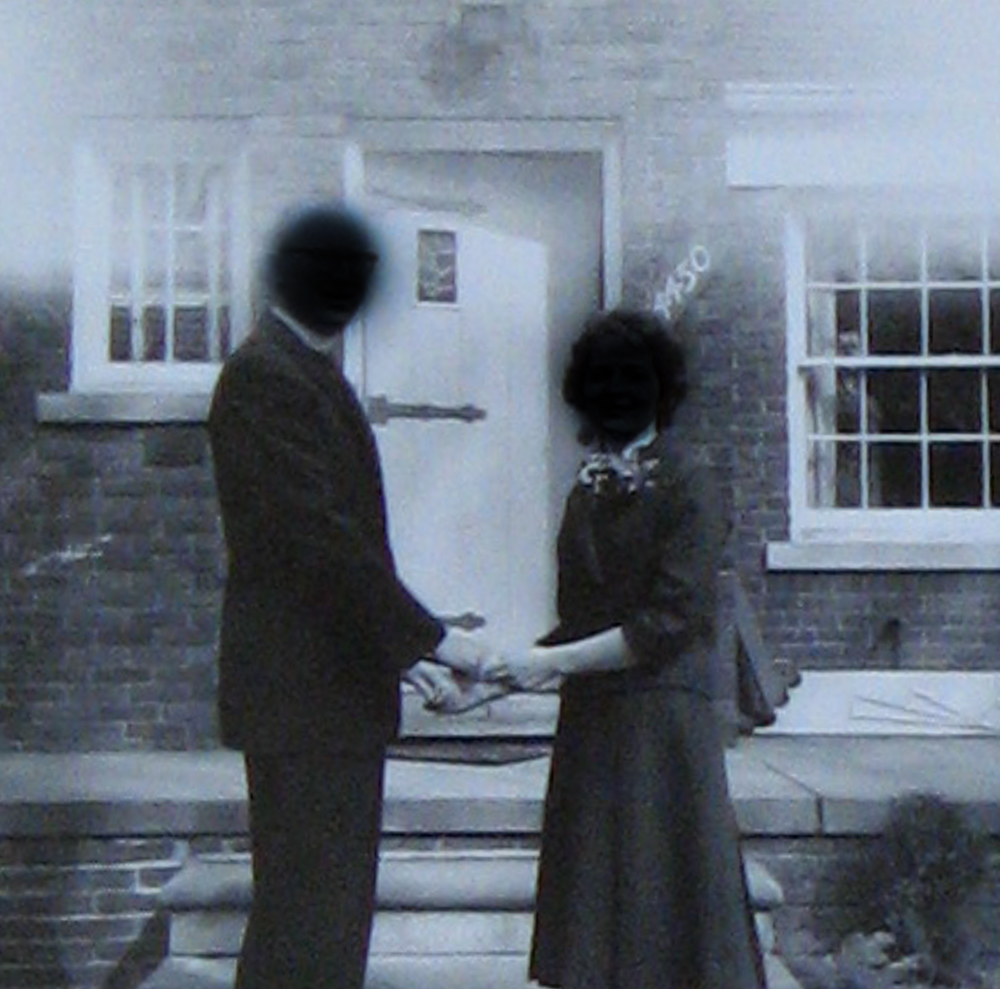
My adoptive parents in front of their west Detroit home, likely in the late 1950s or early 1960s.

When my mom’s memory was sharper in the early years of her Alzheimer’s, she repeated constantly how often my adoptive father would hit her. She said the doctors told her the violence could have contributed to her awful and prolonged brain-wasting disease. I can still remember those incidents as if they happened hours ago. I too can never forget them.

I would always reply during these countless recollections that, yes, mom, your husband—my stepfather—was the best husband in the world. I would say nothing about her comments on her years of domestic abuse at the hands of my adoptive father—her former husband. These conversations continued until the second-to-last time I saw her alive, in September 2019.

In the end, my adoptive mom had two distinct memories, one of violence and one of love, which she likely had little control over because of her deteriorated state from Alzheimer’s.

Making Sense of my Adoptive Father

Though my life with my adoptive father in a nuclear family lasted eight years, I spent another five more visiting him, first in the St. Louis area and then in the Huntington, West Virginia and Chesapeake, Ohio metro area, where he resettled after the divorce.

Those trips with my adoptive sister to stay with him several times a year, as part of the divorce custodial settlement, were as bad if not worse than the times when we lived as a family under one roof.

I tried to reconstruct those years from memory starting about five years ago, as I began to write my memoir as an adoptee. I remember the day I wrote out the first outline to my memoir on a hot July day on a river beach. I then started with a chapter exploring my childhood and younger years with my adoptive father.

I wrote that chapter first. It proved to the hardest one to do because I had to dredge up memories that were neatly buried.

I also needed to revisit the places of my childhood and youth, in Huntington and Chesapeake, letting me remember things I had forgotten, perhaps as a way to carry on with life. I took a road trip there in September 2015.
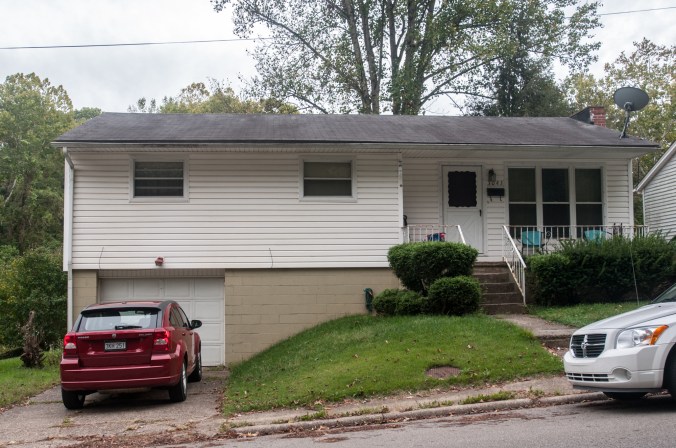
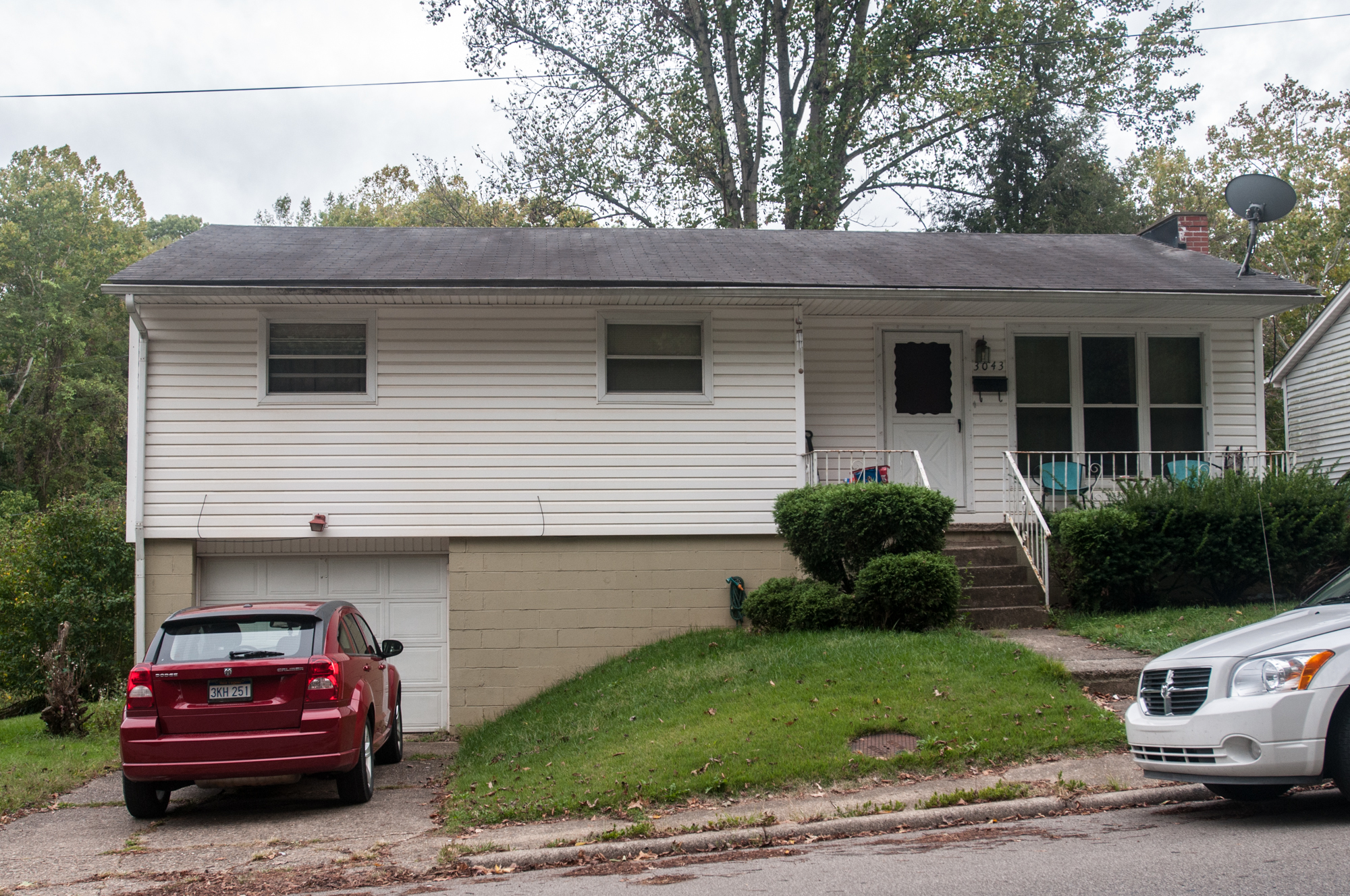
My adoptive father lived for several years in this house, owned by the next door Lutheran church, where her served as a minister in the 1970s.

I published an essay on that trip on one of my blogs. I wrote about my childhood trips to see him: “I had no choice in the matter. I had to go there. I had to visit my father. It was bad to awful, and sometimes downright terrible. But when you are young, you are flexible and stronger than you think. You actually can do impossible things, and still come out at the end of the tunnel with a smile. I did. Despite the odds, I really did.”

When I finished the revised text to my memoir in late 2017, I left my first chapter on my adoptive father out. That decision came easily. I decided it was too personal about a relation that shaped my life. No one else would understand that journey but me. By that time in my life, into my fifth decade, I also realized I had become more like the generations who preceded me, who were reserved, not someone who wanted to “tell all.”

I also had come to a deeper realization about living life and finding meaning. I was able to see my unpleasant times with my adoptive father through a completely different perspective, shaped by my life and the knowledge I had gained from life.

Rudy Owens’ memoir on his experience as an adoptee and on the U.S. adoption system.

I described my later life’s wisdom in the introduction to my book, which I published in May 2018: “My adoptive father, a Lutheran minister, was abusive and an alcoholic. He had a serious drinking problem before I was even placed in his and my adoptive family’s middle-class, two-story brick home in metro Detroit. He treated my adoptive mother, my adoptive sister, and me very poorly. At times, when he was drunk, he could have killed my sister and me on more than a dozen occasions—when he would drive us in a total stupor. My adoptive family’s struggles were not pleasant, but they are also things no one could have predicted, and their meaning and purpose may still not even be clear to me. However, the way I confronted these challenges was uniquely my own, and I own how I addressed my reality and the conditions of my life. No one else is responsible for that.”

The Impact of Living through Domestic Violence Never Goes Away

As I continue to reflect on my life, I remain honest that the impacts of my adoptive father’s actions never fully disappeared. I see that most clearly when I read and learn about how domestic violence impacted others in their youth and their eventual journeys in life.

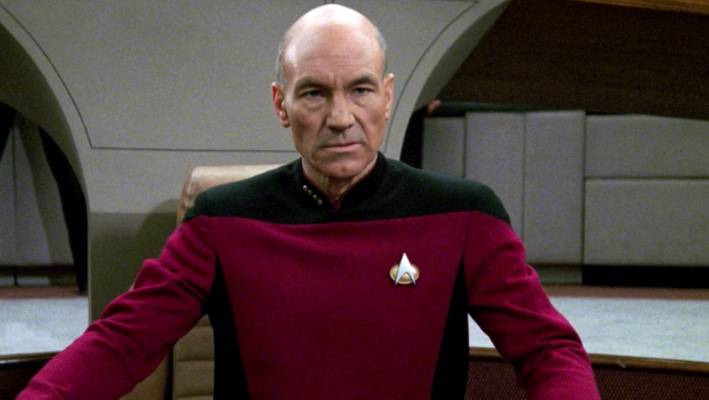
Patrick Stewart in his role as Captain Jean-Luc Picard on the Star Trek: The Next Generation TV series and film franchise.

I only recently learned that the fine British actor Patrick Stewart, known to the world as Captain Jean-Luc Picard of the Star Trek: The Next Generation TV series, also grew up in a home marred by domestic violence. I had always felt something raw when watching Stewart’s performances, as Picard, as Ebenezer Scrooge in his version of A Christmas Carol, and his lesser and earlier roles in films like Excalibur. He always had bursts of rage that felt like a smothering volcano, but controlled just barely.

By accident this month, I found his essay published in November 2009, in The Guardian (Patrick Stewart: the legacy of domestic violence). In it, he laid bare what he and his mother experienced at the rough hands of his World War II hero and domestic-abuser father. He wrote in the bluntest of terms how his father badly beat his mother, especially when he was drunk. He described the terror of living under the shadow of a violent person, who put their lives at risk.

“Violence is a choice a man makes and he alone is responsible for it,” Stewart wrote. “No one came to help. No adult stepped in and took charge. I needed someone else to take over and tell me everything was going to be all right and that it wasn’t my fault. I wanted the anger to go away and, while it stayed, I felt responsible. The sense of guilt and loneliness provoked by domestic violence is tainting—and lasting.”

Everything Stewart described echoed eerily what I had written in 2016, without ever reading Stewart’s essay, penned six years earlier.

In the section of my book I deleted, I wrote: “In those frequent drunken conditions, the ordinary looking man could transform into frightening malevolence, and you never quite knew how he would erupt. The well-worn expression walking on eggshells is actually a perfect match for what my mom, sister, and I faced for years around him.”

I also described the ravaging effects of alcohol, which I internalize to this day, as a survival mechanism. “In those intoxicated moments, my father’s ordinary appearance would be transformed by alcohol. His speech would slur. His left eye would slant behind his glasses. It was the mark an alcoholic I learned to spot instantaneously in others the rest of my life—one of the weird outcomes of growing up around someone with this affliction. To this day I can spot a problem drinkers with Spiderman-like quickness, usually in the first five seconds of meeting them. And my self-defense response kicks into a state of hyper readiness, just in case.”

On some days, like ones I have had this month, I revisit my life’s decisions that still leave sorrow, including my decisions to live a life that eschewed anything resembling domestic normality and middle-class happiness. I still associate these with my adoptive family and father.

Like all of us, we have to confront ourselves and decisions. There are days it is hard, when I might see families that appear “normal,” and I can observe a father who acts compassionately around others without toxic masculinity or the effects of alcohol. On those off days, these apparently normal activities allow me to play “what if” games in my mind.

In the end, I let those thoughts go, because I own this path and my thoughts entirely.

In the chapter I cut from my memoir, I concluded with a meditation on restorative justice. I described how embracing forgiveness means letting go of the power the offense and the offender over a person. It means no longer letting the offender and their actions control you anymore. Without this act of healing, the wound can fester and can control one’s actions indefinitely.

Like Stewart, I cannot entirely let go of the memories of a violent man who failed as a father. But I have found a path to becoming a better person and the person I wanted to be. I never followed in my adoptive father’s footsteps. For that I take credit. I accomplished more than I knew I ever would.

A Chance Meeting with Ike

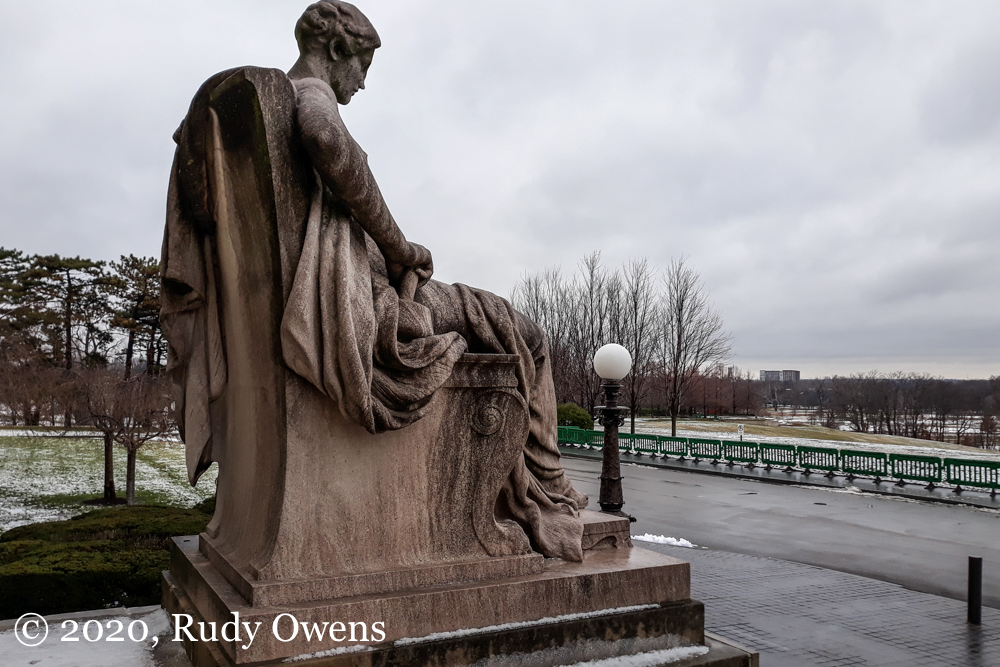
Every one of us has a mother, and that can bring together strangers. (Sculpture in front of the St. Louis Art Museum, taken three weeks before my mother died in early February 2020.)

In mid-February, I flew across the country from Portland to St. Louis. My trip came suddenly, but not as a surprise. After more than seven years of battling Alzheimer’s my mother finally passed away.

My plan was to write a eulogy on the long flight I would have from Seattle to St. Louis, the second leg of my journey. My tale was meant to focus on young woman, who was raised in a scrappy New Jersey town just outside of New York City.

That’s what I thought at least.

I ended up writing two stories. One I published after I returned. The other I put aside. It was a story I never intended to have, but had to be told. I finally am telling it now, at the end of May 2020, in the middle of a pandemic and protests occurring nationally in the United State against racial injustice and much, much more.

Perhaps by fate, I think my mom decided to play a funny trick on me on the way for me say goodbye. The experience allowed me to recall her wisdom and share it with a stranger.

On that trip, a stranger crossed my path. However, it was up to me to do something with this opportunity and make sense of it. My mom’s passing gave me a window.

Wakanda PatchOn the escalator coming out of the Airport shuttle tram at SeaTac, Seattle’s international airport, I spotted a large African-American man in a red and black checkered shirt. He must have weighed 225 pounds. He stood about 6’2” and had a massive chest and arms for linebacker.

I didn’t really think about him until I spotted two items pinned to his backpack.

One said, “Wakanda is not a shithole country.” The other was a medallion with the Latin words “Memento Mori,” or remember that death comes to all. During the period of the Roman Empire, the phrase would be whispered in a mighty Roman emperor’s ears by a slave as he entered Rome. It reminded a mighty emperor of his mortality and that he, the mightiest person in the world, faced the same ultimate fate as slave behind him.

When I read the Memento Mori medallion, I decided I had to introduce myself. I recently had found myself drawn to Stoic ideas, from ancient Greece and Rome, which are embodied in the words carved on that medallion.

I said, “Hi. I’m Rudy.” He replied simply, “Ike.”

I asked about his backpack decorations. We laughed about Wakanda.

I told him I recognized the Stoic medallion, and he said, yes, it’s sold by Ryan Holiday. Not by coincidence, we both followed and liked Holiday’s blog called The Daily Stoic. Both of us obviously found something in these ideas that connected with us.

I could hear a West African accent in his voice and asked about his background.

Soon I learned Ike originally hailed from Nigeria, the son of political refugee parents. He told me his mother arrived in Boston with just the shirt on her back and four kids while his father rotted in a jail back home.

I then discovered we were on the same flight. He was on a business trip from Seattle to St. Louis.

I told him about my family, being raised in a family of three with a single mom in St. Louis. I said I was flying to St. Louis to attend the funeral of my mother.

Ike commented how important funerals were in Nigeria for the Igbo, Yoruba, and Hausa-Fulani ethnic groups. Ike called them festive occasions where the life of a person was remembered as a joyful thing.

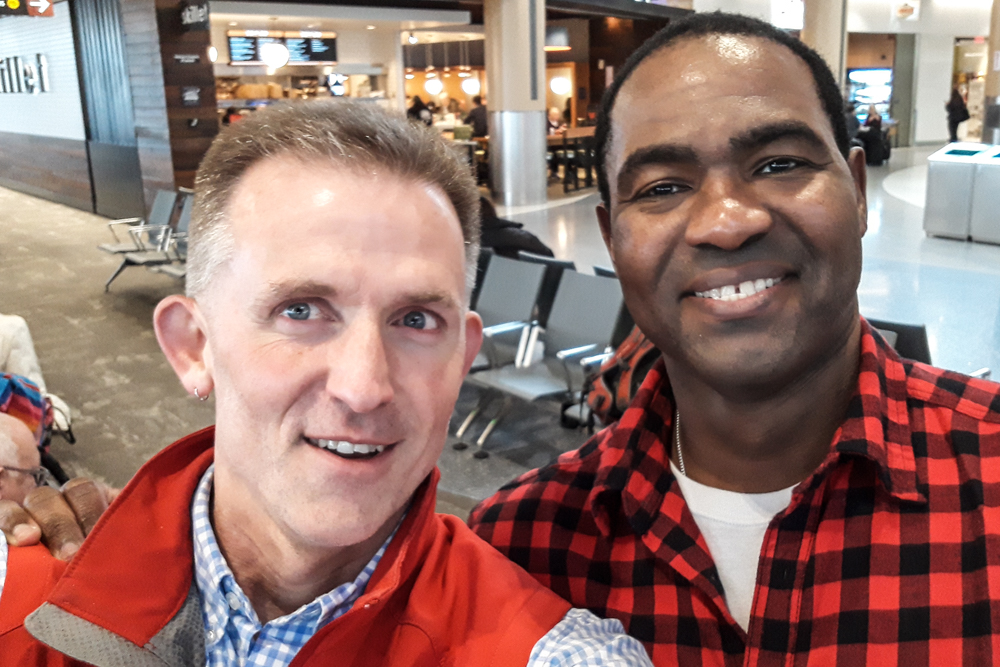
Rudy and Ike

Rudy and Ike, connecting over mothers, death, funerals, and remembrance during a chance meeting at SeaTac in mid-February 2020. It is sad knowing we can’t enjoy the friendly embrace of strangers anymore for a long time amid the pandemic.

He said as a child, he wasn’t afraid of death because funerals were always so fun. Only later did he learn of the sadness that also accompanies the loss of a loved one. But first he learned that death was not a thing to fear and that it was a part of life.

Somehow we began to talk about how our mothers raised us and what life skills they taught us. Ike said his mom, and dad, always taught him he had to fight, because nothing in life came without some sort of struggle.

He said they never spoiled him or pampered him or over-parented him. If he was hurt, without requiring a hospital visit, he was expected to overcome his circumstance, because he if wasn’t gravely injured, he would be OK. He said it was the right thing to teach him, and he later understood the importance of this teaching. It helped to make him successful.

I said my mom was the same way. She understood good luck and bad luck. Like everyone, she had her share of both, and maybe in stronger doses that she deserved at times. I said, she could handle a strong wind and not snap. She would bend back. I said she had raised me not to be blown down during storms, even if I wasn’t aware of this when it was happening. Like her, I had to learn on my own to let storms pass and then come back up, stronger. Maybe I was more successful at this than she bargained for.

I also talked about my mom’s battle with Alzheimer’s and how it had given me a chance to learn about things that frighten us all—our mortality and death. By the end of this journey, watching this illness take my mom, I had grown. I had become less afraid of the end that awaits us all (“Memento Mori”). I simply did what I could do for my mom, mostly in a way that worked.

I told him that in the end, my mom always had an ability to see goodness. She could find something good amid something terrible, including her illness. Though she despised it, and would rightly say, “I hate this. I can’t stand this.” She also said one line all the time, right up to the end. “I have the nicest husband in the whole world, “ she would tell me, again, and again, and again, and again. I must have heard this hundreds of times in the past seven years.

It was one of the last things she told me on the phone, the last time we had a conversation during the Thanksgiving 2019 holiday. I remember replying to her the way I always did, with utmost sincerity: “Yeah mom, you do. He’s a great husband.”

I reality, my mom had said this for all 37 years of her marriage. She was speaking a truth about what the second half of her life was like with her best friend and husband.

“I got so lucky,” she might add. “Yes, mom,” I’d reply. “You got real lucky indeed.”

At that moment, in telling Ike my mom’s story, I started to feel my eyes water up and looked away. Here I was, crying to a man I had never met, telling him about the passing of my mother. He gave me a hug. “It’s OK, man. It’s part of the journey of life.”

Ike and I took a selfie and I gave him my card. I don’t know if I will see him again. He lives in Seattle with his wife. He’s not even sure how much time he has, having just had a heart attack on Jan. 18. He told me it was almost a blessing, because it reminded him of how precious life is and how important his wife and health are.

I think my mom would have loved to meet Ike. She could have easily found herself talking to him, like I saw her do countless times before whenever we travelled, or went to the Missouri Botanical Gardens, or the St. Louis Art Museum, or on a holiday. She was always warm and welcoming with strangers, of any race or background—always eager to hear about their lives and talk about their families and especially their kids.

In some ways, I felt my mom somehow played a serendipitous role that crossed my path with Ike’s, and therefore my mom’s story with his mom’s story, and the story all of us have with our mothers and the lessons they teach us, so we can pass them on to others, the way all people do, in the USA, Nigeria, or any other place.

Yes, maybe there was a reason I would be in an airport tram on that very day, at that very hour, at that very second, with an imposing looking man next to me, who just happened to have a reminder that captured the wisdom of a long journey my mom just completed. In some ways I felt that was her reaching from beyond through a stranger letting me it would be OK.

Remember to always get up and welcome a stranger into your life, I think she’d say. It was something her long and abiding Christian faith had given her until the very end.

Letting go of the living

During the last six years, I have been forced to confront the collapsing health of my family. Not by coincidence, my reflections on these changes and death itself led me to writers like Viktor Frankl and branches of thinking such as Existentialism and the Greek and Roman school of philosophy known as Stoicism.

The Stoic philosophers from ancient Greece and Rome provide a roadmap that remains remarkably relevant today. The most famous ancient stoics—Epictetus, Seneca, Marcus Aurelius—did not focus on abstractions. Rather, they wrote about the most pressing realities of life and issues of what define us and how we live each day.

At this point in my own life’s journey, I found comfort in old ideas that embraced questions about death. As Seneca wrote, “A man cannot live well if he knows not how to die well.” Stoic ideas helped me think about how all of us can prepare ourselves for misfortune and navigate through the worst possible events, in order to confront what inevitably lies ahead.

My journey, with my family, was now one confronting inevitable loss. This chapter of my life story, with my family, will perhaps soon end in the death of the remaining two members of my nuclear family—my mother and sister.

Losing my Mom

My father died in 1985, when I was 20, and I can scarcely remember him as a person. He was an alcoholic and unimportant in my life. I unfortunately lost my mother more than six years ago, but this loss is ongoing.

In 2013, she was diagnosed with early onset Alzheimer’s disease. The illness has been especially cruel to her husband, my stepfather, who saw his intimate partner and best friend of 30 years slowly lose her mental abilities and her ability to function as an independent adult. I have observed her slow decay, mostly during short visits and on phone calls that always got worse with each week, month, and then year.

My mother changed from being someone with a razor-sharp mind and who loved crosswords to a woman who could no longer remember the names or even faces of her neighbors and family.

On this last trip to St. Louis in September 2019, we were alone. I asked her, “Who am I?” She gave me a long look with that blank stare, created by the destruction of her neurons and the accumulation of amyloid plaques in her brain. She replied with my stepfather’s name. I said, “No, mom, it’s your son, Rudy.” She didn’t reply. She then asked me a question she had asked half a dozen times earlier in the last 15 minutes.

I have spent these last six years flying back and forth from Seattle and then Portland to her home in the St. Louis area. My trips were motivated by personal concern for her and her husband caregiver and a sense of duty to help as her son.

I have shed tears. I have felt anguish. I have gnashed my teeth. I have cursed scores of times to myself as I walked alone after work, daylight or dark. I have felt powerless. I have felt my desires for my own dreams bend and be extinguished, just so I could be there for her, albeit from afar.

When I read about my friends’ lives, involving travel or a life where the future is filled with promise, I compare it to my stepdad’s world. His involves non-stop and constant care for my mom.

I have, in the end, simply abandoned thoughts of vacation and time alone that don’t involve flying halfway across the continent, so I can spend time with her. On past trips we have held hands and took walks. We could even squeeze in visits to the St. Louis Art Museum and Missouri Botanical Garden. Even those stopped on my last trip.

On this trip, like the ones before, she asked me questions she had asked dozens of times before: Where do you live? Why do you live n Portland? Why won’t you live here? Do you have a girlfriend?

My mom often chastised me, saying, that’s too far away, you should be closer, even when she has no idea who I am or that she even had a son.

Losing my Sister

During these last six years, and for at least a decade earlier, I have also watched my sister slowly spiral out of control.

She has battled addiction, obesity, mental health issues, a long spell of homelessness, and finally the collapse of her body. Her obesity finally made it nearly impossible for her to walk. After living on the mean streets of St. Louis for months, and then in an unsanitary drug house in a very unsafe St. Louis neighborhood, she rebounded with the help of my mom and stepdad. My sister found a low-paying but stable job with Missouri’s welfare office.

Yet each visit, from 2000 on, turned into a portrait in loss. By the last time I saw her in January 2019, just before she had a heart-attack, she was out of her job, living in squalid conditions alone, and having no contact with anyone or any person except a former drug addict neighbor in a poor south St. Louis suburb.

Each time I came, her apartment looked dirtier and more cluttered and chaotic. I am choosing not to share the details. They are too depressing and also private.

Finally, in July 2019, she called for first responders who discovered her collapsed on her apartment floor, unable to walk. She had deep and open pressure ulcers and was immediately taken the emergency room at Barnes-Jewish Hospital in St. Louis. From there the hospital managers and social workers placed her in skilled nursing facility in the city that accepted Medicaid eligible patients. She moved into the facility that month and has been bedbound and no longer able to walk.

Her new home is a facility for indigent patients, all eligible for Medicaid-paid care. The population is a mix of mostly older African Americans and fewer whites. When I visited in September 2019, more than half appeared bedbound. Patients with mental illnesses wandered the halls, without interference from staff. The front door was coded, and no one but staff could get out without the punch key.

To me, it felt like a madhouse from the Victorian era, with staff unconcerned with the patient wards in their care or visitors from the streets who could walk in the facility without even signing in.

No staff member required me to present my ID or sign in. So I could wander the facility without interference, startled that no one cared who I was. In one of the community rooms, I saw silent, elderly, and sick patients gaze blankly at their television. Others sat in the courtyard, silent and hunched over. Still others in their rooms lay silent, with their televisions blaring reality shows and their faces staring blankly at the blue light. I imagined this was like hundreds of others similar facilities nationwide.

My sister looked like she had aged 10 years. She had lost one of her front top teeth. She had a bad rash and dirty, unkempt hair. She remained unable to walk.

The hardest part of my trip was visiting my sister’s cluttered, dirty apartment that had long gone to hell. Amid the clutter that littered each room, I found evidence of her past life. I located her diaries she had kept from the time she was in her 20s, still with dreams of living a good life, even as it was slowly going sideways from her substance-abuse problems. I found her jewelry she made as a hobby for years, as her mobility began to decline and her world closed in on her.

I spent about two hours finding all of her legal documents and her writings. That was my plan from the start. I put those in a pink plastic tub and filled another with her nicest dresses, pants, and shirts, even though I knew she likely would never wear them again.

We had a falling out when I refused to help her rent a storage locker to put her stuff. She cried, feeling betrayed. I knew from all I had seen she would not leave this place or another. She still believed she could walk again and live on her own with her public assistance.

On my last morning in St. Louis, I visited her room again. Her roommate, who is in her 30s and likely had a mental health disorder, was there. I held my sister’s hand and said I was happy I had come to see her. She looked at me, and said, “I love you.” I responded the way I always had in the past, with a smile.

I then left her room and found one of the young, African-American nurses dressed in purple scrubs. She smiled, punched the code, and the door opened. I walked out into the fresh-smelling fall morning and the sunshine on a beautiful St. Louis day. It was time to catch my flight and leave behind this warehouse for the infirmed.