The time for sitting on the sidelines has long passed

My “neighbors” include everyone who did this wonderful performance of traditional Mexican folkloric dances at the Multnomah County Fair on Memorial Day 2025, not far from my home.

A dear friend I know is worried sick about this type of horror story of family separation by deportation happening to their family. This isn’t abstract. It’s now reality in probably every community in this country, because immigrants are our neighbors, coworkers, family members, and friends. Immigrants are in my step-family even. My great grandparents were immigrants, and they were not forced to leave largely because they were Finnish, and white. And as someone who is an adult adoptee, who was severed from my family by a state bureaucracy and then denied the ability to connect with them for decades relentlessly and also immorally by a state bureaucracy, this story and its sorrow has special resonance for me. If you think these stories don’t matter for your role in the workplace, you are gravely mistaken. Everything you do matters, wherever you engage others, including in and out of work. There’s no firewall here. We’re all in this as a nation, and that means where you work, where you live, where you worship, where you spend time, and where you do business. You have agency, and this is not a thing to sit out. The choice is always yours. 

Find good people and work together

University of Toronto professor Timothy Snyder (used for editorial comment purposes)

This week, I had a chance to create a new relationship with someone who I didn’t really know.

I did that because I saw someone who did something different—they spoke out, and they did that where it was not expected and was not comfortable. It was something that created a quiet stir, in my opinion.

After that happened I quickly contacted that person and, I hope, created the start of a mutually respectful connection, one built on trust and shared values.

This was necessary because I needed this person to know that they had done something that matters: they stood out and broke the spell of silence. This matters, according to experts on authoritarianism.

One of the most important voices to help people understand how authoritarianism works and how to confront it is University of Toronto historian of authoritarianism, Timothy Snyder. He is best known as the author of Bloodlands, a detailed and magisterial history of genocides, campaigns of starvation and mass murder, and conflicts in eastern and central Europe in the first half of the 20th century, bookmarked between the two horrific wars. I read about a third of it four years ago, and I did not have the stamina to complete it, but I was impressed by the scholarship.

(Go to my website to read the complete essay.)

My holiday card tradition on Thanksgiving day

Habits can be extremely rewarding.

One of mine is to write my holiday cards on Thanksgiving day. I have kept this tradition for more years than I can recall. No matter where I have lived or what happened on that day, I always found time to think about those in my life, including family and friends.

The act of writing and remembering reminds me of the bonds of connection I have with people far-flung across this country. Some of these connections help sustain me, good times and bad. Some have little impact in my life.

I went with an Oregon-themed card this year. In past years I have made my own. On each of the cards I create a personal message, written by hand and signed. A regular theme, if I can find one, is to share a positive wish of good fortune for the coming year. It is always preferable to be positive, even when we know some persons may be experiencing hard times, like some of my relations and friendships.

In my case, my card writing involves my circle of friends who seem to remain a part of my life as I age. They can be called my “chosen circle.” They are not family, for me at least. They matter a great deal in my life.

My “family card list” includes my step-family, my adoptive family, and my biological family. Because I am adoptee, and because that status is fraught with complexities about the meaning of “family,” my holiday card tradition has challenged me.

Having had a step-family since I was 18 years old, I can vouch first-hand that these relations are not easy. Step-family bonds are not blood-based or kinship-based.

Everyone in those dynamics knows the minefields, and to deny these tensions is to deny the critical role of genetic kinship in how all species, including humans, care for and help their close genetic relations succeed. This is equally if not truer of adoptive-family relationships.

I explore this in my greater detail in my adoptee memoir and critical exploration of the U.S. adoption system, in my chapter appropriately titled “Blood is thicker than water.”

Author and adoptee Rudy Owens gets ready to mail his 2022 holiday cards to his biological, step-, and adoptive family and friends on Thanksgiving day 2022.

In my book, You Don’t Know How Lucky You Are, I write about the meaning of relationships with non-biologically related step-family and other distal adoptive kin: “There simply is no bond that joins us, much the way I feel about my adoptive cousins, uncles, and aunts. For me, there is no blood that ties us, nor DNA to bind us. We are not true kin, both as I perceive it and as I have experienced this relation for decades now.”

Yet each year, on Thanksgiving I will still write letters of fellowship for the coming Christmas, or winter holidays if you prefer to call it that.

There is very little power I have to create relations where none are hardwired to exist by the determinant laws of biology and genetics. What I do control is my ability to offer a hopeful gesture. Whether that gesture is accepted or rejected, like so much in our lives, is not in our power to manage.

Because I was separated as a newborn baby from my biological family by laws and systems that erased my past and discriminated against me and millions of others by status of birth, I only began my biological family relations in my mid-20s. I explain all of this in my book for any reader seeking to understand what that means for me and other adoptees.

As someone who is now in my mid-50s and getting older, I remain clear-eyed how those relations will remain forever impacted by this system of separating families. And with my surviving biological family members who I do have contact with, again, I am not able to control how they respond. It has never been simple or easy to explain to anyone who is not adopted and separated from their biological family relations.

So with Thanksgiving now behind us, and my holiday cards on their way to my blended, adoptive, and biological family, I will celebrate what some may call our betters selves, to be the person I prefer to be.

Yes, adoption as a system forever made my holidays a mixed up time, but I have, for decades now, not let this define the meaning I give this time of year freely.

A Chance Meeting with Ike

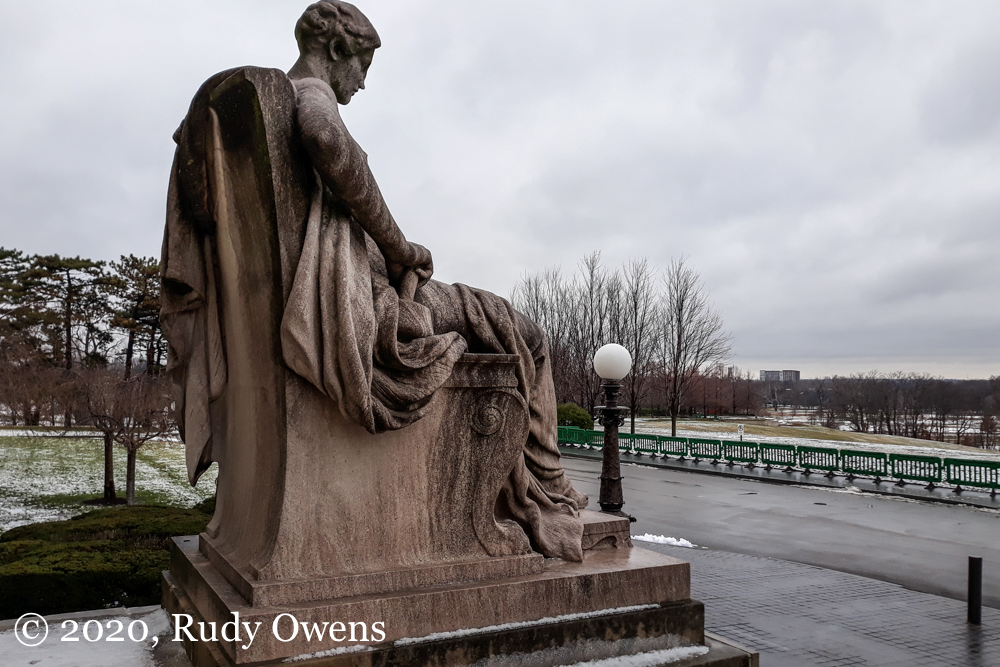
Every one of us has a mother, and that can bring together strangers. (Sculpture in front of the St. Louis Art Museum, taken three weeks before my mother died in early February 2020.)

In mid-February, I flew across the country from Portland to St. Louis. My trip came suddenly, but not as a surprise. After more than seven years of battling Alzheimer’s my mother finally passed away.

My plan was to write a eulogy on the long flight I would have from Seattle to St. Louis, the second leg of my journey. My tale was meant to focus on young woman, who was raised in a scrappy New Jersey town just outside of New York City.

That’s what I thought at least.

I ended up writing two stories. One I published after I returned. The other I put aside. It was a story I never intended to have, but had to be told. I finally am telling it now, at the end of May 2020, in the middle of a pandemic and protests occurring nationally in the United State against racial injustice and much, much more.

Perhaps by fate, I think my mom decided to play a funny trick on me on the way for me say goodbye. The experience allowed me to recall her wisdom and share it with a stranger.

On that trip, a stranger crossed my path. However, it was up to me to do something with this opportunity and make sense of it. My mom’s passing gave me a window.

Wakanda PatchOn the escalator coming out of the Airport shuttle tram at SeaTac, Seattle’s international airport, I spotted a large African-American man in a red and black checkered shirt. He must have weighed 225 pounds. He stood about 6’2” and had a massive chest and arms for linebacker.

I didn’t really think about him until I spotted two items pinned to his backpack.

One said, “Wakanda is not a shithole country.” The other was a medallion with the Latin words “Memento Mori,” or remember that death comes to all. During the period of the Roman Empire, the phrase would be whispered in a mighty Roman emperor’s ears by a slave as he entered Rome. It reminded a mighty emperor of his mortality and that he, the mightiest person in the world, faced the same ultimate fate as slave behind him.

When I read the Memento Mori medallion, I decided I had to introduce myself. I recently had found myself drawn to Stoic ideas, from ancient Greece and Rome, which are embodied in the words carved on that medallion.

I said, “Hi. I’m Rudy.” He replied simply, “Ike.”

I asked about his backpack decorations. We laughed about Wakanda.

I told him I recognized the Stoic medallion, and he said, yes, it’s sold by Ryan Holiday. Not by coincidence, we both followed and liked Holiday’s blog called The Daily Stoic. Both of us obviously found something in these ideas that connected with us.

I could hear a West African accent in his voice and asked about his background.

Soon I learned Ike originally hailed from Nigeria, the son of political refugee parents. He told me his mother arrived in Boston with just the shirt on her back and four kids while his father rotted in a jail back home.

I then discovered we were on the same flight. He was on a business trip from Seattle to St. Louis.

I told him about my family, being raised in a family of three with a single mom in St. Louis. I said I was flying to St. Louis to attend the funeral of my mother.

Ike commented how important funerals were in Nigeria for the Igbo, Yoruba, and Hausa-Fulani ethnic groups. Ike called them festive occasions where the life of a person was remembered as a joyful thing.
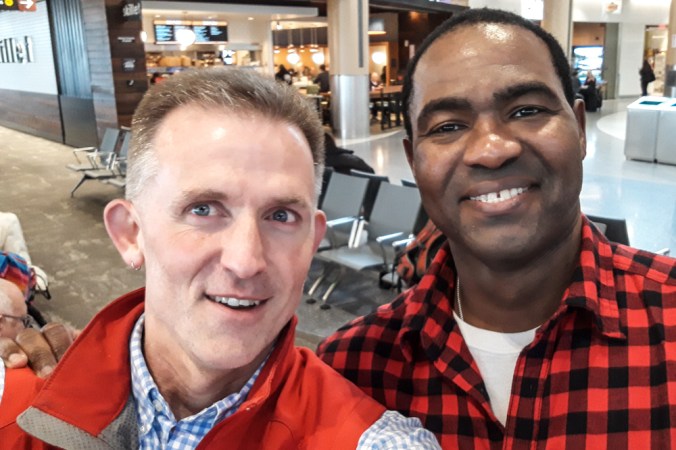
Rudy and Ike

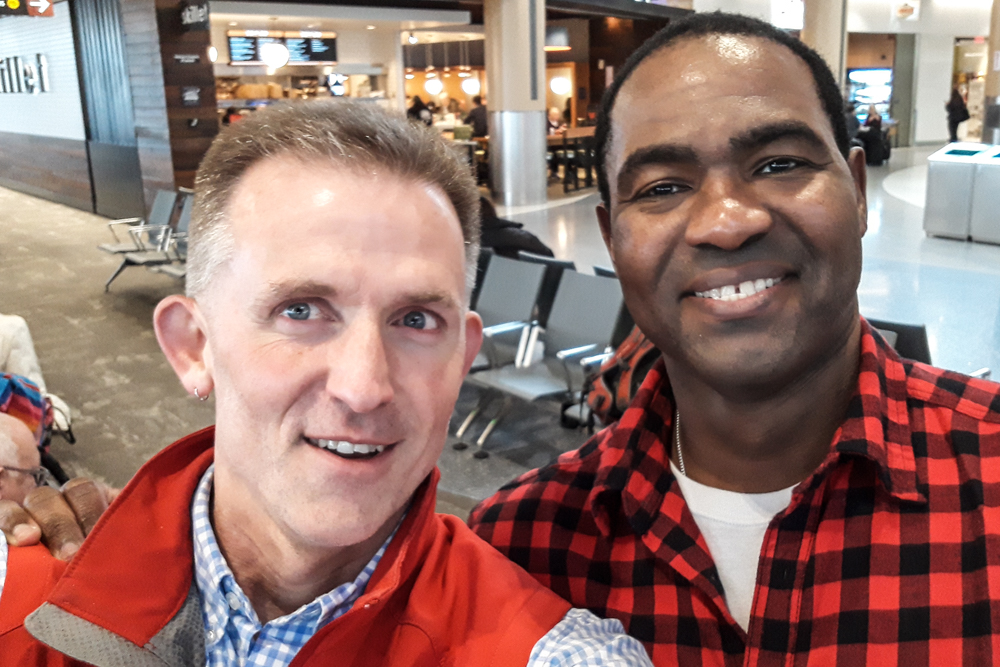
Rudy and Ike, connecting over mothers, death, funerals, and remembrance during a chance meeting at SeaTac in mid-February 2020. It is sad knowing we can’t enjoy the friendly embrace of strangers anymore for a long time amid the pandemic.

He said as a child, he wasn’t afraid of death because funerals were always so fun. Only later did he learn of the sadness that also accompanies the loss of a loved one. But first he learned that death was not a thing to fear and that it was a part of life.

Somehow we began to talk about how our mothers raised us and what life skills they taught us. Ike said his mom, and dad, always taught him he had to fight, because nothing in life came without some sort of struggle.

He said they never spoiled him or pampered him or over-parented him. If he was hurt, without requiring a hospital visit, he was expected to overcome his circumstance, because he if wasn’t gravely injured, he would be OK. He said it was the right thing to teach him, and he later understood the importance of this teaching. It helped to make him successful.

I said my mom was the same way. She understood good luck and bad luck. Like everyone, she had her share of both, and maybe in stronger doses that she deserved at times. I said, she could handle a strong wind and not snap. She would bend back. I said she had raised me not to be blown down during storms, even if I wasn’t aware of this when it was happening. Like her, I had to learn on my own to let storms pass and then come back up, stronger. Maybe I was more successful at this than she bargained for.

I also talked about my mom’s battle with Alzheimer’s and how it had given me a chance to learn about things that frighten us all—our mortality and death. By the end of this journey, watching this illness take my mom, I had grown. I had become less afraid of the end that awaits us all (“Memento Mori”). I simply did what I could do for my mom, mostly in a way that worked.

I told him that in the end, my mom always had an ability to see goodness. She could find something good amid something terrible, including her illness. Though she despised it, and would rightly say, “I hate this. I can’t stand this.” She also said one line all the time, right up to the end. “I have the nicest husband in the whole world, “ she would tell me, again, and again, and again, and again. I must have heard this hundreds of times in the past seven years.

It was one of the last things she told me on the phone, the last time we had a conversation during the Thanksgiving 2019 holiday. I remember replying to her the way I always did, with utmost sincerity: “Yeah mom, you do. He’s a great husband.”

I reality, my mom had said this for all 37 years of her marriage. She was speaking a truth about what the second half of her life was like with her best friend and husband.

“I got so lucky,” she might add. “Yes, mom,” I’d reply. “You got real lucky indeed.”

At that moment, in telling Ike my mom’s story, I started to feel my eyes water up and looked away. Here I was, crying to a man I had never met, telling him about the passing of my mother. He gave me a hug. “It’s OK, man. It’s part of the journey of life.”

Ike and I took a selfie and I gave him my card. I don’t know if I will see him again. He lives in Seattle with his wife. He’s not even sure how much time he has, having just had a heart attack on Jan. 18. He told me it was almost a blessing, because it reminded him of how precious life is and how important his wife and health are.

I think my mom would have loved to meet Ike. She could have easily found herself talking to him, like I saw her do countless times before whenever we travelled, or went to the Missouri Botanical Gardens, or the St. Louis Art Museum, or on a holiday. She was always warm and welcoming with strangers, of any race or background—always eager to hear about their lives and talk about their families and especially their kids.

In some ways, I felt my mom somehow played a serendipitous role that crossed my path with Ike’s, and therefore my mom’s story with his mom’s story, and the story all of us have with our mothers and the lessons they teach us, so we can pass them on to others, the way all people do, in the USA, Nigeria, or any other place.

Yes, maybe there was a reason I would be in an airport tram on that very day, at that very hour, at that very second, with an imposing looking man next to me, who just happened to have a reminder that captured the wisdom of a long journey my mom just completed. In some ways I felt that was her reaching from beyond through a stranger letting me it would be OK.

Remember to always get up and welcome a stranger into your life, I think she’d say. It was something her long and abiding Christian faith had given her until the very end.

Saying goodbye and finding meaning

The writer Robert Green, author of many books on human behavior, shared these words that make me think of Mom. Green wrote: “But despite what you may think, good luck is more dangerous than bad luck. Bad luck teaches valuable lessons in patience, timing, and the need to be prepared for the worst; good luck deludes you … making you think your brilliance will carry you through. Your fortune will inevitably turn, and when it does you will be completely unprepared.”

Mom at the Seattle Wooden Boat Festival, July 2004.

Like all of us, Mom had good and bad luck. Unlike many, she always learned from her misfortune and knew exactly when she finally found the tide turning. And she also knew good luck simply didn’t happen. She worked hard for it.

Mom was a child of the Depression and the daughter of an immigrant, who was fortunate to leave Germany before a much worse misfortune befell her homeland. Those immigrant lessons were passed down to Mom from her mother.

Being a child of that era, it shaped Mom and her generation. She spent her early years in a working class community of New Jersey—something that I think taught her about working hard and knowing that others around you could be less fortunate. She never forgot this her whole life.

Mom also grew up in the shadow of a great city, the epicenter of culture, and finance. The Big Apple’s glow could be a draw to anyone, particularly a woman like my mom who had an abundance of great looks. Those looks, however, never went to her head.

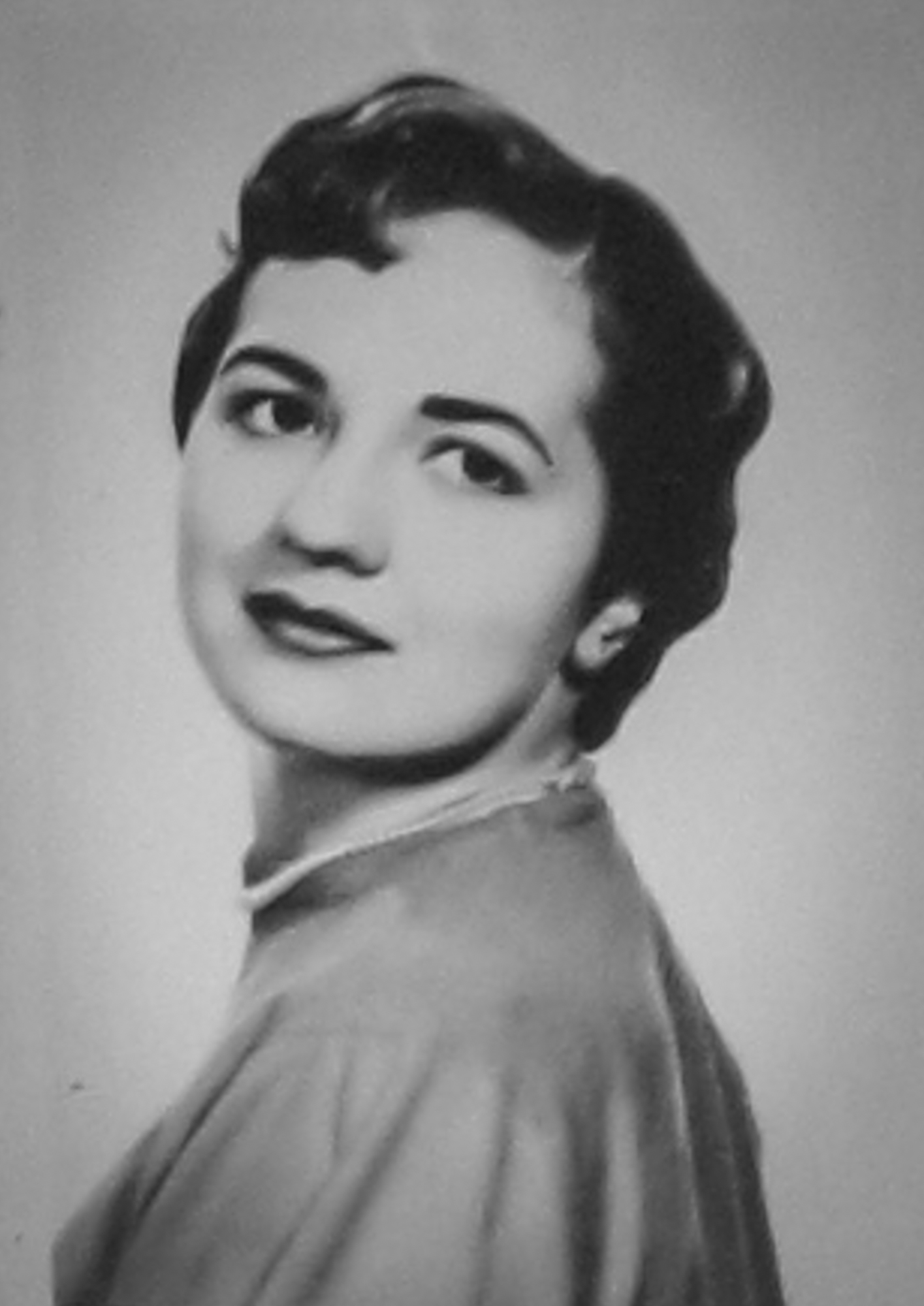
Mom attended Bronxville in NY (Concordia College, Bronxville, today) to pursue professional studies that the sexist workplace of the 1950s offered single women of lesser means. She made lifelong friends there. One became the godmother of one of her children (me). They were called the “Triple Threat.”

Mom, when she would turn heads during her college years in New York.

I don’t know the full story how Mom moved from greater New York to soggy Saginaw, MI in the mid-1950s. My guess is she needed work. When she had to work, she would always “crack on.” I learned this from her early on.

In 1958, she met her first husband. They moved to Detroit. They adopted my sister and I and raised a family. They moved to Boston for a spell in late 1965 and then to Clayton, Missouri, in late 1966. The pair divorced in 1973 and she re-entered the workforce as a teacher, eventually in the St. Louis Public School System and the University City Public Schools system.

She was a lifelong teacher, completing her career in University City Public Schools as a reading specialist. She devoted her professional life to the wellbeing of young people, many of whom were lower income, minority, and had higher needs.

Despite Mom’s great looks, she was remarkably grounded in the world around her, in people, her church, her community, and her family.

She was profoundly spiritual. She didn’t need to tell the world about her faith. It resided in her. She was devoted in the fullest Christian sense to her Christian identity and the congregations she belonged to. She dragged me and my sister to church. She knew better than we did why our nearby Lutheran church would be good for us. She was right. Her faith stayed with her to her last days.

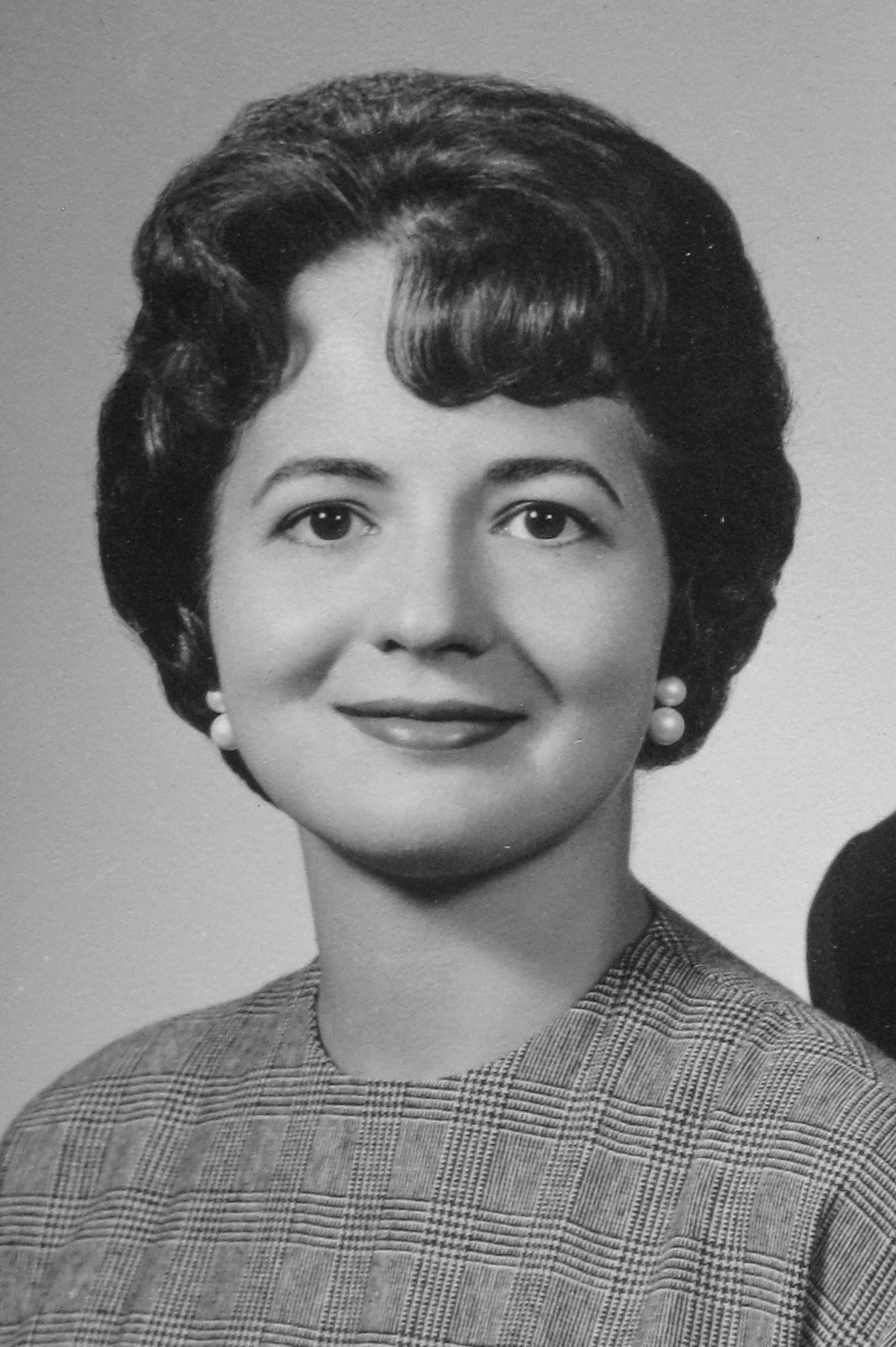
Mom always had style. I never saw my mom look shabby. It’s the style the world saw on the show Mad Men, of women of that era. Mom always carried herself this way.

Mom had style, always

Mom also had an artistic side. Her creative outlets included fixing furniture, making beautiful outfits with her hands by sewing. She could throw herself into project and be unmoved by distractions. The house she purchased together with her second husband became an art gallery. They both loved great art and had impeccable taste.

Mom was very smart—like all her family members. She loved crossword puzzles, which she did for decades. I could never keep up with her when she’d work them out on the kitchen table.

Mom managed the impossible: navigating a divorce, reinventing herself, raising two kids, switching jobs, buying a home on a teacher’s salary without any help. And then, with two kids in tow, she found her lifelong soul mate, who she married in 1983.

Mom may have felt she didn’t see the world, but she did.

With her second husband, they travelled nearly everywhere in the United States and Canada. She even travelled nearly 50 miles up a dirt road outside of Cordova, Alaska, in the pouring rain, just to see a glacier and laugh at how beautiful and crazy that was.

Mom and her second husband lived for a short spell in England, where he had a position for a short term. They also travelled to multiple destinations in Europe together: England, Scotland, Ireland, France, Belgium, Italy, Greece (I believe a couple of times).  They always looked like there were glowing in their holiday pictures. Snap, here we are in Paris. Snap, here we are in in Florence. Snap, here we are in in Rhodes. Wait, here’s Thurso, Scotland and Bruges, Belgium.

Author, Rudy Owens, and Mom, about four months before she finally succombed to Alzheimer’s disease.

She was a great cook. I loved her Christmas stollen and cookies. She taught me this art. She kept learning new recipes and growing with her expanding love of food outside of her St. Louis world.

Through thick and thin, Mom was devoted to my sister and remained generous to her. Mom was always about doing.

Mom was tough. Her friend from college shared some stories about that with me, and I can see that throughout her long life. I call it grit. It’s the virtue I respect the most in people who matter.

I think all that she confronted in life–stuff that might bend or break others–did not push my mom down.

She could weather storms because she always knew something good was ahead.

Mom during one her several moves in the mid-1960s

Mom was right, of course, and her marriage to her second husband was the highlight of her life.

The thing she said the most to me, for the last seven years of her life, when her illness took hold, was, “I have the best husband in the whole world.” I would always say: “I know mom. He’s a great guy.” She was would always laugh and smile. We had this conversation literally hundreds of times. She last said it to me on Thanksgiving Day, on the phone. I said, “Yup, mom. You are a lucky woman.”

Mom was the best friend and loving wife of her second husband for 37 years. She welcomed his family as her own and devoted herself to their shared relations. In the end, her marriage was the enduring happiness and the good luck that came in her life. She earned it and knew how to live it well, only the way those who know the fickleness of fortuna can.

Mom, I salute your memory. Thanks for making us richer.

Confronting the void, with a friend

In the more than the three decades since I graduated from college in Portland, I have maintained a good friendship with classmate of mine. He now lives in southern California. I have been visiting him periodically in Utah and there now for nearly 30 years.

Rudy Owens, on the far left, and my friend are among this group of Reed College students shown here in 1987, in front of the Reed College Library.

As we have aged together, we have encountered different and also similar challenges. I stayed single. I moved to more locations. He got married,  got divorced, raised his daughter, became a river guide, succeeded professionally in a grander way than me, and always stayed true to his curious, creative self.

Though we were raised in very different circumstances—him in a Jewish family in the West, and me in a Lutheran family with a single mother in the Midwest—we had more in common than I would have thought possible when we first got to know each other at our college library steps on long evenings.

Last night we caught up on the phone. I was sharing my feelings of loss concerning people I am close too, including my mother. She is still mostly well, but her issues are ones I will not share in detail here. My friend also shared stories of his mother, who has passed away.

Taken in 2014 in southern California during one of the greatest trips of my life.

During that call, we experienced a moment of understanding that transcended our distance of nearly 1,500 miles and the time we have spent not seeing each other in person the past few years. I learned things about him I did not know. I also shared things about myself I seldom share with others.

I am by nature private and stoic, and I have learned how to control my negative emotions and also my public displays of sadness or anger. I also realized during our talk about life and its inevitable end with death that my embrace of existentialism has given me the ability to confront these challenges I face more clearly.

I told my friend that in suffering, we really can find purpose and meaning. And whatever I did as a result of these circumstances, I would be making choices to respond to the challenges before me.  Those actions would be mine alone, and freely chosen. I was mostly telling myself these points, as I considered those actions yet to come with my mum.

That is pure Viktor Frankl. But it is also how I can face up to what is inevitable on the road ahead. I shared these thoughts with my friend, and he listened in the right way. He did not need to do much other than let me know he listened.

Mostly, I felt relieved to know I could unload to a friend and share my fears and also my resolve. Facing the world alone is not easy for anyone. Maybe it will be easier because I will have friends there to listen when the moment of the void arrives in full force.

Train Station Lessons: Don’t Be the One Left in the Rain

Train stations are magical places. They are portals where we literally jump off to new destinations. They allow people with different lives and destinies to intersect. They are big. They are public. They are filled with promise, confusion, and noise. They can also be places of tragedy and sadness.

I have had many memorable train station moments in my life, in India, Singapore, Malaysia, Egypt, Thailand, the USA, Canada, Japan, and throughout Europe. I have almost been robbed, lost my money, found friends, and often sat around for hours waiting to escape a few terrible places and even countries.

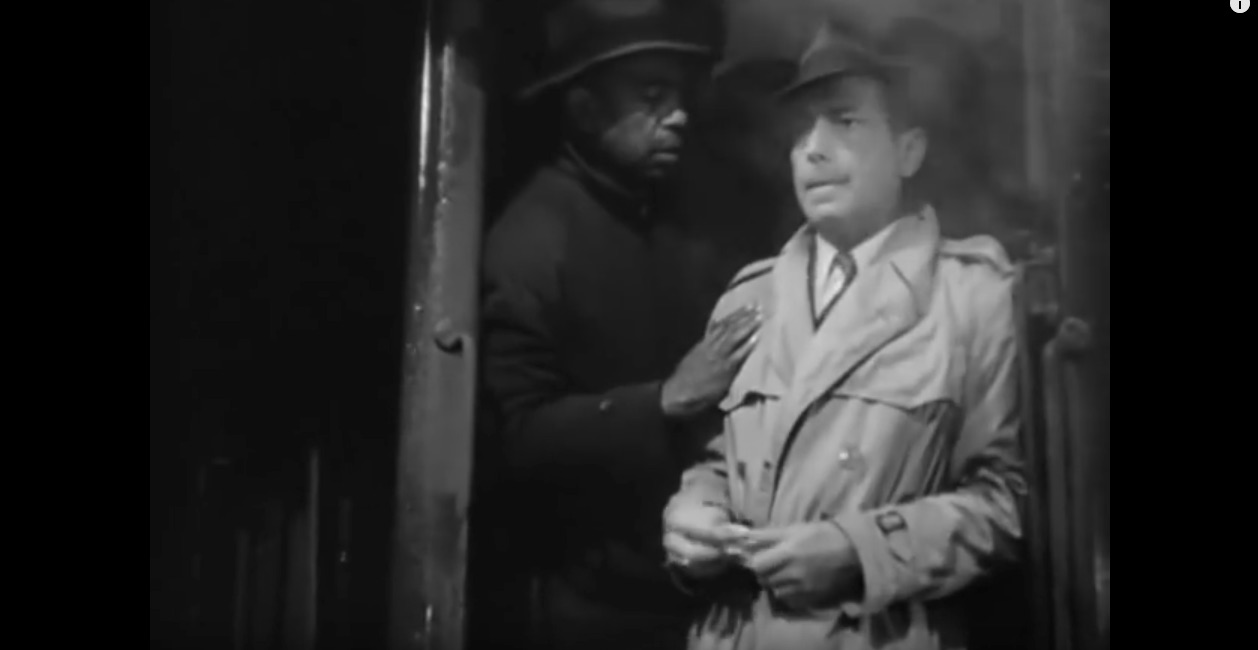
Sam and Rick leave Paris without Ilsa, who just moments earlier had broken Rick’s heart with her farewell letter. And, yes, it has to be raining for such a scene.

When I think of trains, I always think of the great train scene, set in Paris on a rainy June 1940 evening, as two protagonists get ready to flee the advancing Nazis. One is Humphrey Bogart’s Rick Blaine, and the other is his best friend Sam, played by Dooley Wilson. The film is the Warner Bros. 1942 classic Casablanca.

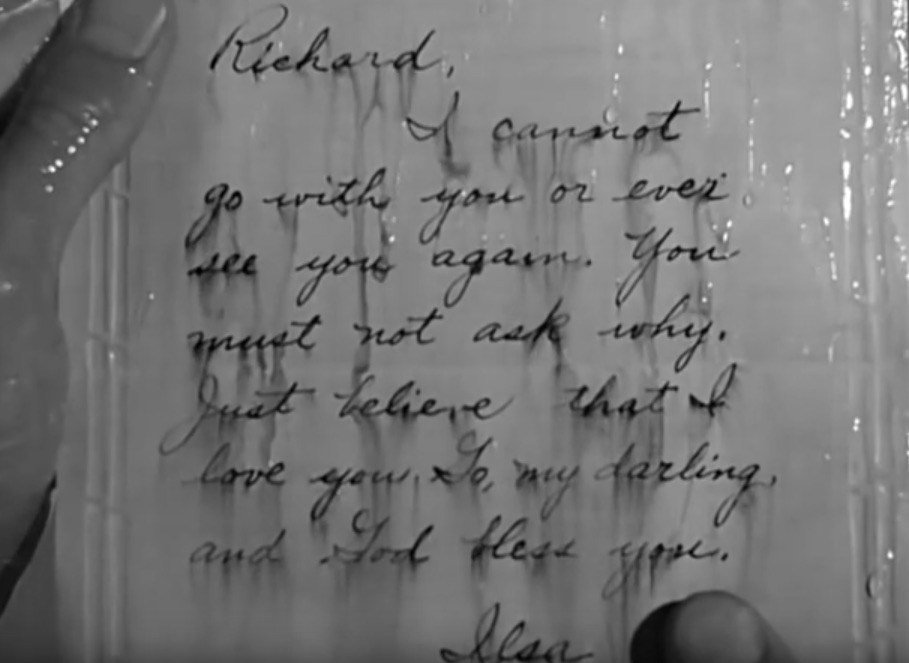
Come on, you know the short scene. Sam shares the note from Rick’s lover, Ilsa, who is not seen in this sequence, but played by Ingrid Bergman. In her letter, she bids Rick what she thinks is her final farewell.

Rick is devastated and watches the words melt away on the sheet in the downpour and his heart breaks apart right at that very moment. The scene ends with Rick tossing the toxic rejection missive aside, as he and Sam steam away, fleeing for what we know will be North Africa and eventually the film’s namesake, Casablanca.

Ilsa’s goodbye letter to Rick in the 1942 Warner Bros. film Casablanca.

I thought about that memorable scene yesterday, when I found myself at Union Station in Portland.

It was raining. It also was colder than expected. I had dashed down to give a gift to a friend who was leaving town with a lot on her mind. The whole scene brought back a memory from about two years earlier, when another woman I knew had come to Portland, in the midst of a personal crisis, and I had dropped her at the station on a very rainy late fall day. I had listened to her story as well, and a few tears.

I will leave out other scenes from my first Union Station episode, but it was a terrible day for the person I was with. My job, whether I wanted it or not, was to help her out and then to be forgotten. I was disposable in some ways. The event yesterday was not quite on that scale, but it had eerie echoes from the one before.

I laughed at myself walking away from Union Station after I bid my friend farewell. So was I just the sap, getting caught in the rain, like Bogie, whose love interest left him for another man without saying goodbye in person? In both cases I was not the love interest, but I was barely a secondary character in the film unfolding for these two leads in their complicated lives.

Clearly there are elements of an archetypal modern story at play when man and woman cross fates in railway stations: The man, feeling sappy and sorry for himself. The woman, crying over another man. The station as the stage, where the drama unfolds. And of course the beating rain, soaking the characters to their skin.

On some days, you have to be Bogie’s Blaine, and stop thinking about yourself. That is OK. I have no regrets. It is fine to play the part of a tragic but complex character.

But having lived this scene, I advise any future Ricks who are left behind, avoid the habit of being the one who leaves the station alone, drenched by rain and feeling nothing but regret. There are much better ways to end your stories. And don’t wait until the bad guys like the Nazis are practically knocking at the city gates. Leave town a lot earlier.

Note: Use of images from the film Casablanca are solely for the purposes of comment and criticism.

Remembering my friend Matt

Matt, my good friend from University City High School

I was moving my photo albums around this week, when by accident a picture of my best friend in high school, Matt, fell out.

I must have taken the picture sometime in 1982 or 1983. He finished high school early, with a GED, to immediately pursue an auto mechanics program in St. Louis. When I las saw him at his wedding in the mid-1980s, he had gone on to a career in that field.

The picture shows the guy I remember well and still respect. He was looking macho, wearing a smile.

Matt never seemed mad. He always had a positive attitude. He was born cool and did not need to have his badass status affirmed by the limited social world of my high school. Let’s face it, some people simply are born to be a little wild, and stand out from a crowd.

Matt worked his ass off at a tire retailer, making more money than me. With his savings, he paid for a 1969 black and red Camaro Z, a V8 hot rod he fixed up for speed and show. You cannot be more cool when you are 17 than having one of these cars. When Matt hit the gas in neutral, the engine roared and heads turned. He also paid for his own Triumph motorcycle with a beautiful blue trim. Both the car and bike could fly, and he loved speed.

The more mature and beautiful young women our age fell for Matt—something they told me years laters—but he didn’t pay attention to them. He had been dating his sweetheart from a different city since he was in the seventh grade.

Matt and I played soccer together on our high school’s soccer team our junior and senior years. He was stronger, more athletic than me, playing a center fullback position, holding up our defense with grit, speed, and power.

Matt learned how to play in Brazil, where his mother took him kicking and screaming when he was in the seventh grade. She saw him going wild at that age. As a teacher committed to social causes, she wanted to expose her only son to the third world and a life outside of urban St. Louis and clean him up from the many influences of drugs that surrounded all of us then. It worked. I wish I could have done the same.

He told me about clearing fields of sugar cane in the blazing sun at a village near Brasilia, where he and some other Americans were living and helping residents for a year.

After Brazil, Matt totally changed. I have never seen anything like it up to that point. Most young men, like me, at that age are immature. Matt had already become a man, he was clear about what he wanted to do (auto mechanics), and he achieved his goals with hard work.

Matt and some of our classmates (a good sampling of the diversity of University City High School)

Matt could deal with anyone from any race or culture. I never once saw any of the bad boys at our majority black high school try to test and taunt him with threats of violence—something that happened a lot. Some of that was racially motivated, and a good part was about establishing the male pecking order. Matt had street cred, and in that world, it was the currency that mattered. Matt was a different kind of dude. He had respect.

I never knew why Matt spent time with me. He was a shop guy, a genius at auto mechanics, and I was trying to be a serious, nerdy student going to college. Maybe we got along well because both of us had divorced single mothers as parents who had fathers who had left our families in bad circumstances. And we both had cleaned up from the dope scene at the same time too, when many of our peers were just starting to do drugs. We had replaced those vices with soccer and jobs. Maybe we had moved on already before we had left that school.

Sadly, I lost touch with him midway through my college degree. I left for Portland in 1983. He was married by the time he was 21. I never came back to St. Louis, except for occasional holidays. None of the few people I stayed in touch with from my high school knew where he went. I think Matt left that world behind, bought an auto garage, and became a business owner while raising a family.

Every year or two I try to find him. He has stayed off the grid or has already passed away. I don’t know.

However, Matt’s memory lives on. On a list I made of all of the mentors who influenced me, my old friend sits near the top of the list. His year in Brazil made me want to find places outside of the United States where life was more raw and more real than suburban St. Louis. Most of all he showed me that authenticity can never be faked. When you show up real, people will treat you accordingly.

Matt, wherever you are, if you are still with us, I wish you the best.

Learning by the decades

I just celebrated my birthday.  The day always gives me pause. It forces me to think about what I am doing with my life and what I have learned.

I thought about the important things that emerged over the 10-year increments that I have lived on this world. Here are a few of the big “aha’s” that stuck with me and have made me a better and smarter person.

Rudy as BabyDecade 1 (0-9 years): This was a scrappy period. I learned that I could take care of myself even in situations that were unpleasant. The resilience I learned as a kid has given me the ability to overcome challenges and persevere when the going gets tough. This was a great life skill to master, and I was lucky I had the (mis)fortune to internalize this lesson early on.

Decade 2 (10-19): This was the period when I learned from mentors. My greatest teachers were guys who gave me a chance and allowed me to work for them, and get real-world life skills and also much needed cash. I was lucky to have two very generous business owners and bosses. Everything good I learned about how to run a business I learned from these two men, who decided to give me a lucky break.

Decade 3 (20-29): This was the decade I first learned about the world first-hand and saw how much we all have in common. No matter what country I found myself or how poor or wealthy the residents were, people were genuinely good to me if I treated them with respect and an eagerness to learn about their culture, language, customs, and religious traditions. The world really is a wonderful teacher.

rogerandmeDecade 4 (30-39): This was the decade I learned that life can provide you wild surprises, and what matters in the face of curve balls is how well you deal with rapid change and crisis. I reinvented myself a few times during this decade and did not allow these sideways detours to keep me from moving forward.

Decade 5 (40-49): This was the time when I learned again about the meaning of life, from the example of a wonderful person I knew who taught everyone around him how to live a good life. I made some adjustments for the better and doubled down on my goals to live even more purposefully than before.

Rudy-MaryAnne Rhododenruns
Decade 6 (50 … ): This is an open chapter, and I am learning more about letting slowly go of people I know and care about. But this particular journey this decade has only just begun, and there will be time to write the final chapter many years later.

My favorite holiday, and for great reasons

My friends prepared a phenomenal Thanksgiving dinner, yet again, in 2014.

My friends prepared a phenomenal Thanksgiving dinner, yet again, in 2014.

Thanksgiving approaches. By far it always has been and remains my favorite holiday.

For me it is the most genuine of our American celebrations. Commercial interests have not transformed it into a crass, commoditized event, though they try their hardest the day after we gather to give thanks with food, friends, and family.

It is seasonally specific. Thanksgiving dinners celebrate the North American harvest season, and with that, all of our land’s lovely fall foods. There are squashes, sweet potatoes, Brussel sprouts, potatoes, carrots, and cranberry sauce. These all taste better when blended and mixed on the plate with a big bird and gravy. Let’s not forget pumpkin and apple pie, layered with whip cream, and perhaps maybe wine or cider to add zest.

I have spent the last five Thanksgivings in Seattle with friends. It has always been a way I have let the world fall to the wayside, so I can focus on friendship, camaraderie, and celebrating all we have to give thanks for.

Two of those years were not my favorite periods, being back in graduate school and not feeling perfectly in tune with my program and the field I was studying at the time. I continue to live far from my family, so I have not been able to share it with them for decades, and during those two years, time with my family would have been nice. So for me, Thanksgiving has been about friends, actually for decades now.

Thanksgiving also celebrates a key moment in American history, marking the Union victories over the slave-holding Confederacy at Vicksburg and Gettysburg. The holiday, despite what you may have learned from myth and school, was first declared by Abraham Lincoln in October 1863, a dark year in American history when it was not clear if we would survive the storm of violent civil conflict, slavery, and division. Lincoln’s speech is a good one, even if he may not have written the whole thing (I do not know for sure).

I also have memories every late November of losing a good friend just before Thanksgiving in 2008.

So at this time of year, particularly on this great holiday, I think of what is good in my life and the good people in my life. I hope you do too, if you find yourself in the United States, with a home over your head, and friends and family to help you remember what is truly important.