Tribal loyalties run far and deep

In the United States, we use many methods to define ourselves and our loyalties. Race, religion, ethnicity, and geography are common ways we come to understand ourselves and our circles. Groups we belong to, and schools we attended, also seek to capture our loyalties, and help us navigate the world.

In my case, I was adopted into a Lutheran family. My father was a Lutheran minister. I was brought up as a Lutheran by my mother. I was confirmed as a Lutheran as a teen. I attended a Lutheran church until I was 18 years of age and old enough to leave home forever. Today, when I hear Garrison Keilor on his show, A Prarie Home Companion,  affectionately make fun of and celebrate Midwest Lutherans, I know the world he speaks of.

Bob Dylan wrote this line in his haunting ballad, With God on our Side, in describing the world he came from in northern Minnesota and also of who we are as Americans:

Oh my name it is nothin’
My age it means less
The country I come from
Is called the Midwest
I’s taught and brought up there
The laws to abide
And that the land that I live in
Has God on its side

Well, the country I come from is the Midwest, and whether I wanted them or not, I became one of them–a Midwest Lutheran. It is not a bad thing. It is just is part of who I am, regardless of what I believe about faith.

(Click on the photo to see a larger picture on separate picture page.)
Trusted by a stranger, in a strange town, in the middle of the night

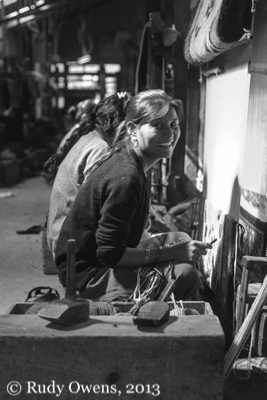
Tibetan Refugee Carpet Maker Photo

This contagiously positive carpet weaver is among the many Tibetan refugees I met in India at Dharamsala and Darjeeling, two hill stations.

Recently, I had two experiences over a couple of days during which I realized I was not trusted. It saddened me. Trust is almost always earned, but it also is very dependent on one’s own life’s story and circumstance, so some do not give it easily. Trust is one of the greatest treasures. It is a gift we give to young people to show we believe in them. It is also something that one has to demonstrate in life, and not be afraid of the consequences.

My experiences made me think of times I relied on blind trust. One of the most vulnerable moments I had traveling in India in 1989 took place in the middle of a late November night, in Dharamsala, the Indian hill town that is also refuge to the Dalai Lama and many Tibetan refugees. I had arrived very late at the lower city of McLeod Ganj after 12 hours of bus rides. As there were no taxis, I walked up the hill, in the dark, having no reservations. It was 1:45 a.m. when I finally arrived sweaty on the cold hill city, but found all the hotels were shuttered. It was not particularly safe to be on the streets, and I had to find shelter.

So, I visited a tea stall restaurant, owned by a Tibetan man in his 50s. He was awake, making bread and cooking. I motioned I needed a place to sleep in his restaurant. I was likely dirty, a bit smelly, carrying a big backpack, and not the most welcoming of sights. He did not know me. Here’s what I wrote in my journal: “Imagine this. A total stranger appears at his doorstep at 2 a.m. and he lets him in to sleep at no cost. I pulled out my sleeping bag and crashed for 4.5 hours. I woke up to the sounds of my friendly patron saint bustling in the kitchen. I wonder if he sleeps. He smiled at me and gave me a cup of tea.”

The power of redemption … it never, ever goes out of style

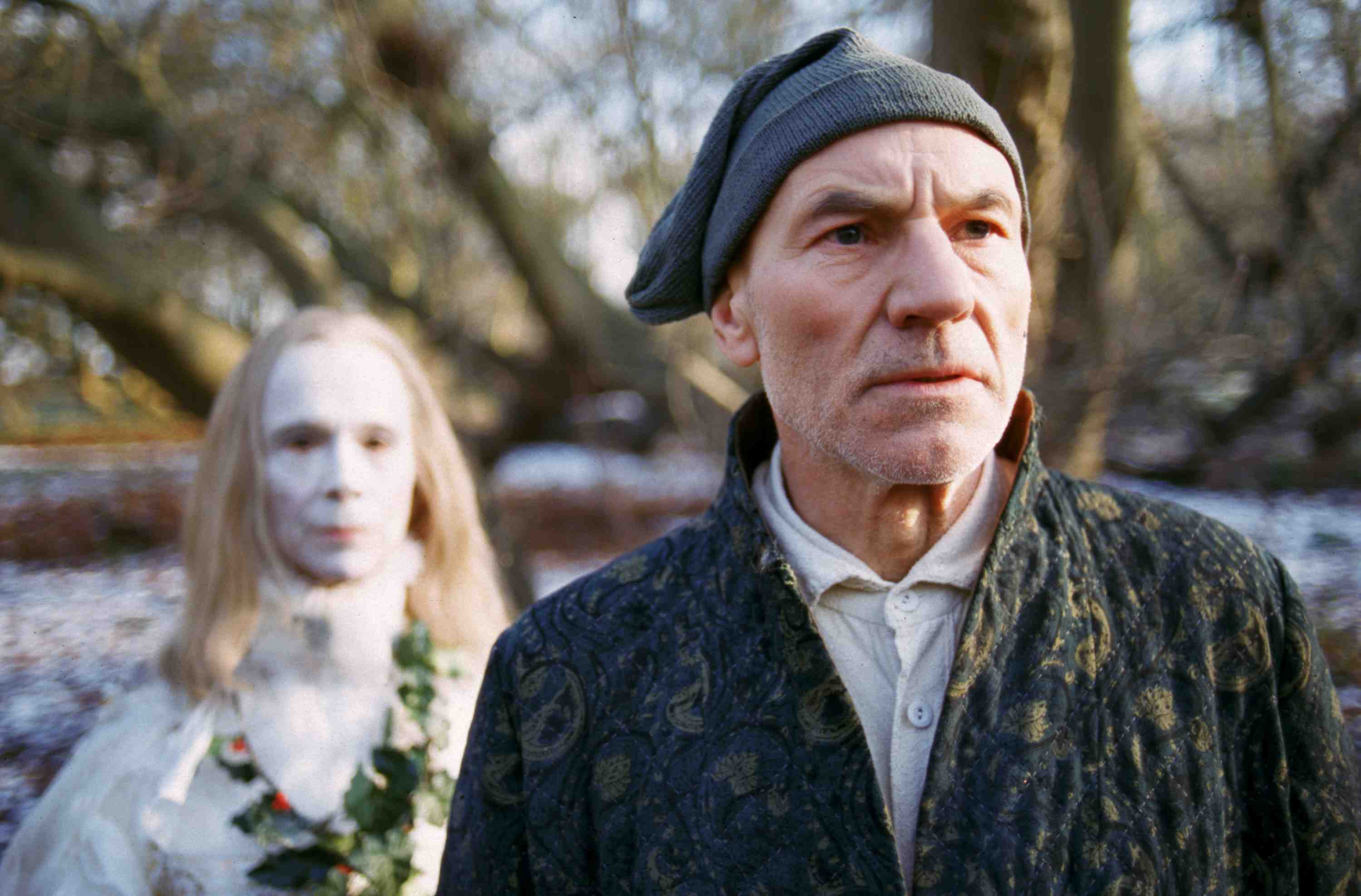
Patrick Stewart as Scrooge.

One of my favorite cinematic renditions of A Christmas Carol stars Patrick Stewart. Here is a photo from the 1999 version for television.

No holiday season is complete without seeing A Christmas Carol onstage. I just saw a nice performance in Portland by a group at the Portland Playhouse. Tales of redemption seem to be among my favorites. But good stories often involve change in our protagonist(s) and trial and tribulations that test the soul.

So, good reader, have you been tested like Ebenezer Scrooge, who was visited one Christmas night by four ghosts, trying to help him find purpose in his life? Do you need to be tested? Do you envision becoming a person who is fulfuling a better and higher purpose? Or maybe you have not fully appreciated what you have accomplished (in the case of our much tested George Bailey, from It’s a Wonderful Life)?

So here are four quotes from one of the greatest works ever written in the English language, A Christmas Carol, by the genius Charles Dickens, to help you contemplate the power of redemption and finding purpose. Merry Christmas!

  • First a description of Ebenezer Scrooge: “Oh! but he was a tight-fisted hand at the grindstone, Scrooge! a squeezing, wrenching, grasping, scraping, clutching, covetous old sinner! Hard and sharp as flint, from which no steel had ever struck out generous fire; secret, and self-contained, and solitary as an oyster.”

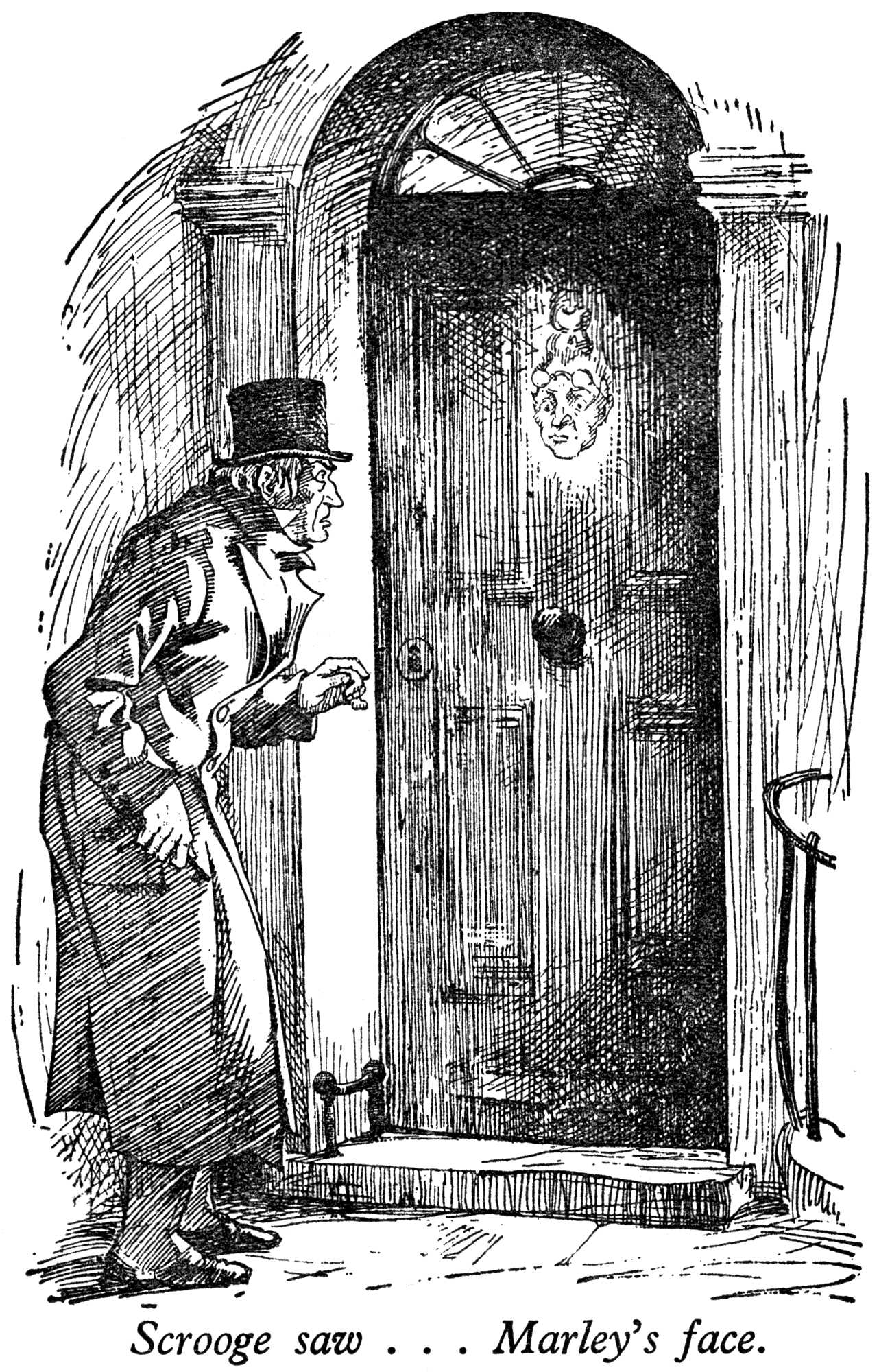
    A scene from the first spirit visiting Scrooge on Christmas Eve.

    A scene from the first spirit visiting Scrooge on Christmas Eve.

  • Scrooge, on Christmas eve, is confronted in his chamber by the spirit of his former partner, Jacob Marley, who describes why he walks in the shadows: “I wear the chain I forged in life….I made it link by link, and yard by yard; I girded it on of my own free will, and of my own free will I wore it.”
  • When Scrooge tries to console Marley that he was a good person, who did good business, Marley replies back: “Business! Mankind was my business. The common welfare was my business; charity, mercy, forbearance, and benevolence were all my business. The dealings of my trade were but a drop of water in the comprehensive ocean of my business!”
  • After a harrowing night, seeing his past, present, and wretched future with no one to miss his presence after he is gone, Scrooge changes on Christmas day: “[Scrooge] went to church, and walked about the streets, and watched the people hurrying to and fro, and patted the children on the head, and questioned beggars, and looked down into the kitchens of houses, and up to the windows; and found that everything could yield him pleasure. He had never dreamed that any walk — that anything — could give him so much happiness.”

Never forget who you are, especially if you are a bastard

Tyrrion Lannister and Jon Snow

This image, published by web site FanPop, captures one of the best moments of dialogue in the whole bloody saga that is Game of Thrones. This is the first episode, season one, when the two characters meet. I like both characters shown here a lot.

As an adoptee, I have great affection for all characters, mythical, imaginary, and historical, who share my status as a man who was born without his biological parents joined in marriage. The word for us, through history, is “bastard.” Don’t worry, fair readers, us bastards are comfortable with the word. We know its true meaning and know how others respond to it. It may be you who is not at ease with the word and the reality.

So it may be no surprise that one of my favorite little scenes from the series Game of Thrones is when the Imp, Tyrion Lannister, gives advice to the main bastard character of the series, Jon Snow.

“Let me give you some advice, bastard,” says a drunken Tyrion. “Never forget who you are. The rest of the world will not. Wear it like armor.”

In other words, make your apparent weakness your strength and own the fullness of your identity, regardless of what anyone may say. Good advice for a bastard. I should know. And so should Jon Snow.

A memory from the end of the earth, in Ushuaia, Argentina

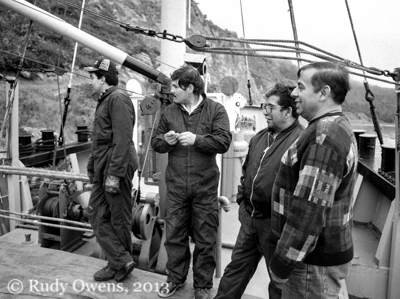
Chilean Sailors

Sailors on the vessel Navarino in the Beagle Channel, in February 1996.

On Feb. 7, 1996, I arrived at the city at the edge of the world, the coastal city of Ushuaia, Argentina. I came here first by cargo container to Puerto Williams, Chile, from Punta Arenas, Chile. I secured a passage on the cargo vessel Navarino. From Puerto Williams I literally hitched a ride on a sailboat owned by a transplanted French sailor and his wife, who gave me and my traveling companion a lift across the Beagle Channel from Chile to Argentina, at Ushuaia.

Here is what I wrote in my journal abut the lovely morning, which really was an all-night adventure: “I remember most the cold breeze, the clouds lit by the moon, and the sights of Ushuaia, glowing in the distance as we approached. I got about 1.5 hours of sleep until I woke up again at 6:30, just as we were pulling into the harbor. It was a beautiful morning with a frontal system lit a milky red. The town was set against a backdrop of severe mountains.”

That was one of the most lovely days of my life. I can still remember the smells, the cold air, the feeling of wonder.

Never, ever look undignified, even when you have nothing

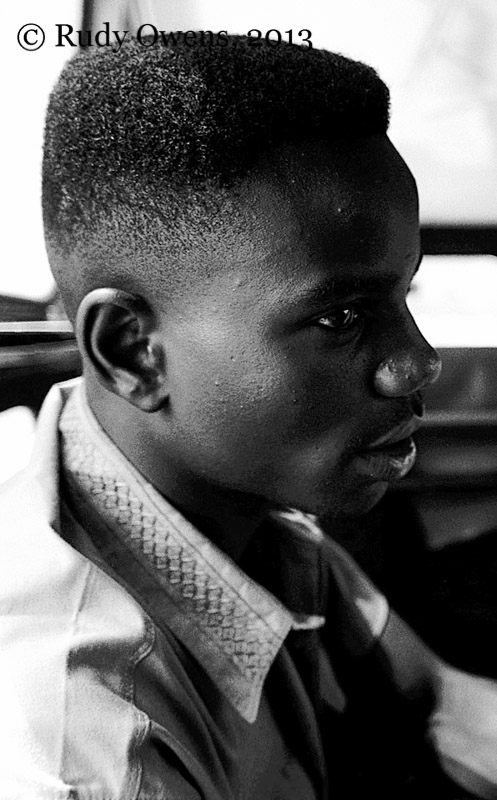
I took this photo of a Rwandan refugee who worked on a bus between Kigali and Kampala. He carried himself with great grace. He was among many who taught me how to project this kind of pride, regardless of the environment.

I took this photo of a Rwandan refugee who worked on a bus between Kigali and Kampala. He carried himself with great grace. He was among many who taught me how to project this kind of pride, regardless of the environment.

One of the great rules to learn about life is to not make snap judgments by appearances alone. Appearances often can be deceiving, and wily and wise individuals throughout history use appearances to fool others and the masses. Robert Greene’s The 48 Laws of Power describes this well, noting, “Playing with appearances and mastering arts of deception are among the aesthetic pleasures of life. They are also key components in the acquisition of power.”

However, a flip side to this truism is that a person’s true character and intentions can shine through one’s costume. In Africa, during my visit in 1997, I observed extreme poverty among many residents of Uganda, Rwanda, Kenya, and Tanzania. Most of the poorer folks I met in many communities did not let their economic reality control their exterior appearance. People carried themselves with grace and style, even if their clothes were not the finest. I do not recall people dressing down or intentionally looking less then proud or intentionally wearing clothes that made them appear less dignified.

When I came back to the United States, I vowed never, ever, under any condition, look like a bum or show that I did not care about my clothes and appearance. This was true even if was wearing shorts and a T-Shirt. There are obviously different rules in this country, but not the rules I choose to follow. The pride I carry is mine to choose alone, and I at least can make this choice.

There is no more dangerous animal in the bush than man

The lion is less deadly than a man in the bush, according to local wisdom in Uganda.

The lion is less deadly than a man in the bush, according to local wisdom in Uganda.

In 1997, I took a trip in upcountry Uganda to a bush administrative village called Moroto. This is the heartland of the Karamajong people, who are cattle herders and who fought a violent war against the Ugandan government during the brutal reign of Idi Amin Data. It was a wildly beautiful place. I only spent two days there.

I got to know some respected village community leaders. I will never forget the words one shared with me, describing the dangers of traveling in bush Africa. I had nearly been attacked by a local bandit in what I thought was a peaceful area. My hosts were deathly afraid I was going to be killed or robbed by the AK-47 wielding man, dressed in simple local clothing similar to the Masai. After that incident, my host told me, “There is no animal more dangerous in the bush than man. He is far more clever than a lion, and often smarter than you.”

I have never forgotten that advice, and I always mind my wits, whereever I find myself.

Life’s journey leads to many friendships

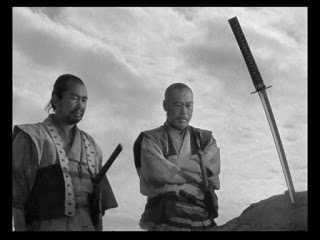
Two of seven samurai mourn a loss.

Katayama Gorobei. left, and Kambei Shimada mourn the loss of their fellow Samurai, Heihachi Hayashida.

I just saw Akiro Kurosawa’s masterpiece, The Seven Samurai, for perhaps my fifth time. It just gets better and better with time. A gem I found in this viewing was in the line from the first samurai, Katayama Gorobei, recuited by the leader of group, the wise and wily Kambei Shimada. When offered the proposition to pledge his life to defend the villagers from bandits with Kambei, Katayama replies with a smile, “In life one finds friends in the strangest places.” Could not agree more.