Americans remember the shot heard ’round the world on April 19

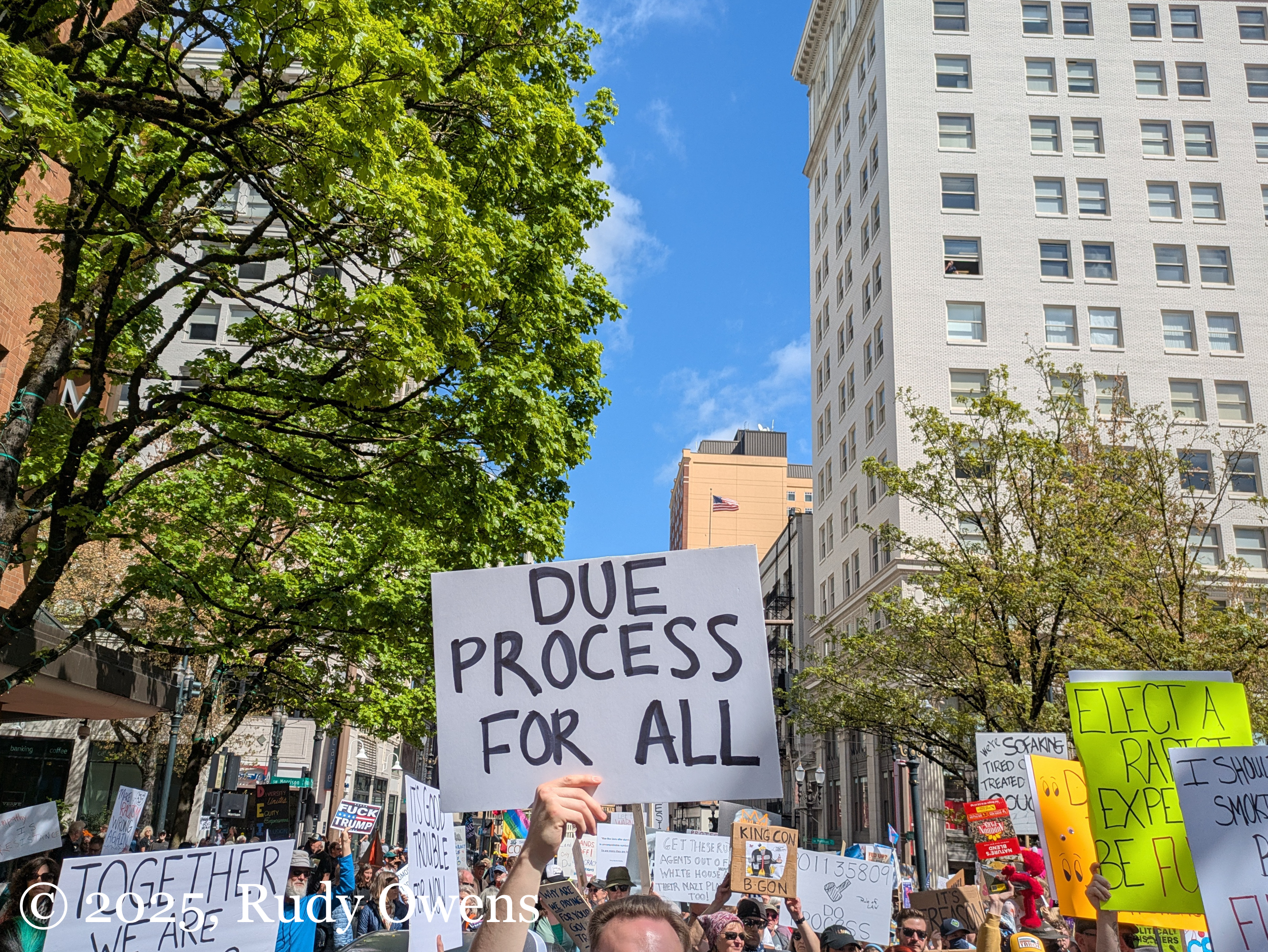
On April 19, 2025, hundreds and hundreds of thousands of Americans in all states protested against the loss of rights enshrined in the U.S. Constitution and the actions of the current Trump administration.

The weekend marked the 250th anniversary of the first shots fired in the American Revolution against the British Empire and a tyrannical monarch, King George III. In Massachusetts, the first battle of the American Revolution on April 19, 1775, known as the Battle of Lexington and Concord, is celebrated over a three-day weekend with the state holiday called Patriots’ Day, recognized on the third Monday in April in the commonwealth.

Today, in U.S. history books, the start of the American Revolutionary War (1775-1783) is known famously, at least to those who learned American history in school, as the famous “shot heard ’round the world.” The skirmishes by colonial militia against the imperial army of the British Empire persuaded many Americans to take up arms in the eventual conflict.

The issues that led to the first conflict of the American Revolution—the right to self-determination, liberty, democracy, the rule of law, a life free from the power of kings—helped to forge a nation 13 years later, in 1788.

That year, the American colonies adopted the U.S. Constitution. While revolutionary, it was also terribly marred and flawed by enshrining chattel slavery that held millions of African Americans in bondage until the end of the bloody Civil War in 1865. It was our country’s greatest sin. Ultimately, it would take over two centuries to guarantee the document’s original promise for all persons.

This framework for a nation, set forth in the Constitution, called for a system of checks and balances by three branches of government: the executive, legislative, and judicial branches. It begins with these famous words: “We the People of the United States, in Order to form a more perfect Union, establish Justice, insure domestic Tranquility, provide for the common defense, promote the general Welfare, and secure the Blessings of Liberty to ourselves and our Posterity, do ordain and establish this Constitution for the United States of America.”

On April 19, 2025, this sacred American text had special meaning for hundreds and hundreds of thousands of Americans across United States, who sought to renew their relation to our country’s charter and find living and breathing meaning of what the Constitution guarantees to all persons in our country, by the force of law.

Boston University historian Heather Cox Richardson, publisher of the newsletter “Letters from an American,” has a wonderful essay on these events two and a half centuries earlier and how we can make sense of these events in our country today. I hope you either read or listen.

Resources:

-Heather Cox Richardson (University of Boston, professor of American History): “Letters from an American, April 18, 2025” (audio).

-Heather Cox Richardson (University of Boston, professor of American History): “Letters from an American,” April 18, 2025 (text):

-Hillel Italie and Micheal Casey, “250 years after America went to war for independence, a divided nation battles over its legacy.” Associated Press, April 19, 2025.

Find good people and work together

University of Toronto professor Timothy Snyder (used for editorial comment purposes)

This week, I had a chance to create a new relationship with someone who I didn’t really know.

I did that because I saw someone who did something different—they spoke out, and they did that where it was not expected and was not comfortable. It was something that created a quiet stir, in my opinion.

After that happened I quickly contacted that person and, I hope, created the start of a mutually respectful connection, one built on trust and shared values.

This was necessary because I needed this person to know that they had done something that matters: they stood out and broke the spell of silence. This matters, according to experts on authoritarianism.

One of the most important voices to help people understand how authoritarianism works and how to confront it is University of Toronto historian of authoritarianism, Timothy Snyder. He is best known as the author of Bloodlands, a detailed and magisterial history of genocides, campaigns of starvation and mass murder, and conflicts in eastern and central Europe in the first half of the 20th century, bookmarked between the two horrific wars. I read about a third of it four years ago, and I did not have the stamina to complete it, but I was impressed by the scholarship.

(Go to my website to read the complete essay.)

South Korea gives the world hope for the rule of law and democracy

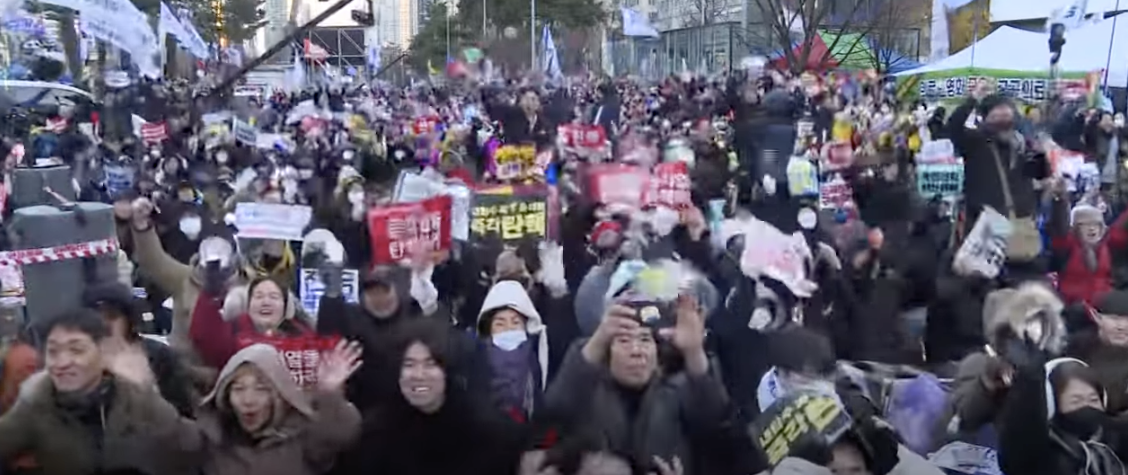
South Koreans cheer the moment an impeachment vote against President Yoon Suk Yeol is announced publicly.

It is so good to have good news again lately.

First, the world mostly cheered as it witnessed the stunning fall of the horribly brutal regime of the Assad family in Syria on December 8, 2024. That situation is not over, and nations including the United States and Israel were quick to take military actions inside of Syria for their own security interests. But seeing ordinary Syrians with smiles brought me joy.

And now, today, December 14, 2024, the National Assembly of the Republic of Korea voted to impeach its president, Yoon Suk Yeol, who declared martial law on December 3, 2024 (literally in the dark of night), only to rescind that order six hours later when faced with democratic opposition in the nation’s elected legislative body and in the streets.

This is what democracy looks like, and I am so impressed by the people of South Korea for defending their country’s basic democratic freedoms. Well done! This is footage, shared by AFP, of the moment the vote by the National Assembly was announced.

Personally, I am in need of hope now, and I want to thank the people of Syria and South Korea for sharing that with the world.

A coup can happen during the dead of night or in the glare of daylight

I woke up this morning, like many in the United States, almost in shock to learn a mostly stable and modern democracy, South Korea, also known as the Republic of Korea, was under martial law, by the unilateral decision of President Yoon Suk Yeol, made late on December 3, 2024, around 10:30 p.m. (KST).

President Yoon Suk Yeol of the Republic of Korea announcing martial law, on television

It was around 6 a.m. Pacific Time, December 3, as I was taking in the morning news and still waking up, when I heard the first news stories on my radio.

And then, about six hour later, around 4:30 a.m. (KST), December 4,  following a courageous vote of defiance  by the members of the National Assembly of the Republic of Korea, including the majority liberal Democratic Party and his own minority People’s Power Party, President Yoon lifted his declaration formally during a cabinet meeting.

All of this happened in darkness.

Most of the country was asleep when the South Korean military forcibly entered and surrounded the parliament building. They were filmed landing on the building with military helicopters and entering the building by force.

My immediate reaction was like the opinions of many regional observers—total disbelief.

You mean the land of K-Pop, high-tech electronics, Kia and Hyundai automobiles, not to mention a growing soccer powerhouse, was again in the throngs of political instability after mostly decades of calm?

How could this happen so fast in a country of more than 50 million people, and also host to nearly 30,000 U.S. service personnel.

It felt completely improbable, and yet it was real.

I needed to trust my senses and my awareness that the world is in the middle of unprecedented change.

The hugely unpopular President Yoon provided an erratic message to justify his decision. He called the actions necessary to protect the country from “North Korean communist forces” and “antistate forces,” and to “rebuild and protect” the nation from  “falling into ruin.” The message could be coming from other comparable strongmen vying for power globally, anywhere.

According to the Center for Strategic and International Studies, Yoon’s  decree, made under Proclamation No. 1 at 11 p.m. (KST), December 3, the following measures were implemented while the short-lived decree lasted:

  • All political activities, including the operations of the National Assembly, local assemblies, political parties, political associations, gatherings, and protests, were banned.
  • Any act that denied or attempts to subvert the democratic system were prohibited, including fake news, manipulation of public opinion, and false incitement.
  • All media and publications were subject to the control of the Martial Law Command.
  • Acts of social disruption, such as strikes, slowdowns, or gatherings, were prohibited.
  • All medical personnel, including interns, who are on strike or have left their medical posts were required to return to their duties within 48 hours and serve diligently. Violators would be punished under the Martial Law Act.
  • Except for anti-state forces and those attempting to subvert the system, innocent citizens would be provided with measures to minimize disruptions to their daily lives.

And then it was over the afternoon of December 4 (KST), with some opponents calling for the arrest and impeachment of President Yoon.

For me the developments appeared absolutely stunning, inside a country with no clearly visible threat, either from the militarized Communist North Korea, led by dictator Kim Jong Un, or any other nation. It was experiencing relative political and economic stability.

Though President Yoon had rescinded the martial law, the world saw how some of the national armed forces faithfully carried out its orders at the nerve center South Korea’s democratic government. Later in the day, after my workday ended, I had time to catch up on news developments and saw footage of South Korea’s military personnel in full body armor breaking into the National Assembly building to take control of Korea’s legislative branch. It was surreal footage, yet also familiar.

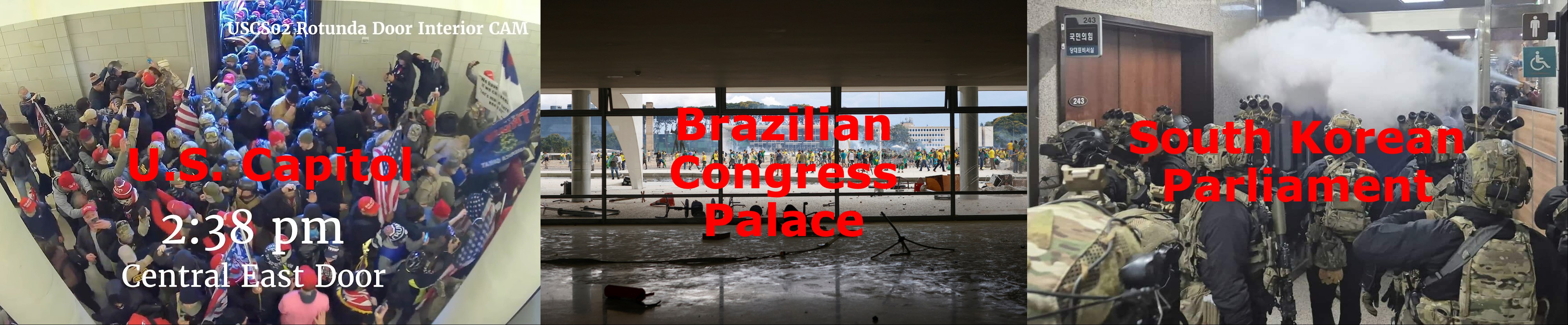
Three coups happened in three democracies over four short years.

All of this had painful echoes of the last two major coups I saw covered live on television in even larger democracies: the United States and Brazil.

The U.S coup, to prevent the peaceful transition of power on January 6, 2021, under the urging of President Donald Trump, led to a coordinated and violent assault by Trump supporters at the U.S. Capitol, trying to prevent Joe Biden from being peacefully being affirmed as the 46th president of the United States. It happened in broad daylight, with the world and nation watching live.

It also resembled the right wing coup in Brasilia, Brazil, at the National Congress, when supporters of former President Jair Bolsonaro, in broad daylight on January 8, 2023, overran the country’s capitol compound, trashing the Brazilian Congress, Supreme Court, and Presidential Palace, to prevent the transition of power to president-elect Lula de Silva. It also failed like the U.S. insurrection.

At the end of the day I shared a post on one of my social media feeds. I wrote: “Democracy, it requires the people to say: ‘No.’ Coups now are looking more routine. After today, what’s next?  USA: January 2021, coup attempt. Brazil: January 2023, coup attempt. South Korea: December 2024, coup attempt.”

You can bet all democracies and autocracies took notes how easy this was and what happened in Seoul, South Korea.

It took courage and the elected legislative leaders in this vital democracy in east Asia to challenge the elected president’s dead-of-night seizure of power by military force, without even a credible national, military, economic, or even public health threat.

So, will the next assault happen in daylight, like in the United States and Brazil, or again in the dead of night, like South Korea? More importantly, will the next effort succeed?