I just heard that Bill Moyers died. He was 91 years old and lived a meaningful life. RIP.
Moyer was a consummate media professional. He was an insightful interviewer and a profoundly insightful human.
I love Moyers’ interviews with Joseph Campbell called “The Power of Myth.” The two collaborated in the PBS TV series released in 1988, exploring what enduring myths tell us about our lives. There were six episodes: “The Hero’s Adventure,” “The Message of the Myth,” “The First Storytellers,” “Sacrifice and Bliss,” “Love and the Goddess,” and “Masks of Eternity.” According to PBS, “The Power of Myth” was one of the most popular TV series in the history of public television, and it continues to inspire new audiences today. Campbell, sadly, died a year before it was aired.
Bill Moyers interviewing Joseph Campbell for the acclaimed PBS series “The Power of Myth.”
The insights from those interviews had an enormous impact on my own life, as I saw how important myth is to the human experience, in the past and the present. Myth in fact defines my lifelong identity as a bastard and adoptee. The series was also one of the most impactful moments for me in the world of engaging ideas.
From his interviews with author Campbell, Moyers elicited truths that speak to me today in many profound ways. This includes my own recent and wonderful adventures finding my biological kin in Finland, a land of my ancestors and also great myths.
Campbell shared with Moyers: “If you do follow your bliss, you put yourself on a kind of track that has been there all the while, waiting for you, and the life you ought to be living is the one you’re living somehow, and when you can see it you begin to deal with people who are in your field of your bliss, and they open doors to you.”
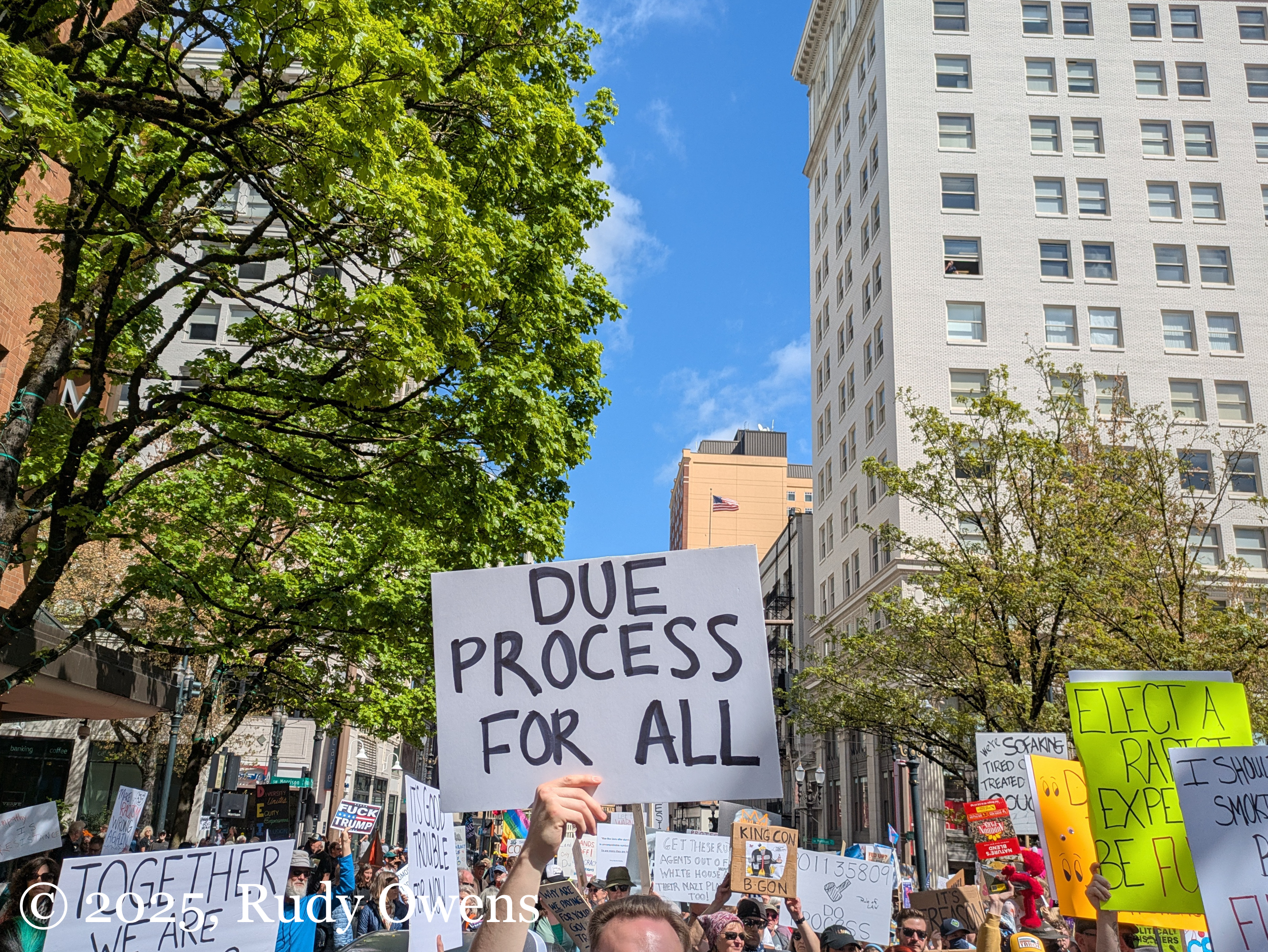
On April 19, 2025, hundreds and hundreds of thousands of Americans in all states protested against the loss of rights enshrined in the U.S. Constitution and the actions of the current Trump administration.
The weekend marked the 250th anniversary of the first shots fired in the American Revolution against the British Empire and a tyrannical monarch, King George III. In Massachusetts, the first battle of the American Revolution on April 19, 1775, known as the Battle of Lexington and Concord, is celebrated over a three-day weekend with the state holiday called Patriots’ Day, recognized on the third Monday in April in the commonwealth.
Today, in U.S. history books, the start of the American Revolutionary War (1775-1783) is known famously, at least to those who learned American history in school, as the famous “shot heard ’round the world.” The skirmishes by colonial militia against the imperial army of the British Empire persuaded many Americans to take up arms in the eventual conflict.
The issues that led to the first conflict of the American Revolution—the right to self-determination, liberty, democracy, the rule of law, a life free from the power of kings—helped to forge a nation 13 years later, in 1788.
That year, the American colonies adopted the U.S. Constitution. While revolutionary, it was also terribly marred and flawed by enshrining chattel slavery that held millions of African Americans in bondage until the end of the bloody Civil War in 1865. It was our country’s greatest sin. Ultimately, it would take over two centuries to guarantee the document’s original promise for all persons.
This framework for a nation, set forth in the Constitution, called for a system of checks and balances by three branches of government: the executive, legislative, and judicial branches. It begins with these famous words: “We the People of the United States, in Order to form a more perfect Union, establish Justice, insure domestic Tranquility, provide for the common defense, promote the general Welfare, and secure the Blessings of Liberty to ourselves and our Posterity, do ordain and establish this Constitution for the United States of America.”
On April 19, 2025, this sacred American text had special meaning for hundreds and hundreds of thousands of Americans across United States, who sought to renew their relation to our country’s charter and find living and breathing meaning of what the Constitution guarantees to all persons in our country, by the force of law.
Boston University historian Heather Cox Richardson, publisher of the newsletter “Letters from an American,” has a wonderful essay on these events two and a half centuries earlier and how we can make sense of these events in our country today. I hope you either read or listen.
My first real exposure to the horror of World War II came through the historic 26-hour documentary series called “World at War,” released in 1973 and 1974 by producer Jeremy Isaacs in the United Kingdom. I watched all of it on my local PBS affiliate in St. Louis as a grade schooler. I was profoundly shaken by what I saw and learned. I never forgot the series and the lessons from these horrific events that still echo today.
Now, more than 50 years later, I decided to revisit the first episode, “A New Germany (1933-39).” To my astonishment, it still crackles with intensity, and for me, it is more relevant than ever. I encourage everyone to watch it, especially now.
For those who haven’t heard about this series, I found a very good description: “One of the titans of documentary television, ‘The World at War’ is a work of astounding ambition, even by today’s standards. Broadcast between October 1973 and May 1974, this 26-part series attempts to encompass the full scope of the Second World War, a conflict fought on multiple fronts across multiple continents, on land and on sea and in the air. There have been many documentaries made in the subject in the decades since…but most have stuck to one aspect or country within the wider conflict. ‘The World at War’ had the audacity to attempt to tell the whole story—and even after nearly fifty years, the results are incredible.”
The first of the 26 episodes includes chilling archival footage of Germany’s immediate prewar years, with the voice of series narrator Laurence Olivier. It succinctly shows how a far-right radical and World War I veteran, Adolf Hitler, was able to seize power in the unstable but still democratic Weimar Republic through a mixture of hate, propaganda, street violence, and political deals with politicians who thought they could control Hitler. Within 100 days, after coming to power through peaceful means, democracy was snuffed out by the National Socialist German Workers’ Party (the Nazi Party), and Germany turned on the continent and beyond, pursuing a path of violent conflict, war, and unspeakable genocide.
After watching this episode, one must ask, How and why did a modern nation, the home of Goethe and Bach, universities and science, turn toward brutal authoritarianism rooted in hateful racial ideology that culminated in the mass murder of millions? How did the German people allow their country to be swept up by fascism that led to their country’s destruction and tens of millions of victims, including the attempted extermination of all European Jews and Sinti-Romani people. Will these mistakes happen again in our times, and what forms will they take?
What frightens me is that those living today, including those who are our supposed protectors and champions of democratic values and civil society, will fail to read the threat when it arrives. Unfortunately, the past can be terrifying. Many of us can simply be prone to willful ignorance because we don’t wish to acknowledge history and that societies can easily repeat our past collective failures. Sadly, when we finally realize some threats, it may be too late.
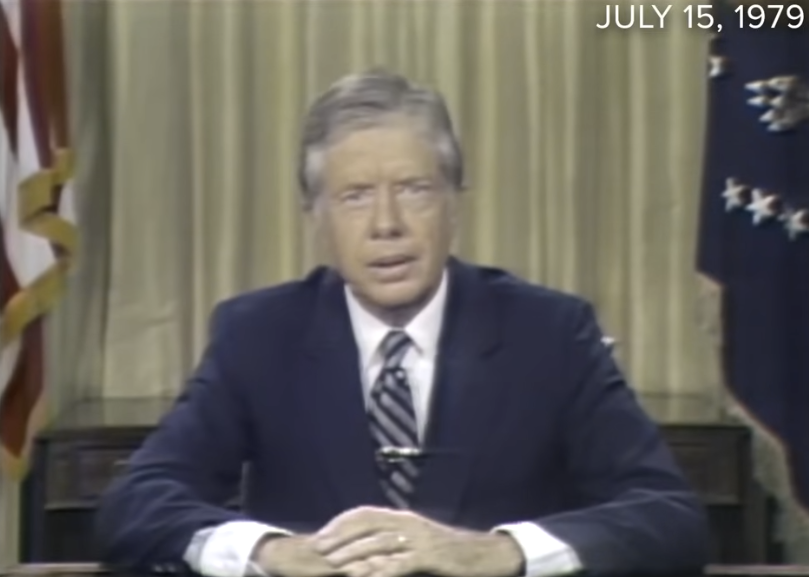
On July 15, 1979, the now-late President Jimmy Carter delivered what modern-day commentators and pundits today call the “Malaise Speech.” They still do not understand who Carter was and what he shared so plainly during his address to the nation.
President Jimmy Carter speaking to the American people on July 15, 1979
What has struck me in the six days since Carter died at age 100, on December 29, 2024, is how outraged and confused the news commentators and politicos remain about a U.S. president who dared talk about our country’s “lack of meaning” and overt worship of consumerism. (This sounds a lot like Viktor Frankl to me.)
Forty-five years later, not much has changed in our country. We are a country fueled by consumer spending, measuring 70 percent of economic activity. In that, there still is little meaning.
Carter was and is still right about the underlying truth, and people are afraid of the truth still.
As the nation gets ready to honor his legacy with his upcoming funeral events, I find his words still speak honestly about larger issues we have never changed: “In a nation that was proud of hard work, strong families, close-knit communities, and our faith in God, too many of us now tend to worship self-indulgence and consumption. Human identity is no longer defined by what one does, but by what one owns. But we’ve discovered that owning things and consuming things does not satisfy our longing for meaning. We’ve learned that piling up material goods cannot fill the emptiness of lives which have no confidence or purpose.”
Discounting history and facts has been one of humanity’s greatest failings. That remains true especially in the bright, glaring hot “now.”
During tonight’s horrifically moderated debate between a sleepwalking President Joe Biden and serial-lying convicted felon and former president, Donald Trump, we saw CNN abdicate all responsibility to moderate by not demanding even a shred of the truth. This event makes this wisdom from past experiences more pressing.
I wrote to a friend right after, “I’ve rarely seen a failure like this ever in presidential debates. I wonder if that’s crossing your mind? The stakes were too high, and CNN allowed this mess to happen. I think history tells us all failures like this are too costly.”
We already know that what has happened before, in a democracy like Weimar Germany 1933, can happen again.
If you’re not familiar with the ease with which a failed coup right-wing plotter, Adolf Hitler, and his Nazi thugs seized power without a majority of the people, I recommend reading this article from Foreign Policy in February 2021, “Weimar’s Lessons for Biden’s America.” There are also dozens of books in your public library. Many will have this story.
We also are dealing with brutal facts about our unfair world.
Authoritarian regimes thrive—in China, Russia, North Korea, etc.—and crush civilian democratic systems without many consequences once public movements are quashed. Who now remembers the brutal crushing of democracy in Hong Kong in between 2019 and 2021. It’s rarely talked about, ever, by media observers or international bodies that promote democratic values.
Minutes after the Biden-Trump debate ended, I sent an email to another older and long-time friend, whose wife is a Belgian citizen, if moving is on their minds. They have a home in Belgium already, and he likely can retire early as a minister.
He probably will mock me as being alarmist, as he normally like to use jokes and insults to deflect hard topics he doesn’t like to address. Also, he is a German American, who never really came to grips with the heritage of his ancestor’s home country, Germany, home of the Nazis and birthplace of what later became some of the greatest crimes against humanity.
I also think that many “smart” and “clever” liberal people, who think their wits and societal standing will endure a society that rips down civil society, will not be able to process past historic facts. In fact, most of us can’t because they are too hard to contemplate.
I believe we are now entering the chapter of historic events, where years later we’ll ask, why did that person see it coming and why did most of the people just allow it to happen and get sucked into the abyss, like the Nazi-sympathizing typical German citizen who was not a criminal or subhuman by Nazi standards. No, this is a new chapter of U.S. history. It’s a chapter where likely violent and also street-smart people will rise to the occasion.
I have already begun planning for what happens next in my country accordingly. I want to be very public about this because I know already this can happen, and I’ve been more than two dozen former Nazi camps that the dictatorship there and its racist regime built.
If you have studied history, you know events and mistakes and horrors can and do repeat themselves, all of the time. Denial is a failed strategy that leads to more failures. I now have to implement a plan.
When I say the words “revolutionary reformer,” I bet the words Genghis Khan do not come to mind. He was both—a radical and a change agent unlike few others ever.
Before winning his honorific name of Genghis Khan, Borjigin Temüjin (1162–1227) rose from obscurity to mythical status, also becoming one of the most misunderstood figures of world history.
He was an unimportant son of an outcast family. His family was abandoned by its clan to die on the Mongol steppes. For a time, the young Temüjin, before his rise to power, was even a slave. He never forgot this humiliation.
Genghis Khan was the greatest conqueror in human history and a radical promoter of egalitarian reforms.
Through harsh life experiences in what is now Mongolia, he honed his abilities to unite disparate groups and people of different religious traditions and end archaic practices that stymied egalitarianism and the rights of those oppressed.
Genghis Khan drew his leadership ranks from those who proved themselves in battle. He was able to identify and promote capable subordinate leaders using a promotion system based strictly on merit. This proved dramatic on the field of battle.
These methods also challenged the orders and religions of the era, including Christianity and Islam in the West and Chinese traditions of Taoism and Confucianism in the East. In creating warriors loyal to his cause, he persuaded them to abandon their religious traditions and pledge allegiance to his vision of a united kingdom.
Unlike other cultures and rulers of his day, Genghis Khan also promoted religious tolerance studied and learned Islam, Buddhism, Taoism, and Christianity. He was remarkably tolerant to the local cultures in the administration of his cities. He provided order in exchange, of course, for taxes.
Above all, he and his armies were unrivaled innovators in the art of warfare. He became the world’s single greatest military conqueror, building a land empire two and a half times larger in its territory than the Roman Empire at its zenith. At the height of their power, the Mongols controlled an area which stretched from central Europe to the Pacific Ocean.
Historian Jack Weatherford, in his work “Genghis Khan and the Making of the Modern World,” summarizes Khan’s amazing feats this way: “In twenty-five years, the Mongol army subjugated more lands and people than the Romans had conquered in four hundred years. Genghis Khan together with his sones and grandsons, conquered the most densely populated civilizations of the thirteenth century. Whether measured by the number of people defeated, the sum of the countries annexed, or by the total area occupied, Genghis Khan conquered more than twice as much as any many in history.”
In the many lands they controlled, the Mongols provided security for travelers and they promoted trade. They reduced taxes and encouraged travel and commerce. This so-called “Pax Mongolica” allowed for the caravan routes of central Asia to flourish. Persian businessmen would visit lands in China regularly, and a diplomatic envoy from the Mongols could visit Europe and take communion with the pope in Rome.
In addition to the creation of cross-continental trade, the Mongols created an efficient and modern postal system. The Yam postal system, similar to the more modern Pony Express, relied on horses and provided the Mongols a rapid communications system, which they also extended to merchants. The merchant Marco Polo in fact used the Yam system to support his travels.
Few have changed world history like Genghis Khan.
He was, when needed, remarkably violent, conquering what is now modern-day Beijing in 1215, as he subdued the kingdoms of what is now modern-day China. The Mongol armies in 1241 decimated Czech, Polish and German knights in Poland in 1241.
In Europe, which fell as spectacularly as the earlier Chinese kingdoms did just decades earlier, the writers of the era branded the Mongol armies as an almost supernatural evil.
Describing the Mongol army that conquered Europe, also known as “Tatars,” after Genghis Khan’s death, a chronicler named Matthew Paris in 1241 wrote “they swarmed out and, like locusts, overwhelmed the face of the Earth. They devastated the lands of the East with dreadful destruction, laying waste with fire and carnage. Traveling through the lands of the Saracens, they leveled cities, cut down forests, tore down fortresses, ripped up vineyards, destroyed agricultural fields, and massacred city dwellers and rural folk.”
Mongol forces won everywhere because they employed superior tactics, weaponry, and speed.
They also were brutal when they needed to crush their foes and send a message to their rivals. In 1258, nearly three decades after Genghis Khan’s death, they besieged, sacked, and burned the great Caliphate of Baghdad in a feat not replicated until the American and British invasion of the city in 2003.
To those defeated by the Mongol’s lightning-fast cavalry and steppe-raised soldiers, organized along egalitarian principles and commanded by the most proven leaders, the Mongol army was the representation of the devil itself. They brought the planet’s mightiest and non-egalitarian systems to their knees unlike any military and political force before or since.
Yet Genghis Khan and his successors were astonishingly modern and enlightened.
John Mullin, writing on the innovations of Genghis Khan for the Federal Reserve Bank of Richmond in 2021, notes: “The Mongol empire was full of juxtaposition. In their military conquests, the Mongols countered resistance with ruthless violence. Yet after establishing control, their rule over conquered territories could be more nuanced. In the ‘Yasa’ legal code that Genghis [Khan] promulgated to complement customary Mongol law, the death penalty was ubiquitous. Acts of robbery and treason were punished with severity—but the Yuan legal code that the Mongols established in China had only half the number of capital crimes as the Song dynasty code that it supplanted, and the death penalty appears to have been used only sparingly on civilians.”
It is also important to remember Genghis Khan’s first acts as a leader. After taking power in 1206 of a united Mongol people, he wiped out practices that had cruelly subjected nearly all women to property status, brutally harmed bastard-born kids (illegitimate kids), and had ordinary people turned into slaves. He ended all of these oppressive systems. He had experienced and witnessed all of these cruelties during his life and rise to leadership. He never forgot what he had learned from the harshest of life lessons.
Today, it is no surprise those who accused Genghis Khan of barbarism were those who lost to him—the Chinese, most of the Muslim kingdoms of the Mideast/Near East, the West, and what is now Russia and Ukraine. Those defeated also were the ones who wrote the recorded history following their staggering defeats. They chose most lurid and exaggerated prose.
Yet, those who wrote the historic record, ultimately, stayed stuck in ways that Mongols were not. The social and religious systems that outlived the Mongol empire kept alive archaic and non-egalitarian systems that continued to the modern era and even today, especially the treatment of women. On the plains of Mongolia, nearly 1,000 years earlier, Genghis Khan had at least temporarily freed a generation of people from their societal prisons.
About 15 years ago, a friend of mine told me a story that has stuck in my memory. It was not her story. Rather, it was the story of her husband’s father. Her husband is Jewish, and she is of Armenian descent. So both have a keen sense of history, and the consequences of history, including the crimes that occurred during war. So this is why I gave this story a lot of weight.
Her husband came from the city where I grew up, St. Louis. His father lived there most of his life. The father, I learned, was a veteran of World War II. He fought in Europe, with an armored division as it entered Germany in April 1945, just as the European conflict was ready to end.
Above is a publicity shot of the WWII action film Fury, starring Brad Pitt (2014).
She told me about her father-in-law sharing war tales. They were not happy stories. There were stories of conflict and death. One story he shared was about his armored column’s capture of Nazi soldiers. The American soldiers chose not to take the surrendering soldiers into custody. Instead, they shot them down with their weapons, and kept their advance.
I had often wondered how much truth there was to that tale. I know war is pure hell, and soldiers on all sides do not allow their better angels to rule when their inner demons are unleashed in life and death combat. I just did not know what to think about U.S. GIs mowing down Nazis surrendering in the heat of battle.
I thought about that tale again while watching the 2014 film Fury, by writer and director David Ayer, starring Brad Pitt as the leader of a U.S. Sherman tank crew. In one scene, Pitt’s character, Don “Wardaddy” Collier, leads a team of tanks and soldiers in an attack on a German position. They overcome the Germans, and in the final moments of victory, slaughter them in brutal fashion. This was far less brutal than the Nazi were everywhere, when they pillaged and committed war atrocities on an unimaginable scale, especially in eastern Europe and the Soviet Union.
Above is a publicity shot from the WWII combat film Fury, with Brad Pitt.
One German soldier escapes the executions and is left at the mercy of the enraged American soldiers. Wardaddy picks out his newest team member, a teenager named Norman Ellison (played by Logan Lerman) and forces him to shoot the surviving German soldier with a pistol. It is a painful scene, because the elder Wardaddy is initiating his new “son” into the art of death to make him ready for combat and a better team player.
The film captured a fair bit of critical acclaim for its gritty realism of combat in the claustrophobic conditions of these metal boxes that were no match for Nazi Panzers. I kept thinking about my friend’s father-in-law as a young man, faced with a choice of capturing the enemy or killing them, so they could achieve their objectives more quickly, with less risk to their side. I now believe everything I heard was true.
It was war, and the most brutal war in human history. This was how the war was won. Fury holds back nothing. It is worth watching to appreciate what happened day in and day out, from Stalingrad to Warsaw to Anzio to the Ardennes to the fall of Berlin. Mercy was in short supply, and a whole lot of killing happened to bring the horrible mess to an end—a mess started by the Nazis and carried to an extreme. As Wardaddy told Ellison, before he died, “Ideals are peaceful. History is violent.”



 The Path to Wisdom