When serendipity is not just an accident

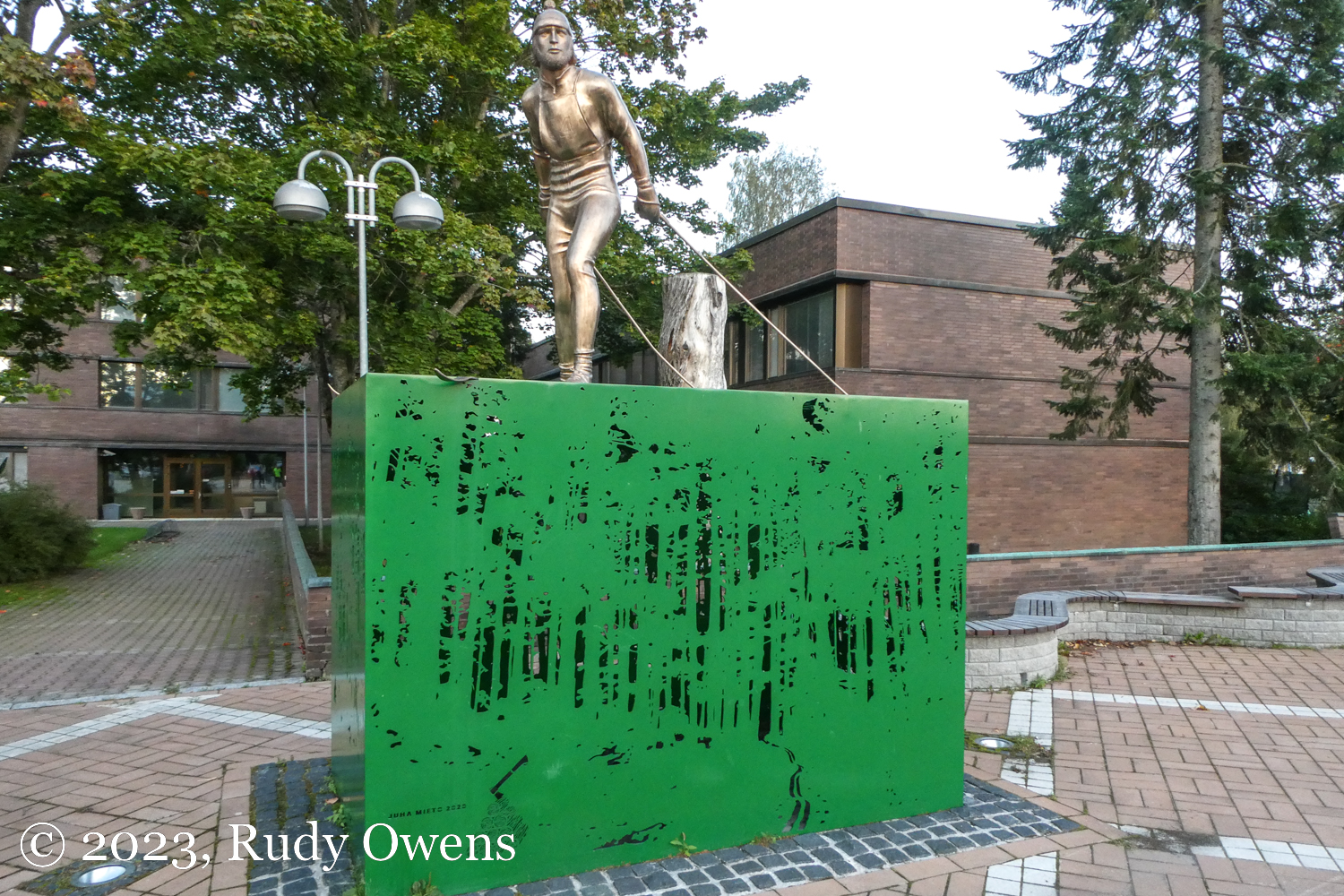
Olympic gold medalist and Finnish ski legend Juha Mieto is celebrated in his home city of Kurikka with this status in the city center.

In September 2023, I visited the 20,000-person community of Kurikka, Finland. Kurikka is the kind of place that will never go into any Finnish guidebook, but it’s where I had a lot of great moments in Finland for my first-ever visit to the Nordic nation.

At the center of the city I found this statue of a very famous Finnish skier, Juha Mieto. It turns out a completely unknown Finnish woman who connected me to my distant relatives in Finland this summer also has a connection to Kurikka and Mieto too, and I had no way of knowing that at the time I saw this statue.

Several months before I was standing in the Kurikka city center, I had been in touch with my “email friend” in Finland asking her for help. Our interaction was an entirely serendipitous human connection that tipped the scales of fate for me and had brought me to this very spot.

Today I learned she is a blood relative of this very famous Finnish national skier. The famous Mieto grabbed a gold medal a 1976 Winter Olympics in Lake Placid, New York, and also a silver medal, in the 1980 Winter Olympics in Innsbruck, Austria, finishing one one-hundredth of a second behind his Swedish rival, Thomas Wassberg.  

Kurikka is also the home city of Finnish relatives I found through my benefactor’s help.

When I visited one of my Finnish relatives in Kurikka in September 2023, I first saw this statue. I photographed it because it was distinct, but I didn’t fully appreciate who I was photographing at the time—a Finnish sports legend. I mentioned this visit in my story about my trip and seeing this statue. I shared the story with my benefactor as a late “thank you” gift to show how important her help was to me. And that’s when she mentioned her personal connection to Kurikka and the man turned into a bronze ski statue.

Talk about funny coincidences. Life is full of them. I have always found that the more you do things to go where your instincts are telling you to go, the more these things will happen. Perhaps good luck, my connection to friendly stranger, and maybe something more made all of this happen.

The famous Swiss psychiatrist Carl Jung created the term synchronicity to explain relationships between events that could not be explained by simple cause and effect logic.

Jung suggested that unique and synchronistic events had meaningful connections rooted in perceptions. He explained it this way: “I found where ‘coincidences’ which were connected so meaningfully that their ‘chance’ concurrence would represent a degree of improbability that would have to be expressed by an astronomical figure.”

I have long thought that synchronicity can be harnessed, especially when I felt it working in wonderous ways for me. I fortunately could tap into that for my trip to Finland.

I would not say that I’m “extraordinary.” I’m just me. And I felt synchronicity the entire time I was planning my trip and then having one of the most rewarding times of my life.

I also have a bit of advice. Trust the siren when you hear it. It calls for a reason.

My holiday card tradition on Thanksgiving day

Habits can be extremely rewarding.

One of mine is to write my holiday cards on Thanksgiving day. I have kept this tradition for more years than I can recall. No matter where I have lived or what happened on that day, I always found time to think about those in my life, including family and friends.

The act of writing and remembering reminds me of the bonds of connection I have with people far-flung across this country. Some of these connections help sustain me, good times and bad. Some have little impact in my life.

I went with an Oregon-themed card this year. In past years I have made my own. On each of the cards I create a personal message, written by hand and signed. A regular theme, if I can find one, is to share a positive wish of good fortune for the coming year. It is always preferable to be positive, even when we know some persons may be experiencing hard times, like some of my relations and friendships.

In my case, my card writing involves my circle of friends who seem to remain a part of my life as I age. They can be called my “chosen circle.” They are not family, for me at least. They matter a great deal in my life.

My “family card list” includes my step-family, my adoptive family, and my biological family. Because I am adoptee, and because that status is fraught with complexities about the meaning of “family,” my holiday card tradition has challenged me.

Having had a step-family since I was 18 years old, I can vouch first-hand that these relations are not easy. Step-family bonds are not blood-based or kinship-based.

Everyone in those dynamics knows the minefields, and to deny these tensions is to deny the critical role of genetic kinship in how all species, including humans, care for and help their close genetic relations succeed. This is equally if not truer of adoptive-family relationships.

I explore this in my greater detail in my adoptee memoir and critical exploration of the U.S. adoption system, in my chapter appropriately titled “Blood is thicker than water.”

Author and adoptee Rudy Owens gets ready to mail his 2022 holiday cards to his biological, step-, and adoptive family and friends on Thanksgiving day 2022.

In my book, You Don’t Know How Lucky You Are, I write about the meaning of relationships with non-biologically related step-family and other distal adoptive kin: “There simply is no bond that joins us, much the way I feel about my adoptive cousins, uncles, and aunts. For me, there is no blood that ties us, nor DNA to bind us. We are not true kin, both as I perceive it and as I have experienced this relation for decades now.”

Yet each year, on Thanksgiving I will still write letters of fellowship for the coming Christmas, or winter holidays if you prefer to call it that.

There is very little power I have to create relations where none are hardwired to exist by the determinant laws of biology and genetics. What I do control is my ability to offer a hopeful gesture. Whether that gesture is accepted or rejected, like so much in our lives, is not in our power to manage.

Because I was separated as a newborn baby from my biological family by laws and systems that erased my past and discriminated against me and millions of others by status of birth, I only began my biological family relations in my mid-20s. I explain all of this in my book for any reader seeking to understand what that means for me and other adoptees.

As someone who is now in my mid-50s and getting older, I remain clear-eyed how those relations will remain forever impacted by this system of separating families. And with my surviving biological family members who I do have contact with, again, I am not able to control how they respond. It has never been simple or easy to explain to anyone who is not adopted and separated from their biological family relations.

So with Thanksgiving now behind us, and my holiday cards on their way to my blended, adoptive, and biological family, I will celebrate what some may call our betters selves, to be the person I prefer to be.

Yes, adoption as a system forever made my holidays a mixed up time, but I have, for decades now, not let this define the meaning I give this time of year freely.