
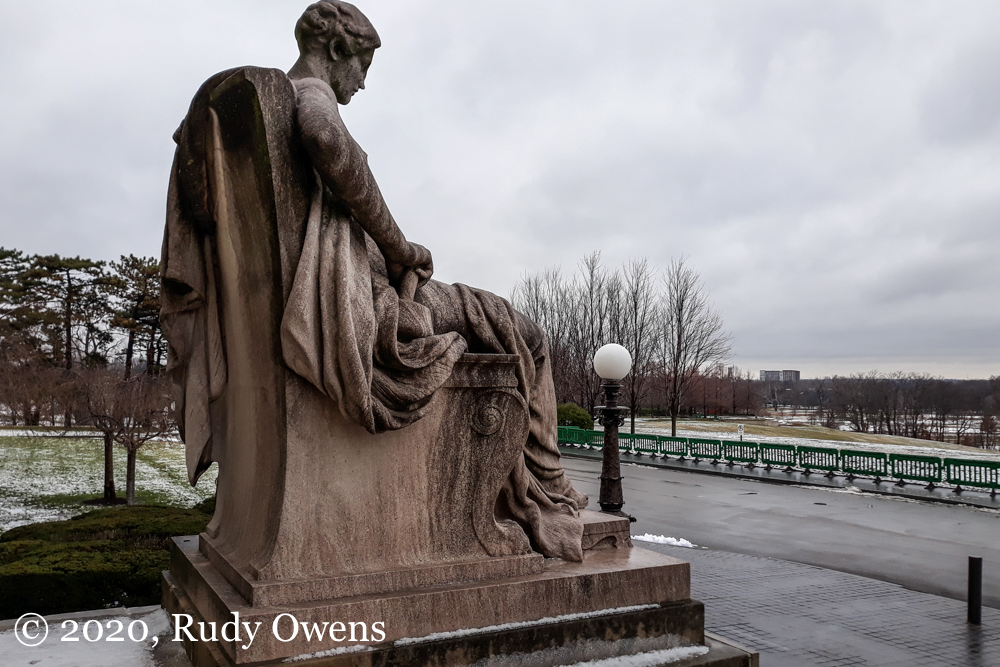
Every one of us has a mother, and that can bring together strangers. (Sculpture in front of the St. Louis Art Museum, taken three weeks before my mother died in early February 2020.)
In mid-February, I flew across the country from Portland to St. Louis. My trip came suddenly, but not as a surprise. After more than seven years of battling Alzheimer’s my mother finally passed away.
My plan was to write a eulogy on the long flight I would have from Seattle to St. Louis, the second leg of my journey. My tale was meant to focus on young woman, who was raised in a scrappy New Jersey town just outside of New York City.
That’s what I thought at least.
I ended up writing two stories. One I published after I returned. The other I put aside. It was a story I never intended to have, but had to be told. I finally am telling it now, at the end of May 2020, in the middle of a pandemic and protests occurring nationally in the United State against racial injustice and much, much more.
Perhaps by fate, I think my mom decided to play a funny trick on me on the way for me say goodbye. The experience allowed me to recall her wisdom and share it with a stranger.
On that trip, a stranger crossed my path. However, it was up to me to do something with this opportunity and make sense of it. My mom’s passing gave me a window.
 On the escalator coming out of the Airport shuttle tram at SeaTac, Seattle’s international airport, I spotted a large African-American man in a red and black checkered shirt. He must have weighed 225 pounds. He stood about 6’2” and had a massive chest and arms for linebacker.
I didn’t really think about him until I spotted two items pinned to his backpack.
One said, “Wakanda is not a shithole country.” The other was a medallion with the Latin words “Memento Mori,” or remember that death comes to all. During the period of the Roman Empire, the phrase would be whispered in a mighty Roman emperor’s ears by a slave as he entered Rome. It reminded a mighty emperor of his mortality and that he, the mightiest person in the world, faced the same ultimate fate as slave behind him.
 When I read the Memento Mori medallion, I decided I had to introduce myself. I recently had found myself drawn to Stoic ideas, from ancient Greece and Rome, which are embodied in the words carved on that medallion.
I said, “Hi. I’m Rudy.” He replied simply, “Ike.”
I asked about his backpack decorations. We laughed about Wakanda.
I told him I recognized the Stoic medallion, and he said, yes, it’s sold by Ryan Holiday. Not by coincidence, we both followed and liked Holiday’s blog called The Daily Stoic. Both of us obviously found something in these ideas that connected with us.
I could hear a West African accent in his voice and asked about his background.
Soon I learned Ike originally hailed from Nigeria, the son of political refugee parents. He told me his mother arrived in Boston with just the shirt on her back and four kids while his father rotted in a jail back home.
I then discovered we were on the same flight. He was on a business trip from Seattle to St. Louis.
I told him about my family, being raised in a family of three with a single mom in St. Louis. I said I was flying to St. Louis to attend the funeral of my mother.
Ike commented how important funerals were in Nigeria for the Igbo, Yoruba, and Hausa-Fulani ethnic groups. Ike called them festive occasions where the life of a person was remembered as a joyful thing.
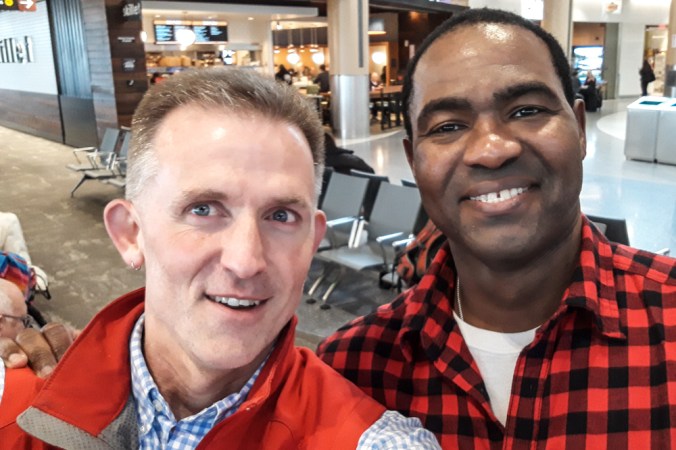
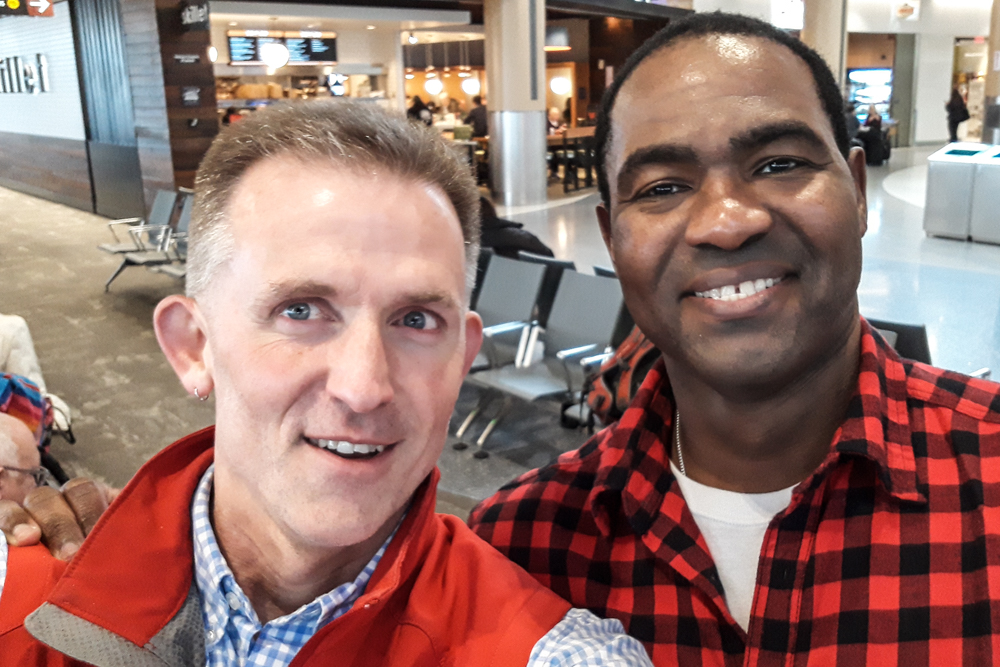
Rudy and Ike, connecting over mothers, death, funerals, and remembrance during a chance meeting at SeaTac in mid-February 2020. It is sad knowing we can’t enjoy the friendly embrace of strangers anymore for a long time amid the pandemic.
He said as a child, he wasn’t afraid of death because funerals were always so fun. Only later did he learn of the sadness that also accompanies the loss of a loved one. But first he learned that death was not a thing to fear and that it was a part of life.
Somehow we began to talk about how our mothers raised us and what life skills they taught us. Ike said his mom, and dad, always taught him he had to fight, because nothing in life came without some sort of struggle.
He said they never spoiled him or pampered him or over-parented him. If he was hurt, without requiring a hospital visit, he was expected to overcome his circumstance, because he if wasn’t gravely injured, he would be OK. He said it was the right thing to teach him, and he later understood the importance of this teaching. It helped to make him successful.
I said my mom was the same way. She understood good luck and bad luck. Like everyone, she had her share of both, and maybe in stronger doses that she deserved at times. I said, she could handle a strong wind and not snap. She would bend back. I said she had raised me not to be blown down during storms, even if I wasn’t aware of this when it was happening. Like her, I had to learn on my own to let storms pass and then come back up, stronger. Maybe I was more successful at this than she bargained for.
I also talked about my mom’s battle with Alzheimer’s and how it had given me a chance to learn about things that frighten us all—our mortality and death. By the end of this journey, watching this illness take my mom, I had grown. I had become less afraid of the end that awaits us all (“Memento Mori”). I simply did what I could do for my mom, mostly in a way that worked.
I told him that in the end, my mom always had an ability to see goodness. She could find something good amid something terrible, including her illness. Though she despised it, and would rightly say, “I hate this. I can’t stand this.” She also said one line all the time, right up to the end. “I have the nicest husband in the whole world, “ she would tell me, again, and again, and again, and again. I must have heard this hundreds of times in the past seven years.
It was one of the last things she told me on the phone, the last time we had a conversation during the Thanksgiving 2019 holiday. I remember replying to her the way I always did, with utmost sincerity: “Yeah mom, you do. He’s a great husband.”
I reality, my mom had said this for all 37 years of her marriage. She was speaking a truth about what the second half of her life was like with her best friend and husband.
“I got so lucky,” she might add. “Yes, mom,” I’d reply. “You got real lucky indeed.”
At that moment, in telling Ike my mom’s story, I started to feel my eyes water up and looked away. Here I was, crying to a man I had never met, telling him about the passing of my mother. He gave me a hug. “It’s OK, man. It’s part of the journey of life.”
Ike and I took a selfie and I gave him my card. I don’t know if I will see him again. He lives in Seattle with his wife. He’s not even sure how much time he has, having just had a heart attack on Jan. 18. He told me it was almost a blessing, because it reminded him of how precious life is and how important his wife and health are.
I think my mom would have loved to meet Ike. She could have easily found herself talking to him, like I saw her do countless times before whenever we travelled, or went to the Missouri Botanical Gardens, or the St. Louis Art Museum, or on a holiday. She was always warm and welcoming with strangers, of any race or background—always eager to hear about their lives and talk about their families and especially their kids.
In some ways, I felt my mom somehow played a serendipitous role that crossed my path with Ike’s, and therefore my mom’s story with his mom’s story, and the story all of us have with our mothers and the lessons they teach us, so we can pass them on to others, the way all people do, in the USA, Nigeria, or any other place.
Yes, maybe there was a reason I would be in an airport tram on that very day, at that very hour, at that very second, with an imposing looking man next to me, who just happened to have a reminder that captured the wisdom of a long journey my mom just completed. In some ways I felt that was her reaching from beyond through a stranger letting me it would be OK.
Remember to always get up and welcome a stranger into your life, I think she’d say. It was something her long and abiding Christian faith had given her until the very end.

 The Path to Wisdom