I woke up this morning, like many in the United States, almost in shock to learn a mostly stable and modern democracy, South Korea, also known as the Republic of Korea, was under martial law, by the unilateral decision of President Yoon Suk Yeol, made late on December 3, 2024, around 10:30 p.m. (KST).

It was around 6 a.m. Pacific Time, December 3, as I was taking in the morning news and still waking up, when I heard the first news stories on my radio.
And then, about six hour later, around 4:30 a.m. (KST), December 4, following a courageous vote of defiance by the members of the National Assembly of the Republic of Korea, including the majority liberal Democratic Party and his own minority People’s Power Party, President Yoon lifted his declaration formally during a cabinet meeting.
All of this happened in darkness.
Most of the country was asleep when the South Korean military forcibly entered and surrounded the parliament building. They were filmed landing on the building with military helicopters and entering the building by force.
My immediate reaction was like the opinions of many regional observers—total disbelief.
You mean the land of K-Pop, high-tech electronics, Kia and Hyundai automobiles, not to mention a growing soccer powerhouse, was again in the throngs of political instability after mostly decades of calm?
How could this happen so fast in a country of more than 50 million people, and also host to nearly 30,000 U.S. service personnel.
It felt completely improbable, and yet it was real.
I needed to trust my senses and my awareness that the world is in the middle of unprecedented change.
The hugely unpopular President Yoon provided an erratic message to justify his decision. He called the actions necessary to protect the country from “North Korean communist forces” and “antistate forces,” and to “rebuild and protect” the nation from “falling into ruin.” The message could be coming from other comparable strongmen vying for power globally, anywhere.
According to the Center for Strategic and International Studies, Yoon’s decree, made under Proclamation No. 1 at 11 p.m. (KST), December 3, the following measures were implemented while the short-lived decree lasted:
- All political activities, including the operations of the National Assembly, local assemblies, political parties, political associations, gatherings, and protests, were banned.
- Any act that denied or attempts to subvert the democratic system were prohibited, including fake news, manipulation of public opinion, and false incitement.
- All media and publications were subject to the control of the Martial Law Command.
- Acts of social disruption, such as strikes, slowdowns, or gatherings, were prohibited.
- All medical personnel, including interns, who are on strike or have left their medical posts were required to return to their duties within 48 hours and serve diligently. Violators would be punished under the Martial Law Act.
- Except for anti-state forces and those attempting to subvert the system, innocent citizens would be provided with measures to minimize disruptions to their daily lives.
And then it was over the afternoon of December 4 (KST), with some opponents calling for the arrest and impeachment of President Yoon.
For me the developments appeared absolutely stunning, inside a country with no clearly visible threat, either from the militarized Communist North Korea, led by dictator Kim Jong Un, or any other nation. It was experiencing relative political and economic stability.
Though President Yoon had rescinded the martial law, the world saw how some of the national armed forces faithfully carried out its orders at the nerve center South Korea’s democratic government. Later in the day, after my workday ended, I had time to catch up on news developments and saw footage of South Korea’s military personnel in full body armor breaking into the National Assembly building to take control of Korea’s legislative branch. It was surreal footage, yet also familiar.
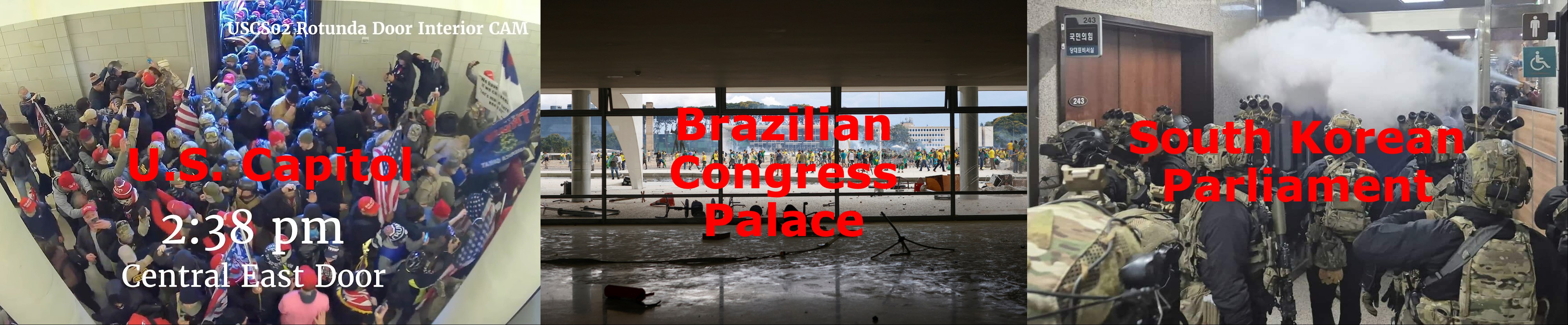
All of this had painful echoes of the last two major coups I saw covered live on television in even larger democracies: the United States and Brazil.
The U.S coup, to prevent the peaceful transition of power on January 6, 2021, under the urging of President Donald Trump, led to a coordinated and violent assault by Trump supporters at the U.S. Capitol, trying to prevent Joe Biden from being peacefully being affirmed as the 46th president of the United States. It happened in broad daylight, with the world and nation watching live.
It also resembled the right wing coup in Brasilia, Brazil, at the National Congress, when supporters of former President Jair Bolsonaro, in broad daylight on January 8, 2023, overran the country’s capitol compound, trashing the Brazilian Congress, Supreme Court, and Presidential Palace, to prevent the transition of power to president-elect Lula de Silva. It also failed like the U.S. insurrection.
At the end of the day I shared a post on one of my social media feeds. I wrote: “Democracy, it requires the people to say: ‘No.’ Coups now are looking more routine. After today, what’s next? USA: January 2021, coup attempt. Brazil: January 2023, coup attempt. South Korea: December 2024, coup attempt.”
You can bet all democracies and autocracies took notes how easy this was and what happened in Seoul, South Korea.
It took courage and the elected legislative leaders in this vital democracy in east Asia to challenge the elected president’s dead-of-night seizure of power by military force, without even a credible national, military, economic, or even public health threat.
So, will the next assault happen in daylight, like in the United States and Brazil, or again in the dead of night, like South Korea? More importantly, will the next effort succeed?
 The Path to Wisdom