I just heard that Bill Moyers died. He was 91 years old and lived a meaningful life. RIP.
Moyer was a consummate media professional. He was an insightful interviewer and a profoundly insightful human.
I love Moyers’ interviews with Joseph Campbell called “The Power of Myth.” The two collaborated in the PBS TV series released in 1988, exploring what enduring myths tell us about our lives. There were six episodes: “The Hero’s Adventure,” “The Message of the Myth,” “The First Storytellers,” “Sacrifice and Bliss,” “Love and the Goddess,” and “Masks of Eternity.” According to PBS, “The Power of Myth” was one of the most popular TV series in the history of public television, and it continues to inspire new audiences today. Campbell, sadly, died a year before it was aired.
Bill Moyers interviewing Joseph Campbell for the acclaimed PBS series “The Power of Myth.”
The insights from those interviews had an enormous impact on my own life, as I saw how important myth is to the human experience, in the past and the present. Myth in fact defines my lifelong identity as a bastard and adoptee. The series was also one of the most impactful moments for me in the world of engaging ideas.
From his interviews with author Campbell, Moyers elicited truths that speak to me today in many profound ways. This includes my own recent and wonderful adventures finding my biological kin in Finland, a land of my ancestors and also great myths.
Campbell shared with Moyers: “If you do follow your bliss, you put yourself on a kind of track that has been there all the while, waiting for you, and the life you ought to be living is the one you’re living somehow, and when you can see it you begin to deal with people who are in your field of your bliss, and they open doors to you.”
Another year of my life gets ready to end. The clock will start anew to begin the exercise of measuring life’s passing by years. That means it is time to reflect on how I spent it, as my planet circled the sun and I counted away irretrievable minutes, hours, and days of being alive in the universe.
I felt a mythical pull to Finland last year, and found myself there twice in six months, completing a journey that started decades earlier.
Physically, I feel a bit older. That is a given.
However, the cumulative issues I have experienced and still feel in my back have sharpened my understanding of my mortality. I have been humbled, even as I respect every aspect about caring for myself. It is now more clear that my days of very good health could be over. I may now be entering a phase of manageable but slow decay. I’m still overall in great health. I run. I bike. I swim. I rollerski. I surf far less frequently, and cross-country ski even less often. But I can feel the reality of what “the slow glide out” now means. My best years, in terms of physical health, were in my 40s.
My mental health, however, has remarkably improved during the past five years, as I continue to appreciate what a purposeful mindset of “finding meaning” has brought to my daily life. The hardest challenges I have navigated the last two decades strengthened my ability to withstand the strongest storms. Maybe I have just accepted who I am, at last, and the wisdom of wiser predecessors who have offered ideas of living well. So despite many challenges, my outlook is very calm.
Awaiting the inevitable loss of family
I continue to plan for loss and death. Human myths have been doing this for all of us since we first collected our shared stories and passed them down orally. So this is nothing new, and because it’s not new, it should not be feared or avoided.
I have three family members who face very severe health challenges. Two are my biological kin and one is my adoptive sibling. The stress can gnaw at any moment, out of the blue. Yet I can do nothing to change what will inevitably come. That could be any day.
I took this shot in 2015 at the Detroit Institute of the Arts with one of my ill family members, who is nearing the end of their journey.
I fortunately have found my safe harbors in spaces that always serve me well: exercise, good food, a sense of gratitude for my own good fortune, being mindful of what is within my power to address, and deep knowledge of what I cannot change.
Feeling at peace with death is one of the oldest roles of myths for humanity, and I have found my place with its company this year even more. As Joseph Campbell, author of the Hero with a Thousand Faces, describes, death and death imagery are the very beginning of mythology. Campbell let all of us know that there is comfort knowing that what we all experience has been charted for millennia in myth: “So there’s a sense of death as not death somehow, that death is required for new fresh life.”
In fact, it was the cumulative stresses surrounding the health and wellness of my surviving family that finally propelled me to visit one of my ancestral home countries of my biological mother, Finland. I felt what I can only call a mythical pull to go there.
Hearing the call of Finland
My planning started on an important day celebrating Finland’s great myth, called the Kalevala. On February 28, 2023, on Kalevala Day, I vowed to visit the Nordic nation that summer. What’s more, I would also seek out my biological family I could trace only as far back as my maternal grandmother and grandfather, who emigrated to the Upper Peninsula of Michigan in the early 1900s. There were no contacts between my Finnish-American biological family and their distal relatives in Finland since the 1950s.
Famous Finnish painter Akseli Gallen-Kallela’s study called “Kullervo Herding his Wild Flocks” (1917) is held in the collection of the Ateneum art museum in Helsinki, Finland.
I announced my idea publicly, to make it known I was taking a mythical journey: “And my new journey into my ancestral past has begun,” I wrote. “Where it ends now, I know not. Once the ship leaves its harbor of safety for parts unknown, the mind, heart, and soul breath in the fresh sea air that only is found by discovery. Finland.”
Everything about this idea was mythical. I could feel the tug, the way I did when I set out to find my birth mother and my biological families in the mid-1980s, completing the task in April 1989 in Ann Arbor, Michigan.
In fact, understanding myth and my adoption story gave me what I consider to be a tactical advantage compared to other adoptees who start their journeys for self-awareness far later in life. I was in a totally different place because I already had deep knowledge of myth’s meaning to the human experience because I read countless books on myths as a young person and learned the stories of the Bible in church every Sunday.
I knew intuitively why my impossible task had meaning and that I would succeed, like the “hero” celebrated in myths and tales across the time and all cultures. My memoir and study of the U.S. adoption experience explores interplay of myth and adoption in detail, where I describe why my experience closely resembled the “hero’s story.”
In this instance, I immediately recognized the myth dynamic in wanting to go back to a family origin location, in Finland.
That recognition propelled me forward with the power that can only be understood as mythical and by all the dynamic rules of a mythical story. It was familiar territory, and it completely energized me. I knew I was on a journey, which made it easier for me to throw myself completely headlong into this project. The myth played out almost effortlessly, with joy instead of sorrow.
I successfully found my long-lost Finnish relatives, thanks to blind good fortune of finding a benefactor named Satu, a professor who I contacted by email in the early summer 2023. (Even Satu’s role felt mythical, like the kindly stranger who intervenes to propel the hero forward on their journey to the unknown.)
In my long story about meeting my biological family, I describe how we first met by video calls and email and finally in person in Kurikka and Tampere, Finland, in September, 2023. Even before I met them, we knew that the meeting would be special for all of us.
I described in my story how one of my aunts told me how I resembled her adult kids. “I find same features on my sons’ and your faces,” she wrote to me. I also noted: “Later I learned that others in the family, including two daughters, said the same thing, completely separate from each other. When I compared a photo to the youngest son in the family with myself, and shared it with friends, everyone I sent them to were mostly stunned; some swore we could be brothers. All my friends mostly shared that the power of genetic similarities were both astonishing and cool.”
Embracing my Finnish mythical muse: Kullervo
I stumbled on the bronze statue of the famous mythical antihero Kullervo and his loyal friend and dog, Musti, my first morning in Helsinki, probably by fate.
On my first morning in Helsinki in September 2023, I went for a run. It was cloudy and rainy. I got lost. Almost by design, I regained my bearings near Toolonlahti, a bay in central Helsinki. I stopped my run the moment I saw a bronze sculpture of the Finnish antihero, Kullervo. The statue shows the famous mythical character, and his dog Musti, the moment before he kills himself with his own sword. It stands peacefully in an outdoor rose garden in Kaupunginpuutarha park in Helsinki, but feels tense with foreboding. This was no accident. It was myth at play. I immediately shared the photos with my Finnish relatives, who told me it was Kullervo.
Kullervo is perhaps the most beloved character from the Kalevala by the Finnish people, despite a mostly short section in the epic myth relative to other heroes in it. Jean Sibelius wrote an entire musical score with a chorus telling his doomed and tragic story. As an infant, he was enslaved and orphaned, only to be tormented by the clan that destroyed his family. Despite abuses, he learns he has magic power, befriends a dog Musti, sleeps with his sister unknowingly (who kills herself), murders the man and clan that enslaved him, and finally kills himself in anguish.
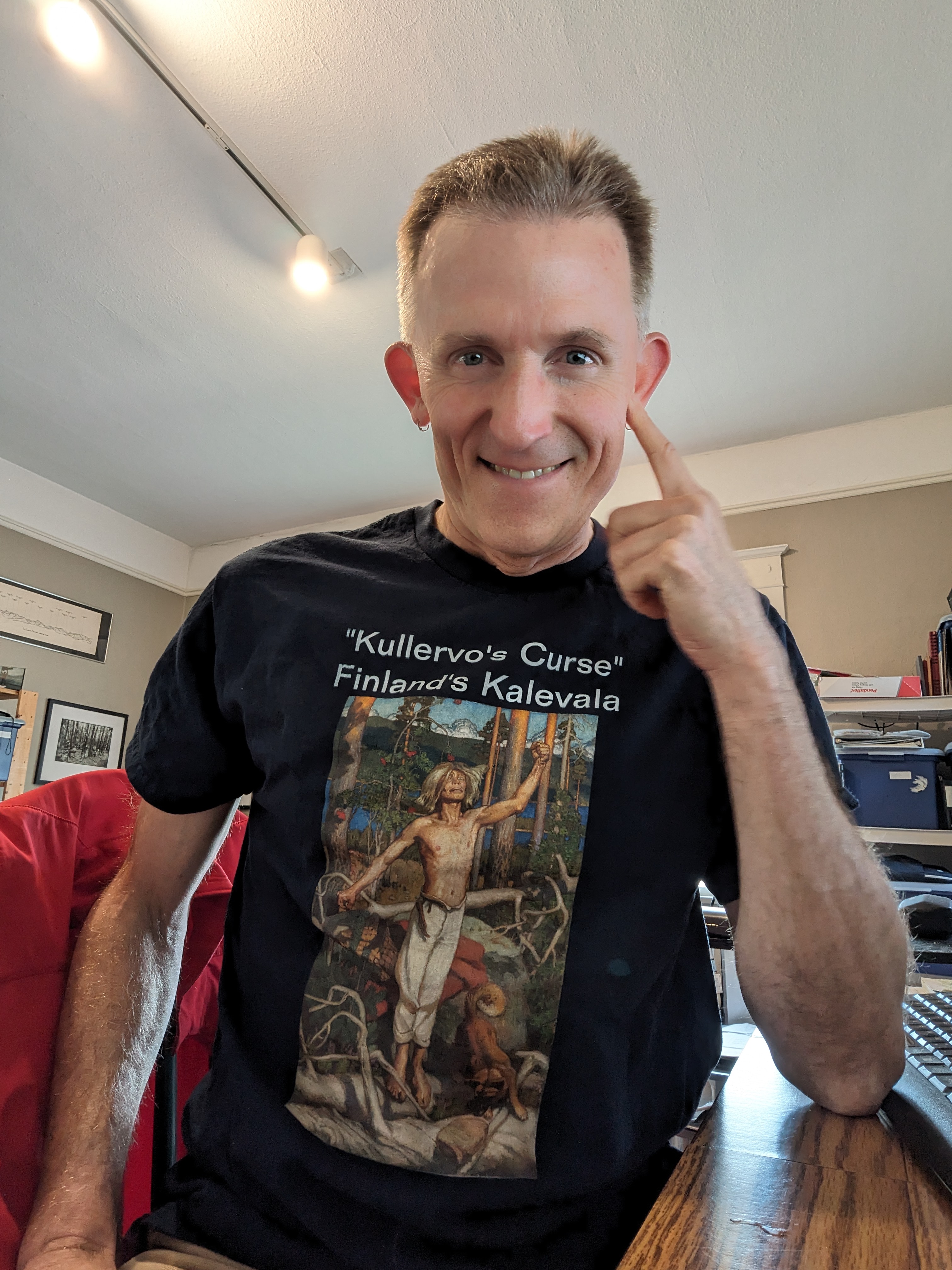
This is my favorite painting by the great Finnish artist Akseli Gallen-Kallela called “Kullervo’s Curse,” which I know proudly wear around town.
I made my T-shirt honoring Kullervo based on the painting by the great Finnish artist Akseli Gallen-Kallela, when I returned from Finland in February 2024.
My latest trip to Finland in February 2024, visiting family again in Tampere and Kurikka, completed the mythic trip I had started in late September 2023. It offered fresh insights into a nation and its national identity and stories. The Kalevala, the national story, is part of this story the Finns tell themselves. It also gave me wonderful insights into my ethnic Finnish roots.
When I returned, I looked back at the year of impossible events. I did what I knew I would always do. I had visited my ancestral villages of my blood relatives. I found my relatives, with whom I shared a physical resemblance and a strong kin connection. I felt connected to my identity that was long hidden from me by laws in Michigan. All told, in one year, I have written nearly 20 stories about my long journey back to my roots.
Without trying to write another book, I laid the foundations for one that arrived almost organically. I had no intention of writing any of these stories when the strange siren call to take the journey started. Yet it just happened, the way a myth naturally unfolds. My friend saw my new collection of essays and called me the “Finland Fanatic.”
What a perfect name for a book. What a perfect description of a mythical character, pulled by the power of the quest. My journey so far has been a happy one. Death of my family is still stalking my path forward. We shall see where it goes this coming year.
When I say the words “revolutionary reformer,” I bet the words Genghis Khan do not come to mind. He was both—a radical and a change agent unlike few others ever.
Before winning his honorific name of Genghis Khan, Borjigin Temüjin (1162–1227) rose from obscurity to mythical status, also becoming one of the most misunderstood figures of world history.
He was an unimportant son of an outcast family. His family was abandoned by its clan to die on the Mongol steppes. For a time, the young Temüjin, before his rise to power, was even a slave. He never forgot this humiliation.
Genghis Khan was the greatest conqueror in human history and a radical promoter of egalitarian reforms.
Through harsh life experiences in what is now Mongolia, he honed his abilities to unite disparate groups and people of different religious traditions and end archaic practices that stymied egalitarianism and the rights of those oppressed.
Genghis Khan drew his leadership ranks from those who proved themselves in battle. He was able to identify and promote capable subordinate leaders using a promotion system based strictly on merit. This proved dramatic on the field of battle.
These methods also challenged the orders and religions of the era, including Christianity and Islam in the West and Chinese traditions of Taoism and Confucianism in the East. In creating warriors loyal to his cause, he persuaded them to abandon their religious traditions and pledge allegiance to his vision of a united kingdom.
Unlike other cultures and rulers of his day, Genghis Khan also promoted religious tolerance studied and learned Islam, Buddhism, Taoism, and Christianity. He was remarkably tolerant to the local cultures in the administration of his cities. He provided order in exchange, of course, for taxes.
Above all, he and his armies were unrivaled innovators in the art of warfare. He became the world’s single greatest military conqueror, building a land empire two and a half times larger in its territory than the Roman Empire at its zenith. At the height of their power, the Mongols controlled an area which stretched from central Europe to the Pacific Ocean.
Historian Jack Weatherford, in his work “Genghis Khan and the Making of the Modern World,” summarizes Khan’s amazing feats this way: “In twenty-five years, the Mongol army subjugated more lands and people than the Romans had conquered in four hundred years. Genghis Khan together with his sones and grandsons, conquered the most densely populated civilizations of the thirteenth century. Whether measured by the number of people defeated, the sum of the countries annexed, or by the total area occupied, Genghis Khan conquered more than twice as much as any many in history.”
In the many lands they controlled, the Mongols provided security for travelers and they promoted trade. They reduced taxes and encouraged travel and commerce. This so-called “Pax Mongolica” allowed for the caravan routes of central Asia to flourish. Persian businessmen would visit lands in China regularly, and a diplomatic envoy from the Mongols could visit Europe and take communion with the pope in Rome.
In addition to the creation of cross-continental trade, the Mongols created an efficient and modern postal system. The Yam postal system, similar to the more modern Pony Express, relied on horses and provided the Mongols a rapid communications system, which they also extended to merchants. The merchant Marco Polo in fact used the Yam system to support his travels.
Few have changed world history like Genghis Khan.
He was, when needed, remarkably violent, conquering what is now modern-day Beijing in 1215, as he subdued the kingdoms of what is now modern-day China. The Mongol armies in 1241 decimated Czech, Polish and German knights in Poland in 1241.
In Europe, which fell as spectacularly as the earlier Chinese kingdoms did just decades earlier, the writers of the era branded the Mongol armies as an almost supernatural evil.
Describing the Mongol army that conquered Europe, also known as “Tatars,” after Genghis Khan’s death, a chronicler named Matthew Paris in 1241 wrote “they swarmed out and, like locusts, overwhelmed the face of the Earth. They devastated the lands of the East with dreadful destruction, laying waste with fire and carnage. Traveling through the lands of the Saracens, they leveled cities, cut down forests, tore down fortresses, ripped up vineyards, destroyed agricultural fields, and massacred city dwellers and rural folk.”
Mongol forces won everywhere because they employed superior tactics, weaponry, and speed.
They also were brutal when they needed to crush their foes and send a message to their rivals. In 1258, nearly three decades after Genghis Khan’s death, they besieged, sacked, and burned the great Caliphate of Baghdad in a feat not replicated until the American and British invasion of the city in 2003.
To those defeated by the Mongol’s lightning-fast cavalry and steppe-raised soldiers, organized along egalitarian principles and commanded by the most proven leaders, the Mongol army was the representation of the devil itself. They brought the planet’s mightiest and non-egalitarian systems to their knees unlike any military and political force before or since.
Yet Genghis Khan and his successors were astonishingly modern and enlightened.
John Mullin, writing on the innovations of Genghis Khan for the Federal Reserve Bank of Richmond in 2021, notes: “The Mongol empire was full of juxtaposition. In their military conquests, the Mongols countered resistance with ruthless violence. Yet after establishing control, their rule over conquered territories could be more nuanced. In the ‘Yasa’ legal code that Genghis [Khan] promulgated to complement customary Mongol law, the death penalty was ubiquitous. Acts of robbery and treason were punished with severity—but the Yuan legal code that the Mongols established in China had only half the number of capital crimes as the Song dynasty code that it supplanted, and the death penalty appears to have been used only sparingly on civilians.”
It is also important to remember Genghis Khan’s first acts as a leader. After taking power in 1206 of a united Mongol people, he wiped out practices that had cruelly subjected nearly all women to property status, brutally harmed bastard-born kids (illegitimate kids), and had ordinary people turned into slaves. He ended all of these oppressive systems. He had experienced and witnessed all of these cruelties during his life and rise to leadership. He never forgot what he had learned from the harshest of life lessons.
Today, it is no surprise those who accused Genghis Khan of barbarism were those who lost to him—the Chinese, most of the Muslim kingdoms of the Mideast/Near East, the West, and what is now Russia and Ukraine. Those defeated also were the ones who wrote the recorded history following their staggering defeats. They chose most lurid and exaggerated prose.
Yet, those who wrote the historic record, ultimately, stayed stuck in ways that Mongols were not. The social and religious systems that outlived the Mongol empire kept alive archaic and non-egalitarian systems that continued to the modern era and even today, especially the treatment of women. On the plains of Mongolia, nearly 1,000 years earlier, Genghis Khan had at least temporarily freed a generation of people from their societal prisons.
“The Procession of the Trojan Horse into Troy,” Giovanni Domenico Tiepolo (1727–1804), the National Gallery, London, used under Creative Commons licensing terms
In the world of politics and international intrigue, one of the oldest stratagems is that of the “Trojan horse.” This is the use of a deception or a trick to overcome the defenses and protection of an adversary.
This applies to everything: computer safety, viruses that attack their hosts, predatory behavior from evolutionary adaptation like spiders evolved to appear like ants, and mostly politics. The warning we have today is “beware of Greeks bearing gifts.”
The saying comes from one of the great tales from the Classical Age. It refers to subterfuge used by the ancient Greeks during the Trojan War, led by the trickster warrior Odysseus, as described in the epic Greek poem the Odyssey. The wily Odysseus and his fellow Greek warriors snuck out of the wooden horse at night that had been left as a fake tribute to the Trojans, whose city they could not conquer by force after years of war.
For those not familiar with the great story in epic Greek poems written by Homer, the Iliad and its successor the Odyssey, written in the 7th or 8th century BC, the summary by the British Museum is as good as any: “The Greeks finally win the war by an ingenious piece of deception dreamed up by the hero and king of Ithaca, Odysseus—famous for his cunning. They build a huge wooden horse and leave it outside the gates of Troy, as an offering to the gods, while they pretend to give up battle and sail away. Secretly, though, they have assembled their best warriors inside. The Trojans fall for the trick, bring the horse into the city and celebrate their victory. But when night falls, the hidden Greeks creep out and open the gates to the rest of the army, which has sailed silently back to Troy.”
The deception is the horse. It is dragged in willingly by the fooled Trojans. It is the Trojans who willingly opened the gates of impregnable Troy. In being fooled, they created the tragic events that ended in Troy’s violent and horrible fall.
The danger lies in the victim accepting the false promise and false gift.
I worked in the Washington State Legislature for the House Democratic Caucus for two sessions, and left in late 2000. One legislative issue that arose during my time there was the expansion of gambling. The proverbial Trojan horse used by the so-called “gambling industry” and its cronies were gaming rooms that were part of a wider spread of this “industry” to become the blight we see today widely in most states, eating away at our communities and wrecking countless lives.
Even though I was not a power player, I knew where the enabling legislation was going, and sadly, we are in that dark space now. This happened nationally too—36 states have legalized sports gambling alone as of now.
The lesson, really, is quite simple. Wherever there are piles of cash, with almost no ability to trace its origins, there is corruption. This eventually will eat its host from all sides.
There is no virtue with corruption either. Corruption knows no boundary by party, nationality, country, or by so-called “virtue” of the people who are sucked up in opportunities to gain personally. Corruption may be one of the great equalizers in the world.
Today, it’s always best to be aware of that proverbial Trojan horse. They come in all shapes and sizes. They are never what they appear to be. Sadly, the horse will usually be accepted with open arms and people fooled. People will cry alarms over the horse, and will be ignored and punished.
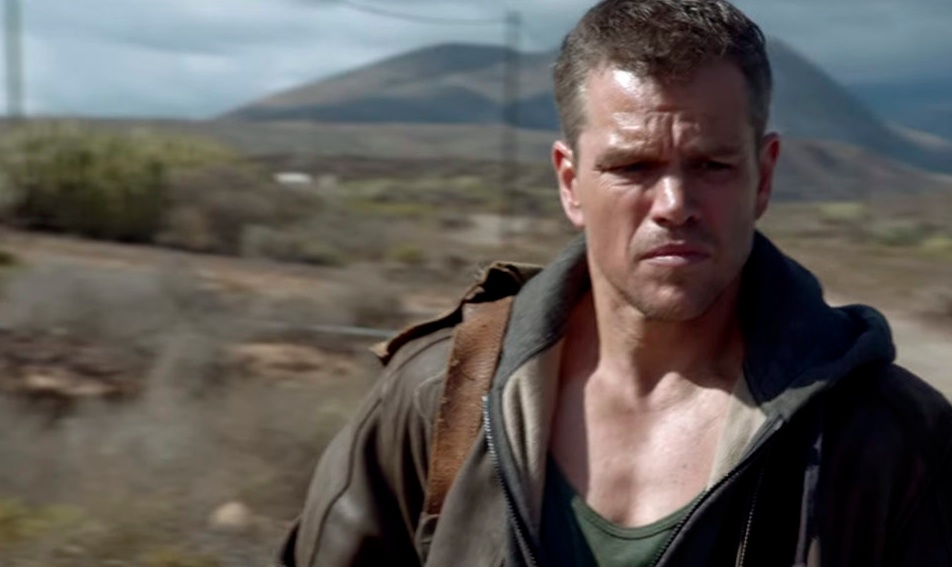
The film character Jason Bourne has staked out a unique place in cinematic history as an anti-hero on a hero’s quest. The essential conflict surrounds a man searching for his past, who will stop at nothing to find out who he is and how he became that way.
Jason Bourne, a man on a mission, to find out who he is–something most adoptees share.
For most viewers, Bourne is an uber-sexy and straight-up action hero, who can improvise killing with a ball-point pen, dirty towel, magazine, toaster, and shoelace. For anyone who is an adoptee, who has spent a life wanting to know who they are and where they came from, they will see this rogue agent with amnesia as a different story, about a person intensely wanting to know one’s self. They likely see Bourne’s narrative as their own.
His very name, which means outer limit in old English, also plays on the word’s other usage, as a verb, meaning coming into life from the womb. He’s a man who is literally born anew, without knowing where he comes from.
Bourne’s many opponents, in the dark world of secret U.S. government black ops programs and intelligence, are part of a vast system that works relentlessly to stop and kill him and those he loves. They had recruited him, brainwashed him, trained him, turned him loose to kill, and now need to terminate him to ensure their own personal survival.
Jason Bourne escapes again on his journey of self-knowledge and discovery.
The right anti-hero for a morally ambiguous world
At one level, this is a perfect story for our complicated times of secret rendition and torture, bulk data collection, and little-publicized military and intelligence operations. During the years Matt Damon’s Bourne emerged on the screen in 2002 in The Bourne Identity, the United States was involved in two official wars following 9-11 and supported other military ventures in Africa and the Mideast. The films emerged while U.S. national intelligence services widely expanded data collection programs on ordinary citizens and real and perceived enemies of the state.
The Bourne Supremacy followed in 2004, ramping up the fight choreography and exotic locations where Bourne battles his enemies. The last Jason Bourne franchise film, The Bourne Ultimatum, released in 2007, presciently predicted the later revelations of 2013 by former CIA employee and government contractor Edward Snowden. Real programs like the CIA-run Prism eerily resembled the fictional Treadstone and Blackbriar programs that our hero Bourne was once a member of in the first three Bourne films.
Like many fans of the Bourne series, I and others secretly cheer our hero as he gathers information through clues captured with surveillance gear, deception, impersonations, odd alliances, and direct confrontations with his nemeses. All Bourne wants to know is, who he is and how did he become the killer who can tear apart a U.S. embassy in Geneva as if it were second nature? How and why did he have to kill people deemed to be threats by his handlers?
Throughout the chases, escapes, explosions, and close-quarter death fights, our hero Bourne is constantly looking for answers. He has PTSD-like flashbacks, and tries to figure out his past dashing from Geneva to Paris, from Naples to Berlin. Why would he keep risking his life seeking answers?
The real motive is archetypal and older than Oedipus Rex
The motive is archetypal. Bourne is acting out a natural desire. It is the drive that is the most innate in humans—a quest of self-discovery. This is precisely the yearning every adoptee has. I would argue that the intensity of this desire for any adoptee is as strong as anything we see in the onscreen Bourne. It has a type of intensity that unsettles those who do not relate to this story in a personal way.
For those in the United States lucky to be born when original birth records were once again made accessible, this quest is much simpler than Bourne’s bloody odyssey. But for adoptees who were born in states where their original birth records are still closed, such as Michigan for adoptees who are my age range, they are more like Bourne on his now 14-year journey—denied answers, obstructed at every turn.
Unlike Bourne, adoptees are not trained in combat, subterfuge, and intelligence. They can’t beat up social service managers and storm into offices to reclaim documents that are theirs, such as their original birth certificates. They are mostly on their own. They have to play ball in a legal reality that treats them as second-class citizens, with no chance to hack a safe that holds all of the secrets kept hidden from them.
The second film in the series, The Bourne Supremacy, concludes with Bourne confronting his murderous past and telling actress Oksana Akinshina’s Irena Neski character, the daughter of two Russian activists, that he killed them and that she should know what he did to her mother and father. It’s a scene worth sharing again:
Jason Bourne discovers he is a murderer, and confesses his crime with the daughter of a couple he killed on assignment–his Oedipus Rex moment of truth and catharsis.
Bourne: Does that mean a lot to you? Neski: It’s nothing. It’s just a picture. Bourne: No. It’s ’cause you don’t know how they died. Neski: I do. Bourne: No, you don’t. I would want to know. I would want to know that my … that my mother didn’t kill my father, that she didn’t kill herself. Neski: What? Bourne: It’s not what happened to your parents. I killed them. I killed them. It was my job. It was my first time. Your father was supposed to be alone. But then your mother … came out of nowhere, and I had to change my plan. Bourne: It changes things, that knowledge. Doesn’t it? When what you love gets taken from you, you wanna know the truth.
This is one of the most moving scenes of the entire series, reminiscent of classic Greek tragedy. It brings instantly to mind one of the most famous adoption narratives ever, Oedipus Rex. In the play by Sophocles, the audience learns that king Oedipus was orphaned as a child to escape his planned murder by his father, King Laius, all because prophecy foretold a terrible future of regicide by his son.
A baby Oedipus was later adopted by a shepherd, never knowing the truth about his past.
Oedipus eventually becomes king of Thebes after killing his then-unknown biological father, King Laius, on the road along the way and solving the riddle of the Sphinx. He is rewarded for defeating the Sphinx by being married to the dowager queen who is his biological mother, Jocasta. The plague that grips the land, we learn, is because of his abominations. But our hero pursues the truth to learn that he is both a murderous adoptee and someone who slept with his own mother—a very stern warning against the adoption from our Greek forebears. He blinds himself plunging a knife into his eyes, and then leaves the throne.
Bourne, unlike Oedipus, does not blind himself. He does, however, confront all three of the father figures in the first three films who failed, in succession, to have their rogue agent killed: Chris Cooper’s Alexander Conklin, Brian Cox’s Ward Abbot, and Bourne’s brainwasher—knocked off in the only Bourne film without Damon—Albert Finney’s Dr. Albert Kirsch. With each character, he chooses not to kill them. He acts more humanely than the “fathers” who wanted him murdered for his quest of discovery.
To put it mildly, the confrontations are cathartic in the truest Greek sense of the word. They bring to stormy conclusions the hidden secrets and the hero’s willingness to accept the consequences for the truth.
To succeed in your journey, you need to be resilient and ready for what you do not expect. Also, you can never just let it be, ever, like Jason Bourne, who comes back in July 2016.
Catharsis and its inevitability for anyone on this journey
For an adoptee who does find out who they are, and who are lucky enough to either meet their birth families and/or find their original birth documents, there will be catharsis.
There will be realizations that the fantasies about one’s past need to be thrown away. There may be realities of knowing who one truly comes from, good and bad. It could be both, but it could be far worse or better than imagined. These moments forever change the lives of the families who tried to keep the information secret, such as the fathers who impregnated and abandoned many single women, or the mothers, who realize that a past that brought so much turmoil must now be confronted.
This is not a place for anything but mythical, archetypal storytelling. It is good that the messenger is someone who is as resilient as Bourne.
I for one am very anxious to see how our hero, Bourne, resolves his journey in the fourth film, Jason Bourne. He will re-emerge from shadows and back into the light. Will he accept himself and find what he needs to know? All we know is that nothing will stop him. For that reason, I will be in the theater, cheering him on, knowing that the journey is worth the burden and obstacles.
I recently watched the 2013 blockbuster based on the prototypical American comic superhero, Superman, called Man of Steel. I was not expecting much. I hoped for mindless Hollywood entertainment.
This film adaptation of the 1930s original comic-book character took a new direction with a very overt narrative, amid the buildings falling down and space ships blowing up. In this rebooted franchise, the Superman tale is told as a story of a man’s—or rather, a Kryptonian’s—search for his identity.
Superman, the adult adoptee on interplanetary steroids–beloved and feared by many.
The Man of Steel relies on one of the oldest mythological stories of human civilization, that of a hero’s search for himself by finding out his “true lineage.” This is the arc of great stories, from Moses to King Arthur. The Man of Steel also includes other classic mythological storytelling tropes, such as confronting a nemesis, the inevitable conflict, and the return from the journey as a hero. In this case, the hero happens to be born of one family and sent across the galaxy to be raised by another family in Kansas. He then must spend years figuring out who he really is.
The Haywood Tapestries show King Arthur, a famous adoptee of noble lineage, like Moses, the greatest adoptee of the Bible and the Jewish and Christian traditions.
The hero’s journey
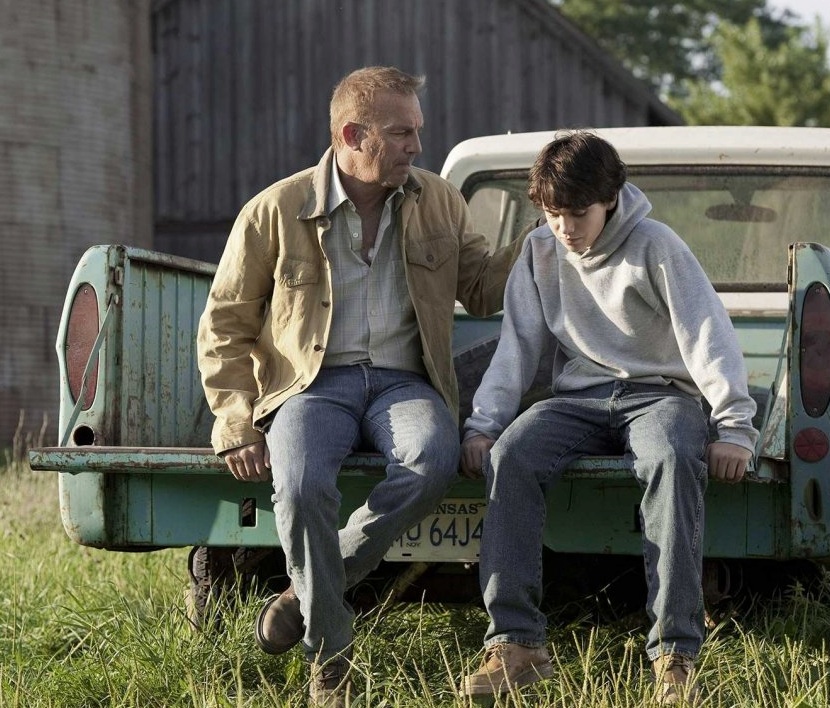
Minus the over-the-top special effects battles, this film is a basic tale a self-discovery. The most compelling moments in the film involve conversations the young Clark Kent has with his “adopted” father, Jonathan Kent, played by Kevin Costner. They discuss their ambiguous relations as non-biological father and adopted son. That tension bursts in a scene where the older Clark tells his father and mother, “You’re not my real parents.” Right on cue, following that conversation, Costner’s character dies in a tornado.
The adult Clark is left adrift not knowing who to call his parents or how to identify with his biological roots or his adoptive roots. So, the journey begins, and he wanders from the Bering Sea to the Canadian Arctic.
In this scene form the Warner Bros. film the Man of Steel, Kevin Costner’s Jonathan Kent talks to the younger Clark Kent, his adopted son from an alien race from the planet Krypton
This cinematic rendering of this rite of passage is nearly identical to what an adopted adult goes through when they have to decide for themselves if they wish to find out their history and biological roots, or accept the decisions institutions and others made for them.
A not-so-super real-life journey by adoptees
The actors who decided those adoptees’ fates are usually shielded by archaic adoption laws and the intransigent bureaucracies who supported the millions of adoptions, as was the case in the United States between the 1940s and 1970s. This adult adoptee decision is never easy, and is often costly. It can be very divisive and unpopular. Such a decision can forever change family relations and be condemned by people who know nothing about this desire to find the truth. It is at its core Superman’s tale.
In my case, I literally had to spend years, like Clark, on a pursuit that took me from state to state, bureaucracy to bureaucracy, until I finally solved the case and learned about the identity of my biological parents. I did not find a space ship buried in the Canadian ice like Clark, and my biological roots are not linked to Krypton. Nor did I meet my computer-generated father, Jor-El, played by Russell Crowe.
A scene from the Warner Bros. film, Man of Steel, showing Russell Crow as Jor-El, father of Kal-El, aka Clark Kent aka Superman.
During their conversation, Crowe’s Jor-El tells Clark his “real name” is Kal-El. This is identical to what any adoptee experiences when he or she learns his or her “real name,” or the name at birth and on an original birth certificate. That document in most states is treated as a high-level state secret and never shared with adult adoptees unless they get waivers from surviving birth parents signed. This is the case with the state of Michigan for me, which still refuses to give me my original birth certificate, even though I have known my biological family history now for 26 years.
So Kal-El is also Clark Kent, much as I had another name for three and a half weeks until I was given a “new name.” It was a name I had until I changed it in 2009 to a name that incorporates parts of my birth and adoptive names.
In the fictional movie, Clark has all of his questions answered. His original Krypton father is a noble and great leader, as was his adoptive father, in Kansas. But in real life, how many people do you know have movie-style fathers? My biological father and my adoptive father clearly were not cut out for any story as formulaic as this film. They would never make it into a screenplay for the masses. I never had a conversation like our film hero did with his biological or adoptive fathers.
Finding your answers unleashes chaos, the not-so-subtle message of Superman
In the last act of the film, Superman is exposed as a space alien and chased by a rogue band of surviving criminals from Krypton, who force Superman to make a choice between his adoptive tribe or his biological tribe.
Superman must also tell his adoptive mother he found his “real parents,” watch her sadness, and then be redeemed for viewers by saving her life and calling her “my mother” while doing it. The rescue creates a comforting way we can have Superman be forgiven for being confused who is parents are or who is mother is, when such warm fuzzies may not be in abundance in the real world.
If you follow the narrative of the Man of Steel, these questions could lead you on a journey that threatens the very fate of the planet earth, or something equally dreaded.
Ultimately, the film reveals that Superman’s activation of a beacon on the spaceship that he found brought the evil Kryptonites to earth, with the goal of total destruction of the planet. You cannot get more grandiose than the genocide of all of humanity as a penalty for discovering your identity and asking, who am I, and where did I come from. Once the chaos is unleashed by the bad invaders, only Superman, the misfit between both worlds and both families, can save the human race. That is a huge burden to lay on a guy who asked a very basic question.
In the end, Superman remains Clark Kent, not Kal-El. He retains his adoptive family loyalty. He will hide his biological self, except when needed, though he may never be trusted because he is “different.” He has solved his riddle, and the package is neatly tied as many Hollywood movies are.
Life does not follow this pattern. There are no heroic battles with invading aliens. Things are more messy.
But the journey of the real-life hero is no less epic than what the film Man of Steel shows. I think the film resonated more deeply, more viscerally with those who have undertaken the quest of Clark/Kal-El/Superman. If you have never had to ask the question that confronted our hero, about who you are and where you came from, you may never understand his journey, and also the conflicts and rewards that must inevitably accompany such a quest.
I have just immersed myself in three seasons of Game of Thrones, HBO’s smash hit about the imaginary kingdom of Westeros where seven kingdoms are at war and a dragon queen seeks to claim the Iron Throne.
More than any show in recent memory, this show delves into the stereotypes and caricatures of bastards, or those who are not born properly. They are the outcomes of illegitimate dalliances by rich lords with low-born ladies. In the series, characters frequently use the word bastard like a curse, almost as if it were the worst insult imaginable in a world where true lineage determines everything.
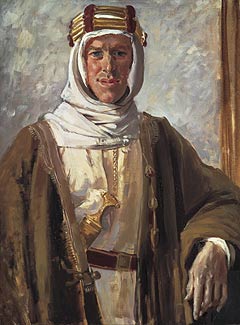
One of history’s most famous bastards, T.E. Lawrence (Lawrence of Arabia).
One etymological reference I found notes the word’s French lineage referring to: “Illegitimate child,” from old French bastard (modern French bâtard), “acknowledged child of a nobleman by a woman other than his wife,” probably from fils de bast “packsaddle son,” meaning a child conceived on an improvised bed (saddles often doubled as beds while traveling), with pejorative ending -art. The definition further notes, “Alternative possibly is that the word is from proto-Germanic banstiz “barn,” equally suggestive of low origin.” In other words, these are really low-down … well … bastards.
As a bastard myself, born from an encounter not blessed by marriage, from a low house on my birth mother’s side, I naturally am fond of the world where bastards romp all over the screen, causing mayhem, murder, and wickedly fun adventure. Five central bastard characters stand out in this epic and now globally popular film tale, adapted from George R.R. Martin’s popular A Song of Fire and Ice fantasy series.
So let us take a look at these imaginary bastards—all guys by the way—and see how they nicely fulfill the typical stereotypes that define our well-entrenched fears and paranoia around children who just happened to be born outside of marriage. (Note all pictures are referenced from online sources, and the use is intended to be fair comment and criticism of the show and its characters, and most of all its obsession with the stereotype of a bastard.)
The Good Bastard: Jon Snow
Jon Snow, the good bastard.
The show pivots around one decent guy. He is the noble bastard, Jon Snow, the son of Eddard Stark, that way-too-easily murdered king of Winterfell. Jon is the “good bastard.” He is handsome, strong, and fearless. He only kills when he has to, and when he does, Jon is like a badass gunslinger of the old West. He swings to kill. Most of the time he is killing really bad people, like traitorous Night’s Watch renegades, marauding wildings wanting to pillage south of the ice wall, and cannibal baddies. He is the prototypical hero who is being tested on a journey, learning to lead and trying save humanity from undead white walkers and uncivilized wildings. Jon is the type of bastard teen girls are allowed to swoon over, cause, really, he is the son of a good king who was ignored by his mom and destined to be a lord one day. No surprise his dire wolf is white, and named Ghost, a pure creature.
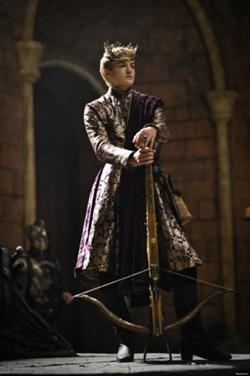
The Evil Bastard: Joffrey Baratheon
Joffrey Baratheon, the evil bastard.
Jon’s opposite sits on the Iron Throne for two seasons and a few more episodes. Hailing from the rival house, Lannister, King Joffrey Baratheon represents the great-abomination-of-nature bastard. A blond-haired beast, sniveling Joffrey is the illegitimate son of evil Queen Cersei Lannister and her dangerous and twisted twin brother, Jaime Lannister. Joffrey was born out of wedlock, so he is a true bastard. No surprise then he is a veritable monster. He likes to torture and shoot prostitutes with crossbows, order random killings of people for laughs at court, commit regicide that launches a bloody war, and be a general prick of the highest order. He is your classic bastard of your royal dreams of noble decadence. See, look what happens if you sleep with your brother or sister. You get a mentally deranged bastard who will destroy civilization as we know it.
The Sadistic Bastard: Ramsay Bolton
The sadistic bastard: Ramsay Bolton.
Another vile bastard of the series actually competes for the worst of them all title, Ramsay Bolton. This extremely efficient and misogynistic murderer is the illegitimate son of the treacherous lord Roose Bolton, who during the infamous Red Wedding episode in Season 3 murders Jon Snow’s noble brother Robb Stark, the heir to Winterfell and failed and not-so-clever revolutionary. Ramsay is mainly shown in the series as a half-crazy, psychotic, sociopathic sadist who commits atrocities and torture for fun. Most of his sadism is directed at a lord’s son whom he castrates, Theon Greyjoy. All Poor Ramsay wants is the love of his murderous and duplicitous father, but Roose plays Ramsay like a cheap ukulele. You cannot treat a bastard like a real person, particularly if you are important. Ramsay is the bastard of the your nightmares and the kind that lives up to the word bastard’s many associations with absolute horror and evil.
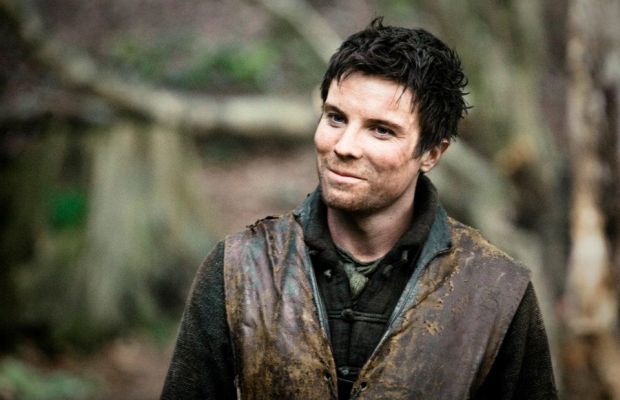
The Likable and Honest Bastard: Gendry Baratheon
The likable and honest bastard, Gendry Baratheon.
Gendry Baratheon, the kindly and talented King’s Landing blacksmith, is the bastard son of the overweight, whoring, and soon-to-die King Robert Baratheon. Robert spent a lot of time in power using his influence to bed and likely rape women, producing a number of illegitimate heirs who posed an existential threat to the false King Joffrey once that little masochist has Eddard murdered in public and took power for good. Gendry spends most the series on the run, trying to avoid the mass murder of innocent bastards that Joffrey ordered in Season 1. Not quite a “noble bastard” like Jon, he is the lovable bastard you would like to hire in a growing startup cause you know he will not double cross you and flee to your competitor with company secrets. He might even be good enough for your daughter, except he has got that damn bastard thing in his lineage. We last see Gendry in Season 3 rowing away from the power-crazed Stannis Baratheon, who wanted him burned alive—a fitting end for many a bastard.
The Honorary Bastard: Tyron Lannister
The honorary bastard, Tyrion Lannister.
The final bastard of the show is our ceremonial bastard, the Imp and none other than Tyrion Lannister. Tyrion calls himself an honorary bastard for having the misfortune of being born a dwarf. As a bastard in his dad’s eyes, and this is a tyrannical dad too, Tyrion is always prey to his affections for misfits, fellow bastards like Jon, and broken things. As a bastard you can never be expected to be the best, and Tyrion fulfill’s his bastard’s destiny through alcohol fueled binges, sleeping with multiple prostitutes, killing his mistress with his bare hands, and in the act of ultimate rage against his own kin, slaying his mean father, Tywin Lannister, in the crapper with a crossbow. Now that is a true murder only a bastard is capable of executing. Who else could pull off the hit in the center of power in all of Westeros, in the sacredness of the privy? It had to be a bastard. Even after a double homicide the night of his prison break, we are left with twisted emotions what to feel about a bastard. After all he was born a dwarf and falsely accused of poisoning Joffrey. His mistress dumped him for his old man. They deserved to die, right? Money and influence, in the end, could not save the honorary bastard, who has to flee a castle locked in a crate.
“The only stories that matter are the ones we tell ourselves.” I bet you have heard that one before. It is a living, breathing idea that permeates the blogosphere like oxygen. The idea is also rooted in so-called positive psychology, whose adherents include Dr. Martin Seligman, who has written pop psychology books such as Learned Optimism.
In fact the American nation is built on a myth of self-made individuals writing their own narratives and reinventing themselves, regardless of what the facts may say. The power of the myth and the power of the story trump irritating details. History, as the old saying goes, is always written by the winners.
Radical revolutionaries, America’s founding fathers, slaveholders and capitalists, brilliant leaders who sought to create a more perfect union? What story is the one that matters? “Declaration of Independence” by John Trumbull. Licensed under Public Domain via Wikimedia Commons.
I think there is a great deal of truth to this idea. As a former and sometimes frustrated reporter, I struggled to ensure my facts were 100 percent accurate. I wanted truth to defeat the fabrications of bureaucracies that did not want to reveal their poor stewardship of the public trust or criminals who would swear they had nothing to do with crimes for which they were charged. That was not their story.
It was clear from my personal experience, not to mention research, people who are masters at this art believe their stories to be the only truth that matters, facts be damned.
Today I found numerous examples of this concept percolating on multiple blogs.
One woman writing about breast cancer in her blogs notes, “But here’s the thing we should never forget. We are the author of our own stories. For every perceived weakness we possess, we posses huge potential too. We get to choose which story we will tell ourselves – a story that will lift us up or knock us down.” No surprise her blog is called “Recreateyourlifestory.com.”
Still another blog called Postive-living-now.com notes, “Few things have a greater influence over our lives than the stories we tell ourselves. Tell yourself that you’re a victim and you are. Tell yourself that you’re destined for success, and success is likely to become your destiny.”
And yet another called Igniteyourlifenow.com urges readers to “focus on a story that you have been telling yourself and rewrite it so you can create a positive change, enjoy a new experience and become a better you.”
You also can buy books like one titled The Stories We Tell Ourselves, which you likely guessed is a self-help psychology book you can buy online.
No doubt all of us have stories for ourselves, our friends, our coworkers, our spouses, and strangers. The narrative we choose to believe likely reveals more about our character than we are comfortable admitting. Perhaps what matters as much as the narrative are the intentions driving the choice of stories. Those truly are ours alone to own when we go about our storytelling, especially to ourselves.












 The Path to Wisdom